
Switserland
Switserland
Filters
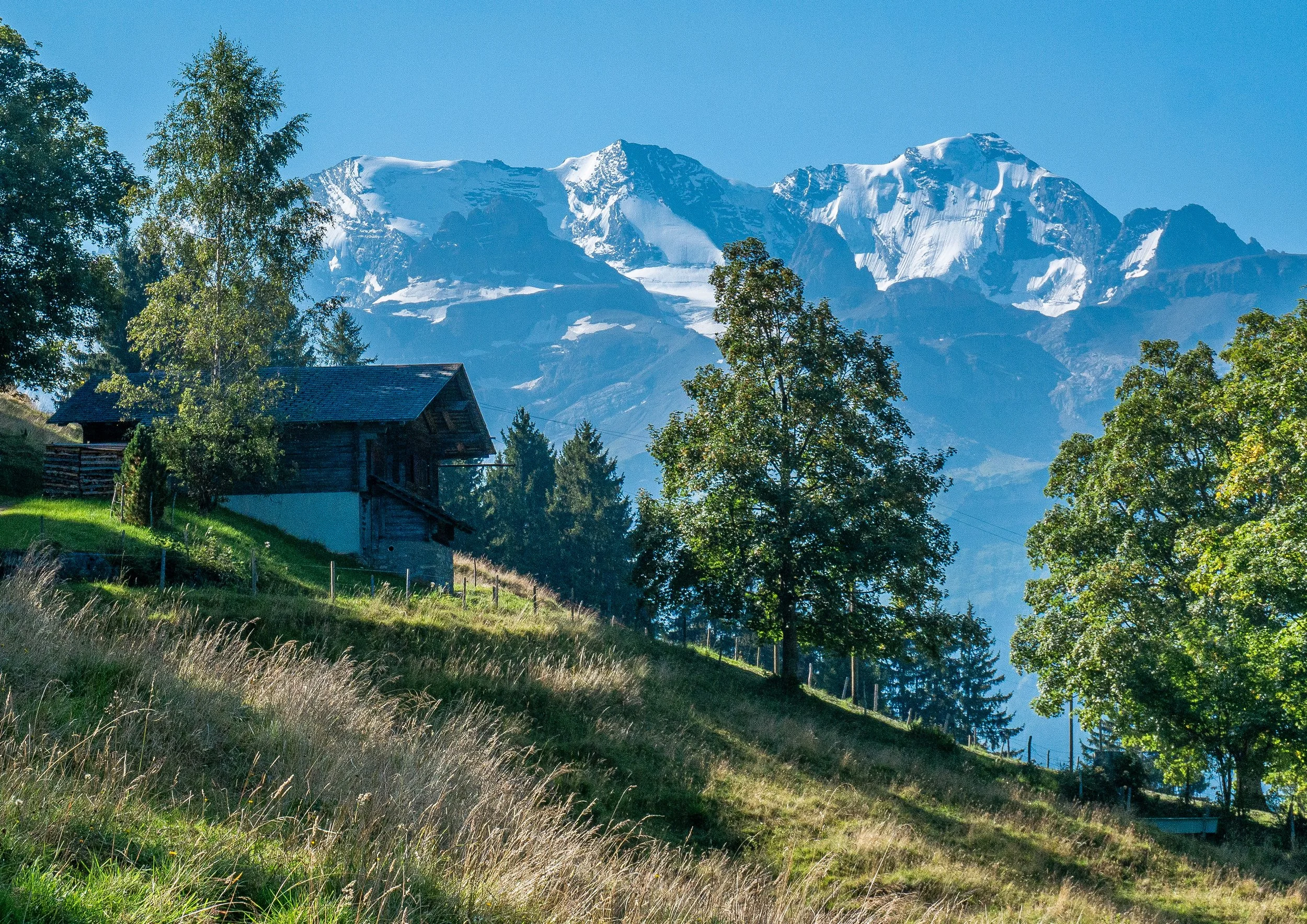
This image captures the quintessential, timeless beauty of the Swiss Alps. It perfectly illustrates the contrast between the rugged, permanent scale of the high mountains and the peaceful, pastoral life in the valleys below.
Here is a breakdown of what makes this scene so iconic to Switzerland:
The High Alpine Backdrop
The focal point is the massive, glaciated massif in the distance. The peaks—likely part of the Bernese Oberland or a similar high-altitude range—showcase the permanent snowlines and glaciers that define the Swiss skyline. The crisp, blue sky highlights the sharp ridges and deep crevasses of the ice, suggesting a clear summer or early autumn day when the air is thinnest and most transparent.
Traditional Architecture
On the left, we see a classic Swiss chalet. These structures are more than just homes; they are a feat of traditional engineering designed to withstand heavy snow loads and steep terrain.
Materials: Darkened wood (often larch or pine) that has aged over decades, paired with a stone foundation.
Design: The wide, overhanging eaves are built to keep snow and rain away from the walls, while the small windows help retain heat during the harsh winters.
The Pastoral Landscape
The foreground shows the transition from the "civilized" pasture to the wild forest.
The Alpage: The grassy slope is indicative of the high-altitude pastures where cattle graze during the summer months.
Flora: The mix of deciduous trees and dark, conical evergreens (firs and spruces) creates a layered texture, framing the mountain peaks and giving the image a sense of depth and scale.
Emotional Resonance
There is a profound sense of "Heimat" (a German word for home and belonging) in this photo. It represents a slow pace of life, where the surroundings have remained largely unchanged for centuries. The silence of the image is palpable—you can almost hear the distant clinking of cowbells or the wind whistling through the pines.
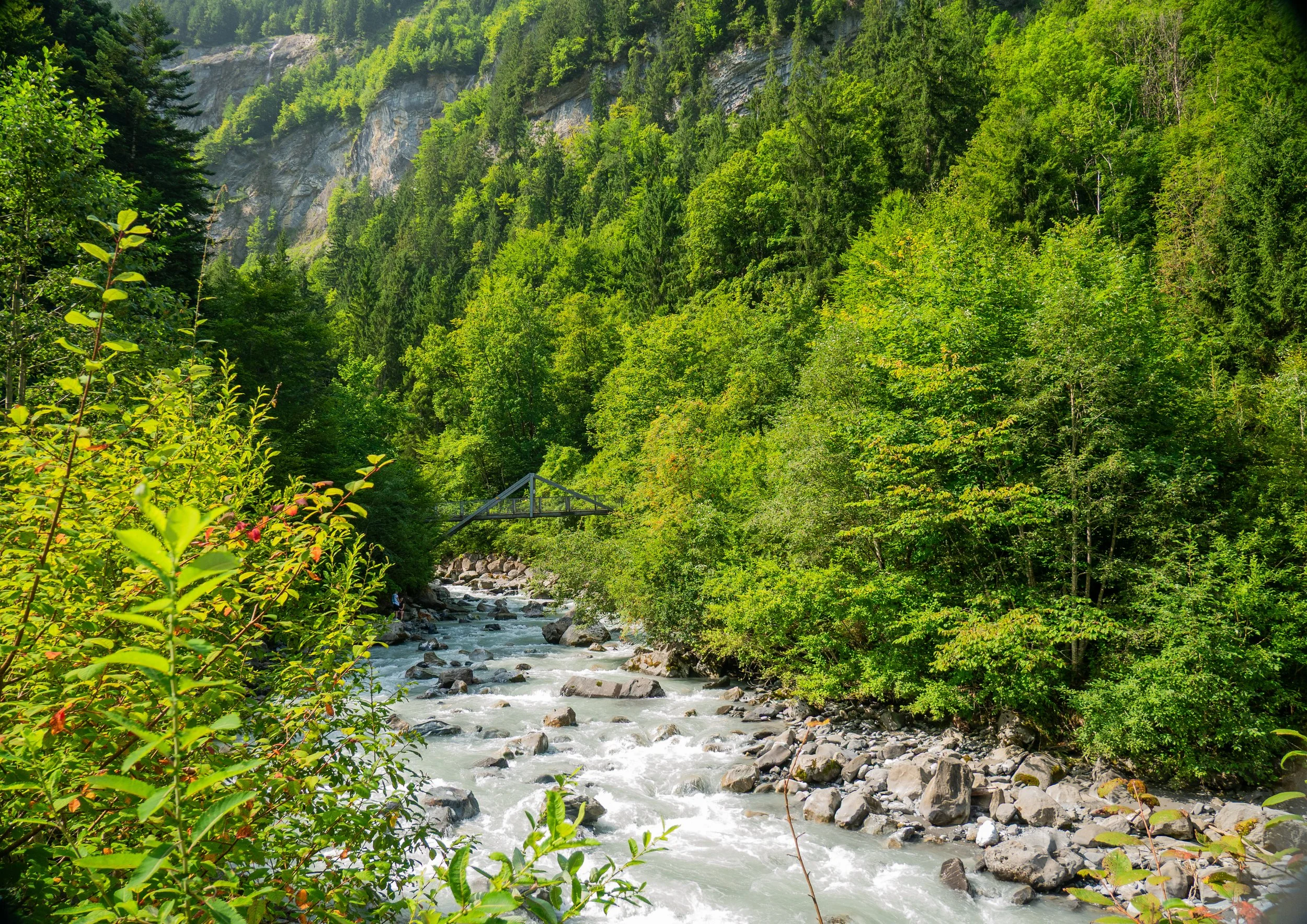
This image captures the serene and rugged beauty typical of the Swiss Alps in summer. The scene is a perfect example of the "glacial milk" rivers and lush valley forests that define the Bernese Oberland or the Valais regions.
Key Elements of the Landscape
The Glacial River: The water has a distinct milky, turquoise-grey hue. This is caused by "rock flour"—fine particles of silt and rock ground down by moving glaciers. When the ice melts and flows into streams like this one, these particles remain suspended, scattering light and creating that iconic Alpine color.
The Bridge: The inclusion of the metal truss bridge highlights Switzerland’s world-renowned hiking infrastructure. Even in deep wilderness areas, the Swiss trail network (Wanderwege) is impeccably maintained, often featuring such engineering to allow hikers to safely traverse powerful mountain torrents.
The Flora: The dense canopy of deciduous and coniferous trees suggests a lower-elevation Alpine valley. The vibrant greens indicate a high level of moisture, common in valleys where mist traps humidity and snowmelt keeps the soil rich.
Atmosphere and Feeling
There is a profound sense of tranquility and scale here. The steep, rocky cliff face peeking through the top-left corner reminds the viewer of the massive verticality of the Swiss mountains. It’s a scene that invites you to imagine the sound of the rushing water against the rocks and the cool, crisp air that usually accompanies these riverbeds, even on a sunny day.
Fun Fact: Switzerland has over 65,000 kilometers of marked hiking trails. A scene like this is often just a small part of a much larger journey toward a high-altitude peak or a mountain hut.
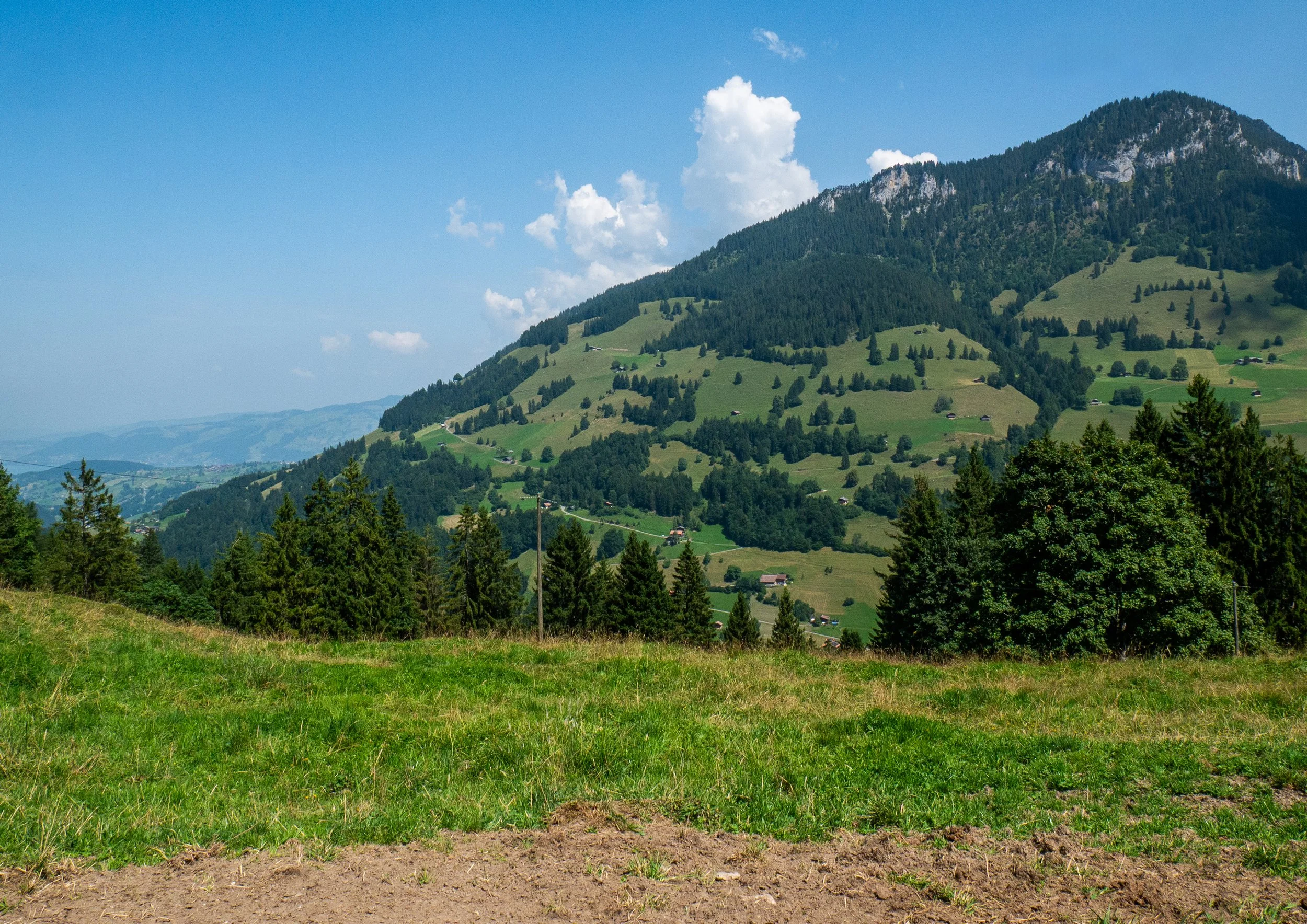
This image captures the quintessence of the Swiss Prealps, likely in a region like the Bernese Oberland or Appenzell. It reflects the harmonious balance between rugged nature and traditional mountain life that Switzerland is famous for.
Landscape Breakdown
The "Alp" Culture: The term "Alp" refers specifically to these high-altitude summer pastures. You can see the scattered chalets and stables dotted across the emerald-green slopes. In the summer, cows are brought here to graze, producing the milk used for world-renowned Swiss cheeses.
Topography: The transition from soft, rolling meadows to sharp, rocky limestone peaks is a classic geological feature of the Swiss landscape. The dense clusters of dark spruce and fir trees provide a sharp contrast to the bright lime-green grass.
Atmosphere: The crisp blue sky and scattered cumulus clouds suggest a perfect summer day in the mountains. The hazy peaks in the far distance hint at the vast scale of the mountain ranges that define the country’s borders.
Why This Scene Is Iconic
FeatureSignificanceLush PasturesEssential for the dairy industry and the "Swiss" aesthetic.Coniferous ForestsAct as natural "protection forests" against avalanches and erosion.Remote ChaletsSymbols of a decentralized, rural way of life that persists today.Clarity of AirThe high altitude and lack of pollution result in these vibrant, saturated colors.
A Note for Travelers
If you are looking to visit a place that looks exactly like this, areas such as Grindelwald, Gstaad, or the Simmental Valley offer this specific blend of accessible hiking trails and dramatic alpine backdrops.
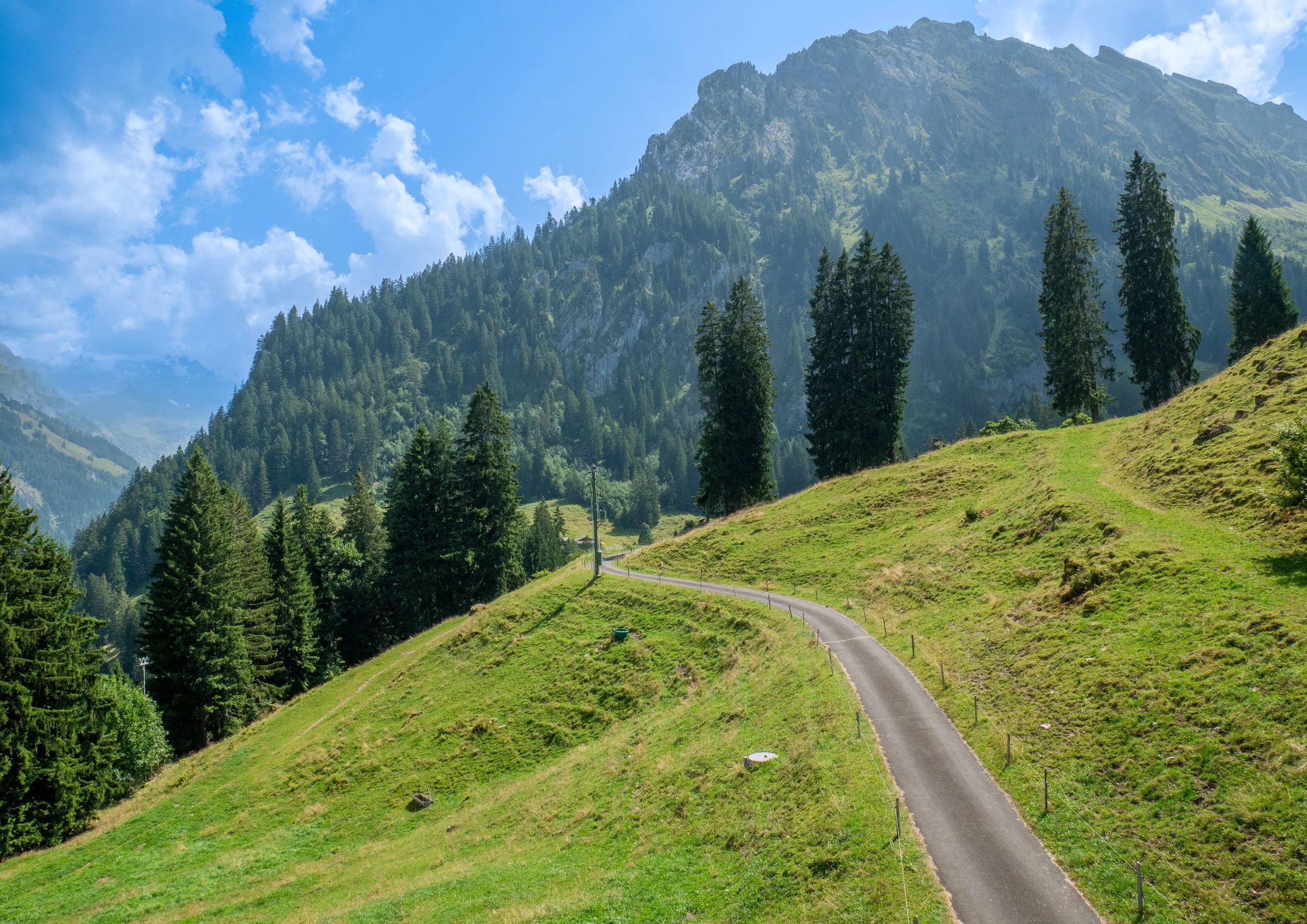
This image captures the quintessential beauty of the Swiss Alps, showcasing the harmonious blend of rugged wilderness and meticulous mountain management that defines the region.
The scene likely depicts the Bernese Oberland or Central Switzerland, where the "Alp" (high-altitude summer pasture) culture is still very much alive.
Key Features of the Landscape
The Alpine Pasture: The vibrant, lush green slopes in the foreground are classic Swiss Matten. These areas are traditionally used for cattle grazing during the summer months (Alpabzug), which is why the grass appears so well-maintained.
Coniferous Forests: The steep slopes are densely packed with Norway Spruce and Silver Fir. These forests aren't just beautiful; they serve as critical "protection forests" (Schutzwald), preventing soil erosion and protecting the valleys below from avalanches.
The Mountain Infrastructure: Notice the narrow, paved road winding through the hills. Switzerland is famous for its incredible infrastructure, ensuring that even remote farming outposts and hiking trails are accessible and well-marked.
The Limestone Giants: In the background, the jagged, grey rock faces suggest the massive limestone formations typical of the Pre-Alps. The play of light and shadow on these peaks creates the dramatic depth for which Swiss photography is known.
Why This Image Feels So "Swiss"
There is a distinct sense of serenity and order in this photo. Unlike the wild, untamed peaks of the Rockies or the Andes, the Swiss Alps often feel like a giant, inhabited park. The presence of the utility pole and the paved path indicates a landscape where humans and nature have coexisted for centuries.
The crisp air and the sheer verticality of the terrain evoke a sense of "Heidi" nostalgia a timeless look at one of the most stable and beautiful environments on Earth.
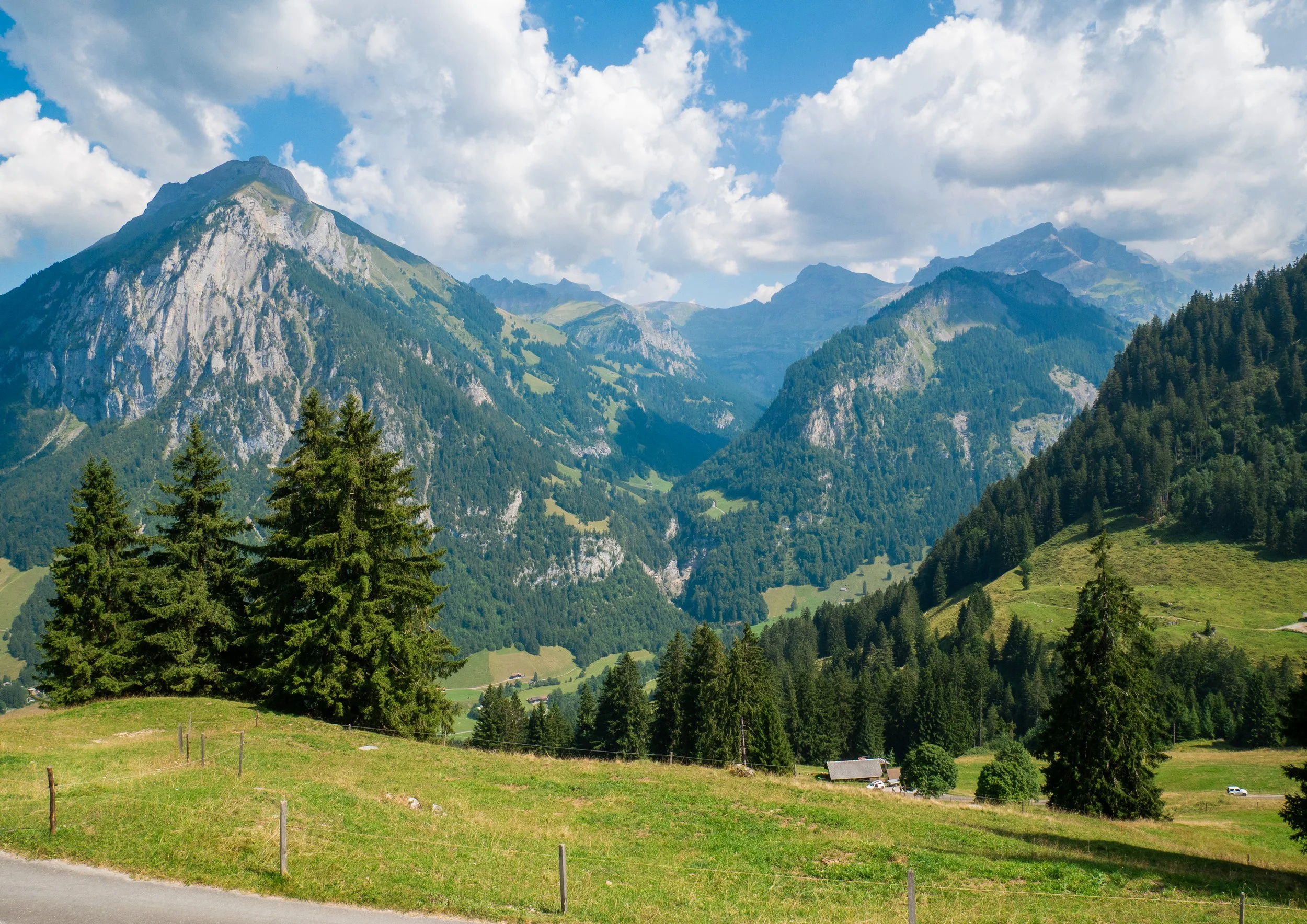
This image captures the quintessential beauty of the Swiss Alps, showcasing the dramatic transition between lush, habitable valleys and the rugged, limestone peaks that define the region's geography.
The photo appears to be taken from a high mountain pasture, or Alp, during the peak of summer. Here is a breakdown of what makes this scene so characteristic of Switzerland:
1. The Alpine Topography
The landscape is dominated by U-shaped valleys, a hallmark of glacial erosion. You can see how the steep, forested slopes give way to vertical rock faces. The prominent peak on the left displays the classic grey limestone common in the Prealps, likely in a region like the Bernese Oberland or Central Switzerland (near Glarus or Schwyz).
2. Traditional Land Use
In the lower third of the image, we see how the Swiss have integrated with this challenging terrain for centuries:
High Pastures: The foreground shows a cleared meadow with a simple wire fence, used for seasonal cattle grazing (the transhumance).
Chalets: Scattered throughout the valley floor and on the lower slopes are small wooden structures and farmsteads, built to withstand heavy winter snow.
Managed Forestry: The dense stands of Norway Spruce and Silver Fir are often carefully managed to serve as "protection forests," preventing avalanches and landslides from reaching the villages below.
3. The Atmosphere
The lighting suggests a bright, slightly humid summer day. The "fair-weather" cumulus clouds gathering around the summits are a daily occurrence in the Alps, as warm air rises from the valleys (anabatic winds) and condenses against the cooler mountain peaks.
Why this photo feels "Swiss"
Beyond the mountains themselves, there is a distinct sense of order and scale. Even in this wild, vertical environment, there are signs of human presence a small road, a parked white van, and perfectly maintained meadows reflecting the Swiss "civilized wilderness" where nature and infrastructure exist in a tight, clean embrace.
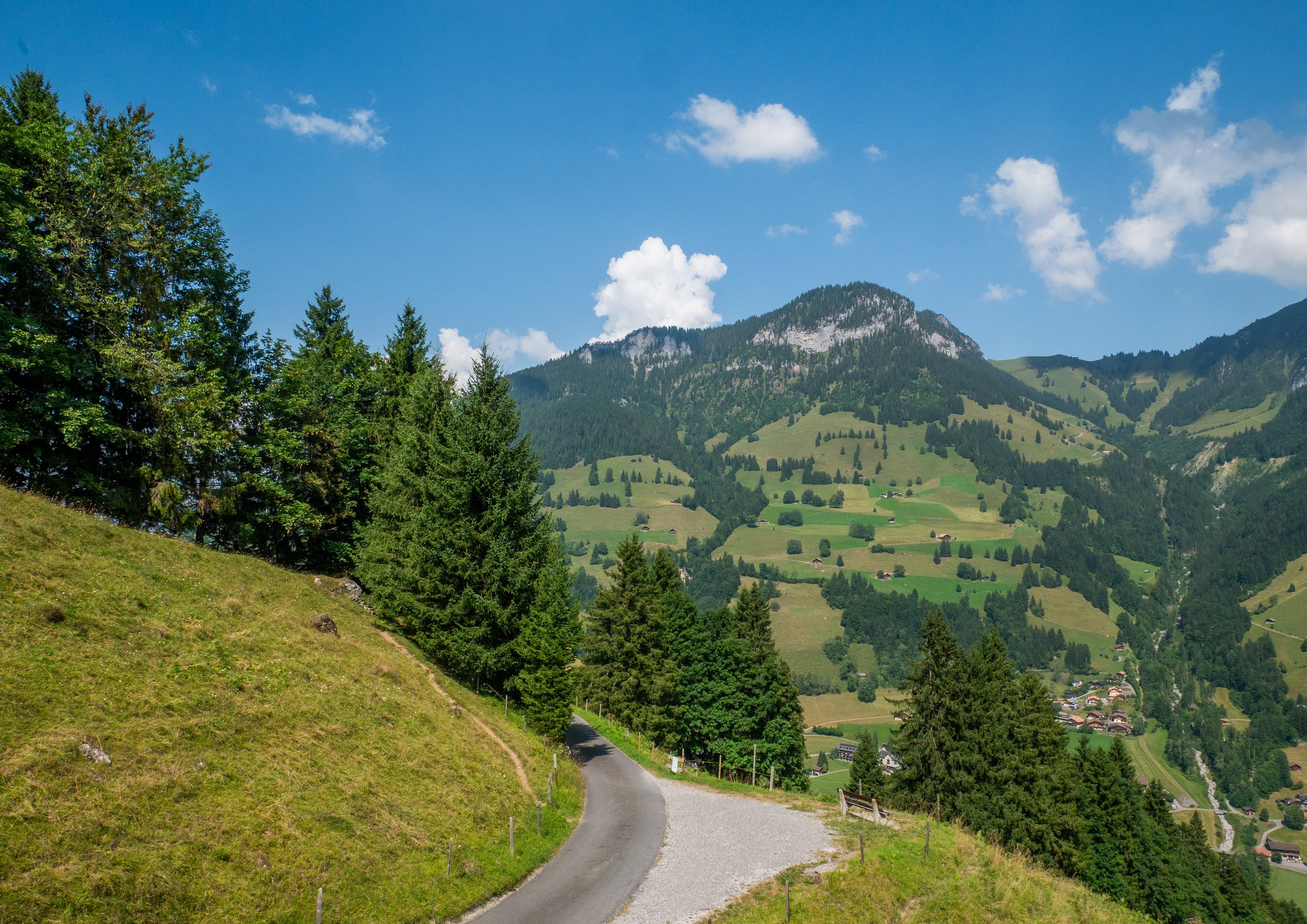
This image captures the quintessential charm of the Bernese Oberland or similar Alpine regions in Switzerland. It perfectly illustrates the harmony between rugged nature and meticulous mountain farming that the Swiss Alps are famous for.
Landscape Breakdown
The Alpage (High Pastures): Notice the bright green patches on the distant slopes. These are "alpages," or high-altitude summer pastures. In Switzerland, cattle are moved up to these slopes in the late spring (a tradition called Alpaufzug) to graze on nutrient-rich herbs and grass, which gives Swiss cheese its distinct flavor.
Traditional Architecture: If you look closely at the mountainside, you can see small, dark wooden structures. These are likely chalets or stalle (stables) used by farmers during the summer months.
The Valley Floor: Tucked away in the bottom right is a small village. The dense clustering of houses with gabled roofs is typical of Swiss mountain settlements, designed to shed heavy snow in the winter.
Flora: The foreground is dominated by Norway Spruce and Silver Fir, trees that are vital for "protection forests." They help prevent soil erosion and provide a natural barrier against avalanches for the villages below.
Atmosphere and Experience
The photo evokes a sense of "Heimat"—a German word deeply rooted in Swiss culture that describes a profound sense of belonging and peace found in one’s homeland.
Walking a path like the one in the photo usually offers a specific sensory experience:
The sound of distant cowbells echoing across the valley.
The crisp, thin air scented with pine resin and drying hay.
The absolute stillness that comes with high-altitude hiking.
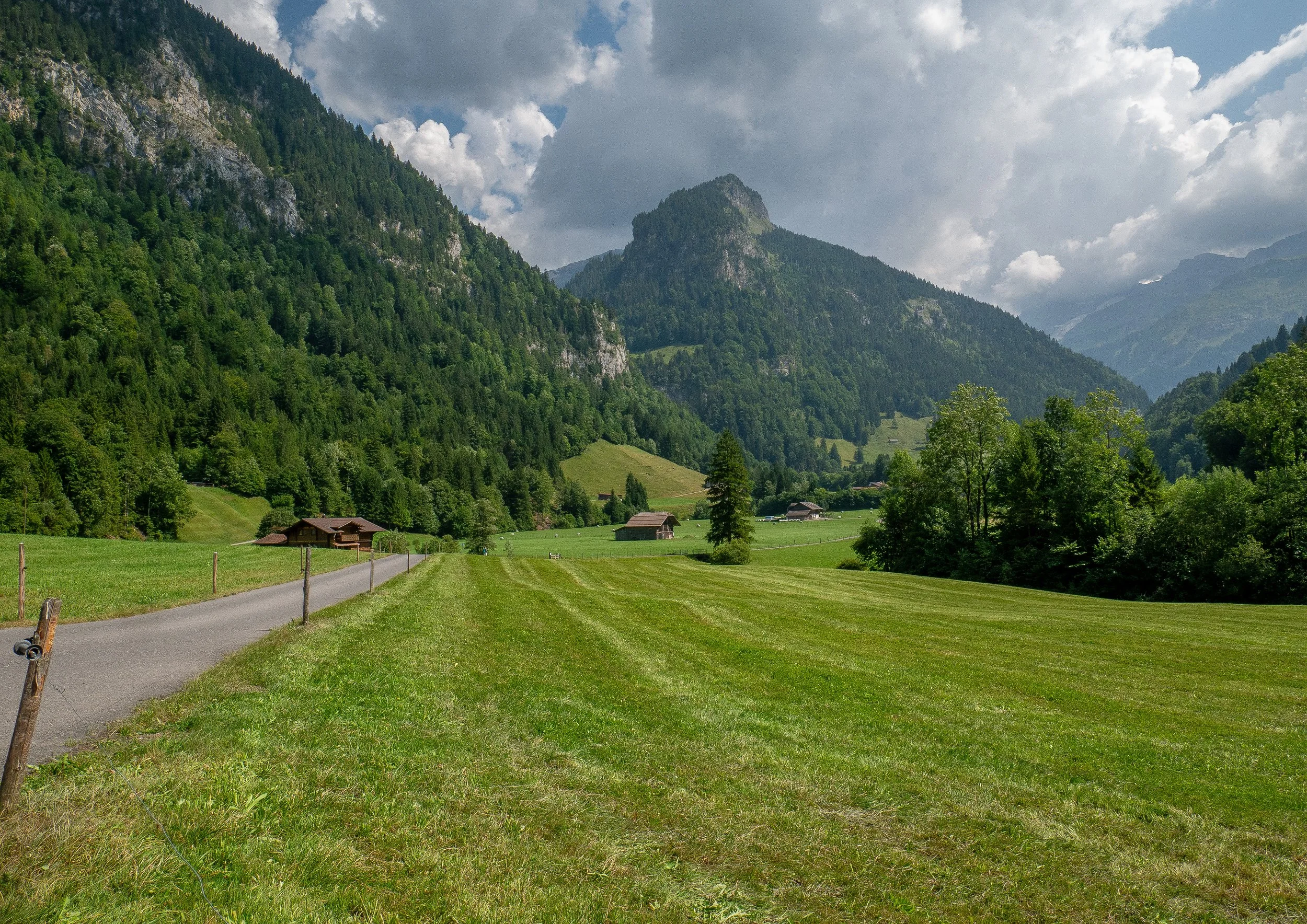
This image captures the quintessential, serene beauty of the Swiss Alps, specifically highlighting the lush, pastoral landscapes of the Bernese Oberland or perhaps the Glarus region. It feels like a scene straight out of a storybook.
Here is a breakdown of what makes this photo so characteristic of Switzerland:
1. The Alpine Topography
The composition is dominated by the dramatic contrast between the U-shaped valley floor and the steep, limestone peaks. The mountain in the center-right, with its rugged, rocky crown partially veiled by soft clouds, is a classic feature of the Swiss Pre-Alps. These peaks often serve as the first line of defense before the high-altitude glaciers deeper in the range.
2. Traditional Architecture
Dotted throughout the valley are traditional Chalet-style buildings.
The Barns: The smaller wooden structures in the middle of the fields are likely Stadel or agricultural barns, used for storing hay or sheltering livestock during the summer months.
Design: Notice the low-pitched roofs and heavy timber construction, designed to withstand heavy winter snow loads.
3. The "Swiss Green"
The vibrant, manicured look of the grass is not accidental. This is part of the Alpine farming heritage. The neatly mown rows in the foreground suggest that "haying" has recently occurred. In Switzerland, these meadows are meticulously maintained for cattle grazing, which is why the landscape often looks like a well-kept park.
4. Human-Nature Harmony
There is a distinct sense of order and peacefulness:
The Road: A narrow, paved lane winds through the valley, indicating the accessibility of even the most remote Swiss hamlets.
The Fencing: The simple wooden posts and wire on the left are a common sight, marking boundaries for dairy cows—the source of the country's famous cheese and chocolate.
Interesting Fact: This type of landscape is often part of the Alpwirtschaft (alpine economy) system, where farmers move their cattle to higher pastures in the summer and return to the valley floors like this one for the winter.
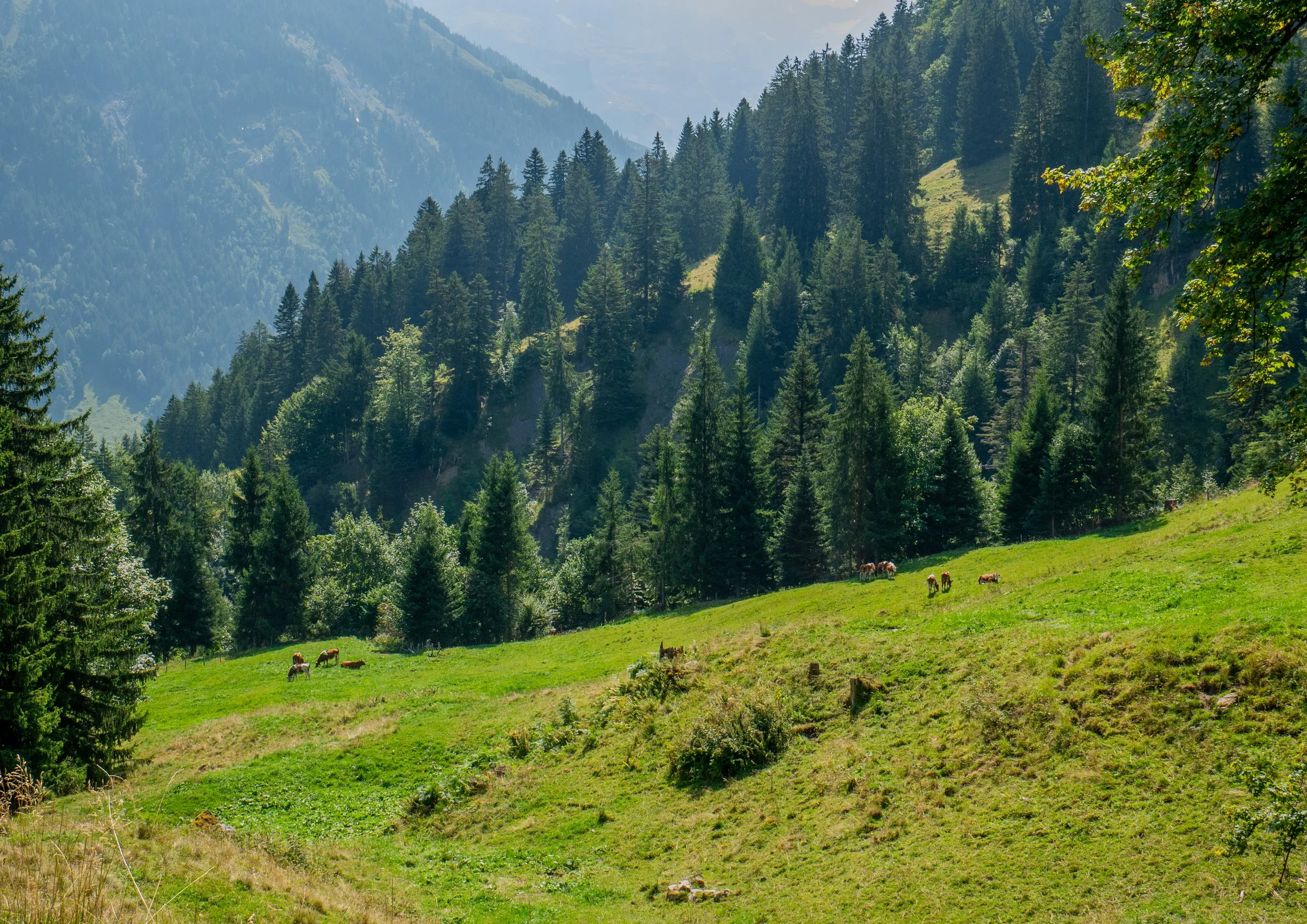
This image captures the quintessential, tranquil atmosphere of the Swiss Alps during the summer months. It portrays a scene of "Alpaufzug" (alpine pastoralism), where livestock are brought to high-altitude pastures to graze on nutrient-rich mountain grass.
Landscape and Composition
The photograph is characterized by a lush, verdant palette and a classic mountain verticality:
The Alpine Meadow: The foreground is dominated by a sun-drenched, sloping pasture. The grass is thick and vibrant, indicating a high-altitude ecosystem well-watered by snowmelt and summer rain.
The Forest: A dense stand of coniferous trees—likely Norway Spruce and Silver Fir—acts as a natural border between the grazing land and the steeper mountain slopes. These forests are vital for preventing soil erosion and avalanches in the region.
Atmospheric Perspective: In the far left background, the mountains fade into a soft, hazy blue. This "atmospheric haze" gives a sense of the immense scale and depth of the Swiss valley systems.
The Heart of Swiss Culture: Livestock
Tucked into the lower left and middle right of the frame are small groups of cattle.
The Breed: Based on their coat colors, these appear to be Simmental or Swiss Fleckvieh cattle. These breeds are world-famous for their dual-purpose use (milk and meat) and their hardiness in rugged terrain.
The Lifestyle: This image reflects the traditional Swiss agricultural method where cows spend their summers in the "Alps" (the high pastures), producing the high-quality milk used for world-renowned cheeses like Gruyère and Appenzeller.
Sensory Experience
Looking at this photo, one can almost imagine the specific sounds and smells of the Swiss countryside:
The distant, rhythmic clanking of cowbells.
The scent of fresh pine needles and wildflowers.
The crisp, cool air that persists even under a bright summer sun.
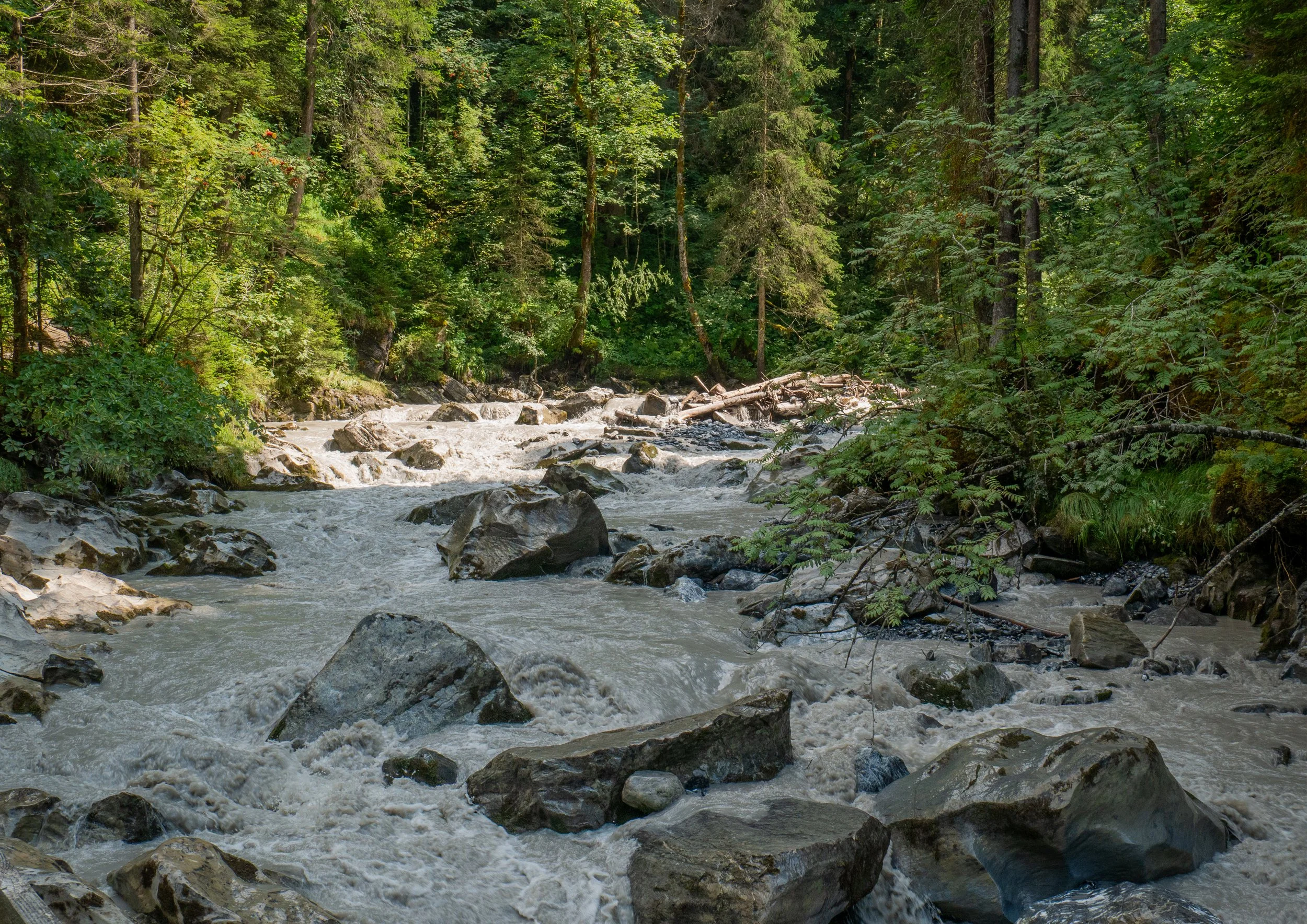
This image captures the raw, powerful beauty of a glacial river in the Swiss Alps. The milky, greyish-white color of the water often called "glacial milk" is a classic characteristic of this region. This unique hue is caused by fine particles of rock, or "rock flour," which are ground down by moving glaciers and suspended in the meltwater.
Here is a breakdown of the scene:
The Landscape Dynamics
The River Flow: The water is turbulent and fast-moving, cascading over large, dark boulders. This suggests a high-energy environment, likely a mountain stream (or Bach) that gains momentum from the steep Alpine slopes.
The Rock Formations: The jagged, dark grey rocks contrast sharply with the lighter water. These are likely fragments of limestone or granite, common in the Swiss Massifs, shaped by centuries of erosion.
The Vegetation: The lush green canopy of coniferous trees (pines and firs) and deciduous shrubs suggests this was taken at a mid-altitude level during the summer months. The density of the forest reflects the high rainfall and humidity found in Swiss valleys.
A Sense of Place
This photo evokes the atmosphere of regions like the Bernese Oberland or the Grisons (Graubünden). These areas are famous for their narrow gorges and powerful river systems that feed into Switzerland's famous lakes.
Sound: Looking at the white water, one can almost hear the deafening roar of the current hitting the rocks.
Temperature: Even on a sunny day, the air near these rivers remains crisp and cool due to the freezing temperatures of the glacial runoff.
Ecological Importance
These rivers are the "water towers" of Europe. The water seen here eventually flows into major European arteries like the Rhine or the Rhône. The presence of fallen logs and natural debris indicates a healthy, un-engineered river ecosystem where the forest and water are in a constant state of exchange.
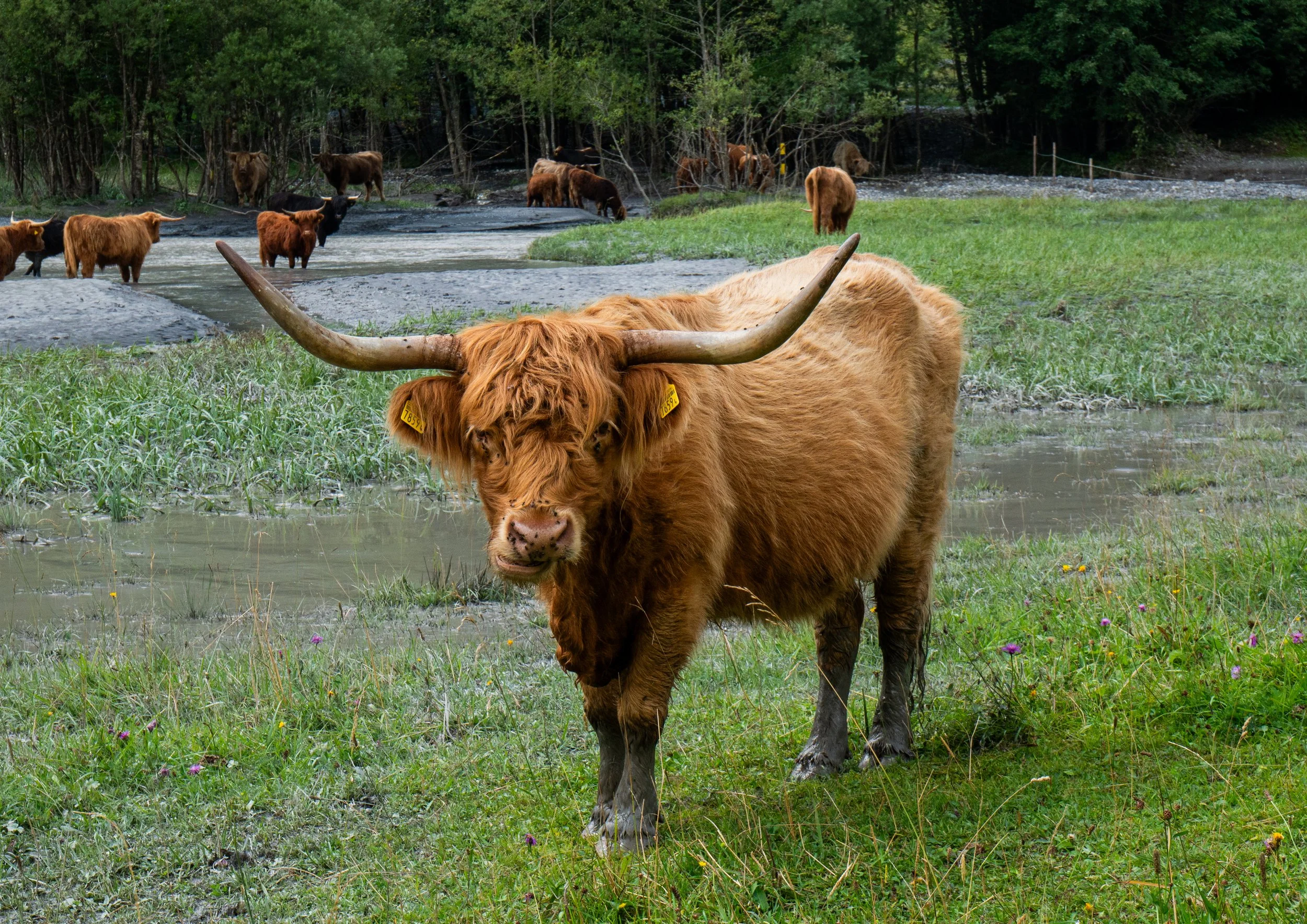
This striking image captures a Highland Cow (or Hérens cross, though the shaggy coat is classic Highland) in a rugged, marshy Swiss landscape. While these cows are originally Scottish, they are incredibly popular in Switzerland—especially in the Alpine regions—due to their hardiness and ability to thrive in cold, wet, and high-altitude environments.
Here is a breakdown of what makes this scene quintessentially Swiss and scientifically interesting:
1. The Subject: The Highland Cow
The cow in the foreground is a magnificent specimen, showing off the breed's most famous traits:
The "Dossan": That thick, wavy fringe of hair protects their eyes from the driving rain and snow common in the Alps.
The Horns: These aren't just for show; they help the cattle forage through snow and brush. In this photo, the wide, sweeping curve suggests an older, well-matured animal.
Double Coat: They possess a shaggy outer layer to shed water and a soft undercoat for warmth, making them "low-maintenance" for Swiss farmers who keep them outdoors.
2. The Environment: Alpine Wetlands
The background reveals a "braided" or flooded pasture, likely near a mountain stream or after heavy snowmelt.
Resilience: You can see the cow’s legs are caked in mud. Highland cattle are preferred for these "marginal" lands because they are lighter on their feet than many commercial dairy breeds, meaning they cause less soil erosion in delicate Swiss ecosystems.
Social Structure: In the distance, you can see the rest of the herd. These animals are highly social and thrive in the free-range grazing systems used during the Swiss Alpabzug (Alpine descent) and summer grazing months.
3. Modern Agriculture in Switzerland
If you look closely at the ears, you’ll see yellow ear tags. These are mandatory in Switzerland for livestock tracking and food safety. Even in this wild-looking setting, these animals are part of a highly regulated and carefully managed agricultural system that prioritizes animal welfare and mountain land preservation.
Interesting Fact
In Switzerland, Highland cattle are often used for "landscape grooming." Because they eat plants that other cows avoid (like thistles and woody shrubs), they help prevent the Swiss valleys from becoming overgrown with forest, maintaining the "postcard" Alpine meadows we all recognize.
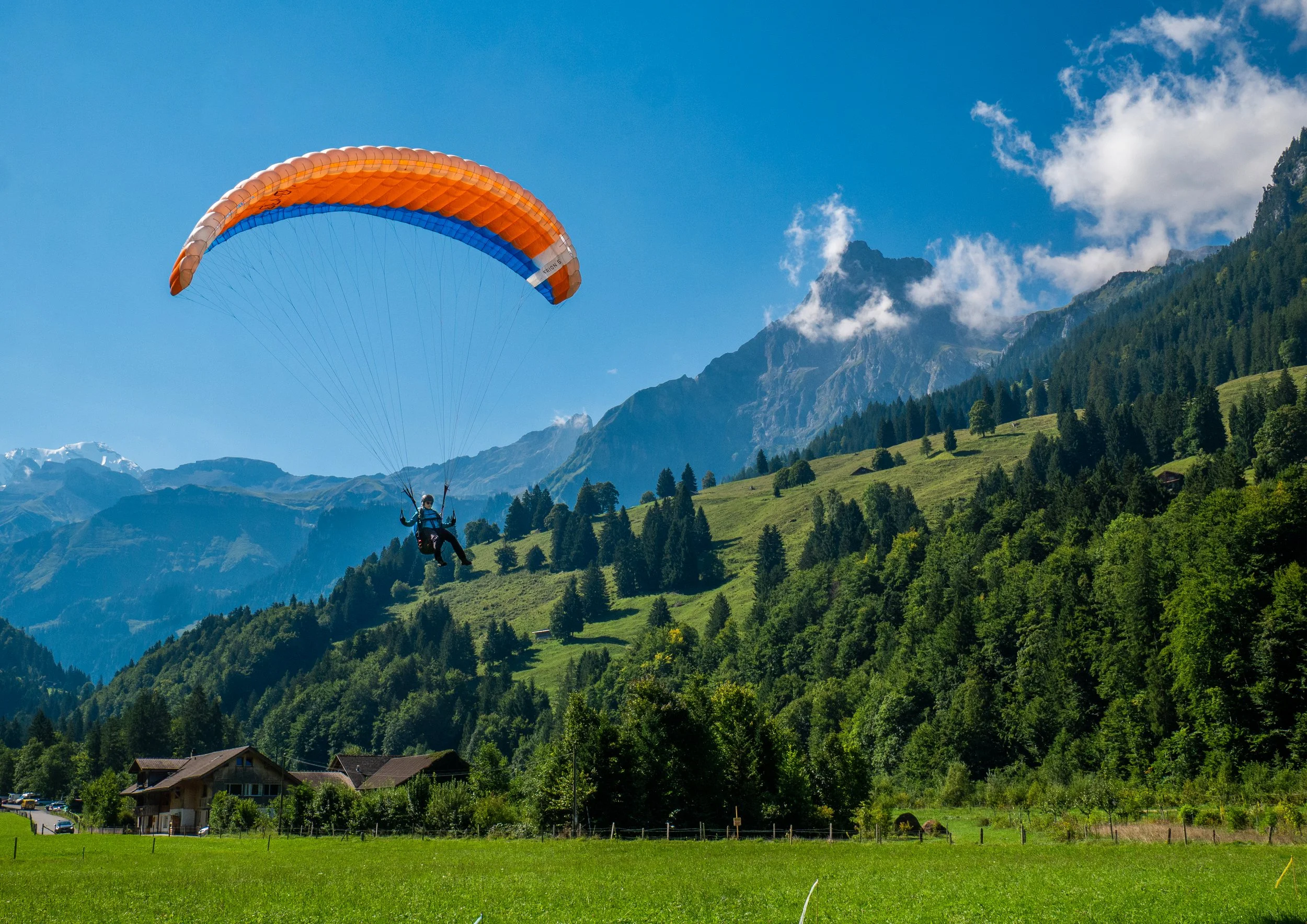
This photo captures the quintessential spirit of the Swiss Alps—a perfect blend of adrenaline and serenity. The image likely depicts the region around Interlaken or the Lauterbrunnen Valley, which are world-renowned hubs for paragliding due to their consistent thermals and breathtaking vertical drops.
Key Elements of the Image
The Paraglider: The vibrant orange and blue wing creates a striking contrast against the deep blue sky. The pilot is suspended in a harness, navigating the air currents high above the valley floor, offering a bird's-eye view that few ever get to experience.
The Landscape: You can see the classic Alpine geography—steep, verdant slopes dotted with dense pine forests. In the distance, the rugged, snow-dusted peaks (potentially part of the Jungfrau massif) remind viewers of the high altitude and the scale of the mountains.
Traditional Architecture: At the bottom left, the sun-weathered wooden chalets are characteristic of Swiss mountain villages. These structures have remained stylistically consistent for centuries, grounding the high-tech sport of paragliding in a traditional setting.
Why Switzerland is the Paragliding Capital
Switzerland is uniquely suited for this sport for several reasons:
Topography: The dramatic transition from flat valley floors to massive peaks allows for long, scenic flights.
Infrastructure: Cable cars and funiculars make it incredibly easy for pilots to reach high-altitude launch sites like Beatenberg or First.
Climate: The "Bernese Oberland" specifically is famous for reliable flying conditions during the summer months.
A Moment of "Freedom"
There is a profound sense of scale in this photo. The tiny silhouette of the person against the massive mountain backdrop highlights the "smallness" of man compared to nature, yet the act of flying suggests a total conquest of the landscape. It’s an image that evokes the fresh mountain air and the quiet whistle of the wind through the lines.
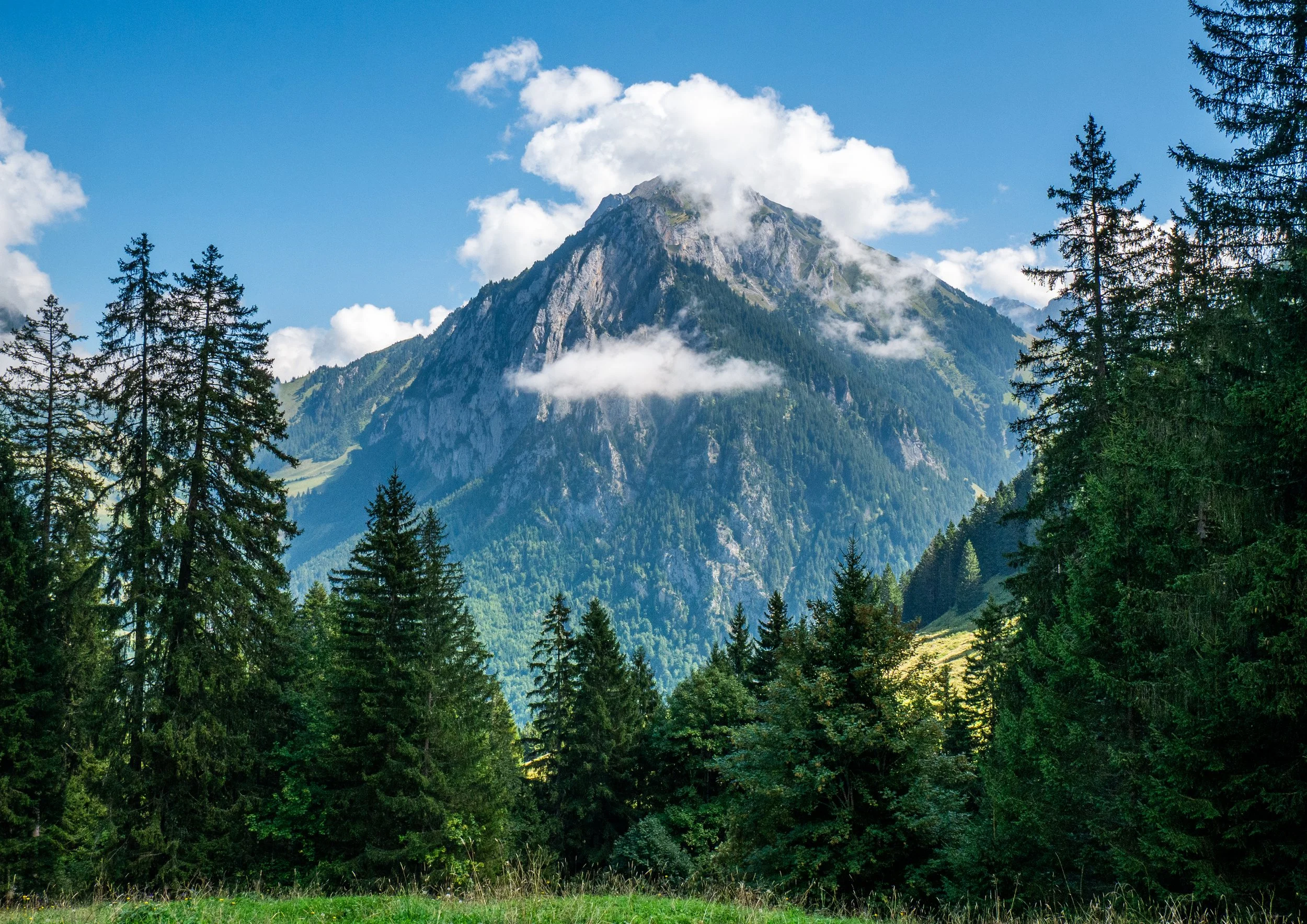
This image captures the quintessential beauty of the Swiss Alps, a landscape defined by dramatic elevation and the peaceful coexistence of rugged rock and lush greenery.
Based on the geography shown, here is a breakdown of what makes this scene so characteristic of Switzerland:
The Landscape Composition
The Peak: The central mountain showcases the classic "Pyramidal" shape often found in the Pre-Alps or the Bernese Oberland. The mix of exposed grey limestone and steep, grassy "alp" pastures is a hallmark of the Swiss tectonic folds.
The Treeline: The foreground is dominated by dense coniferous forests, likely composed of Norway Spruce and Silver Fir. These forests are vital to the Swiss ecosystem, acting as natural "protection forests" that prevent avalanches and soil erosion for the valleys below.
Atmospheric Conditions: The "wafting" clouds clinging to the mountainside are a common sight in the Swiss highlands. This often happens when moist air from the valleys rises and cools (orographic lift), creating that ethereal, layered look.
Cultural Context
In Switzerland, a view like this isn't just "wilderness." It is a managed landscape.
Summer Alping: Those high-altitude green patches on the mountain shoulders are likely used for Sömmerung (summer grazing). Cows are driven up to these heights to produce the rich milk used for world-famous Swiss cheeses.
Hiking Culture: There is almost certainly a yellow-signed hiking trail (Wanderweg) hidden somewhere in those trees. Switzerland maintains over 65,000 kilometers of marked trails, making peaks like this accessible to almost everyone.
Artistic Impression
The photo uses the dark, vertical lines of the nearby fir trees to frame the mountain, creating a sense of depth. The vibrant blue of the sky suggests a "Kaiserwetter" daya term locals use for "Imperial Weather," meaning a perfectly clear, sunny day in the mountains.
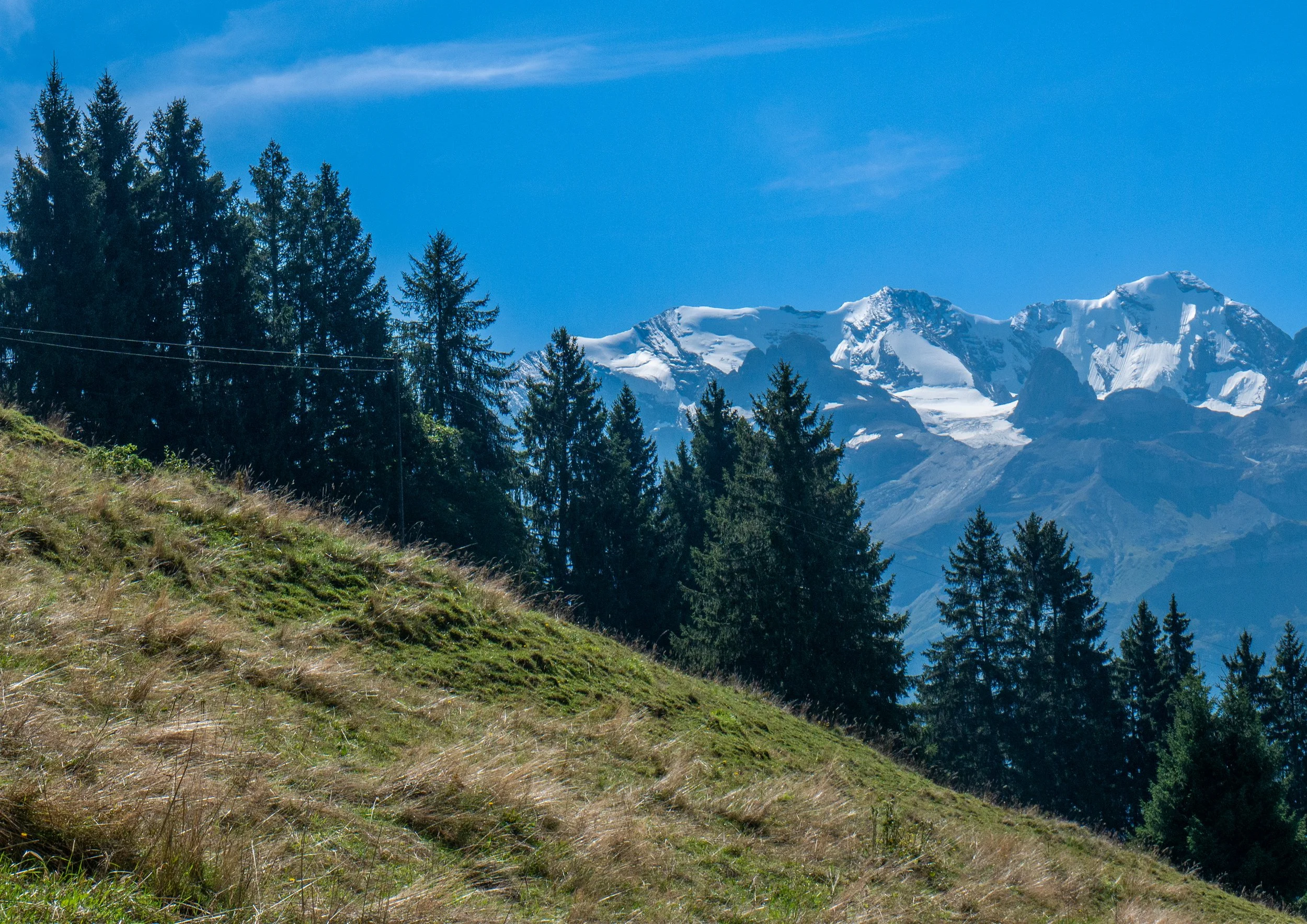
This photo captures the quintessential essence of the Swiss Alps, showcasing the dramatic contrast between lush subalpine meadows and the rugged, perennial ice of the high peaks.
Based on the geography—specifically the jagged, glaciated massif in the background—this looks very much like the Bernese Oberland or perhaps a view toward the Pennine Alps.
Visual Analysis
The Foreground (The Alpe): The sloping green hillside is typical of a Swiss alpage. The grass shows the golden-green hue of late summer, often used for grazing cattle that produce the region's famous cheeses.
The Midground (The Forest): A dense stand of Norway Spruce and Silver Fir frames the view. These hardy conifers are the "sentinels" of the Alps, protecting the lower valleys from avalanches and erosion.
The Background (The High Peaks): The snow-capped giants in the distance likely exceed 4,000 meters. The visible glaciers and "eternal snow" highlight the scale of the range, where winter never truly leaves the summits.
Atmosphere: The vibrant blue sky and the thin, wispy cirrus clouds suggest a high-pressure system, often called Kaiserwetter (Emperor's weather) by locals—perfect conditions for hiking or photography.
The "Swiss" Aesthetic
What makes this photo feel authentically Swiss is the layering:
Productivity: The managed pasture.
Preservation: The healthy, deep-green forest.
Wilderness: The unreachable, frozen peaks.
It evokes a sense of "Heidi" nostalgia while reminding the viewer of the raw, powerful geology that shaped Central Europe.
Artistic Tip
The composition uses the diagonal line of the hill to lead the eye from the bottom left up toward the massive peaks on the right. This creates a sense of depth and scale, making the mountains feel even more imposing.
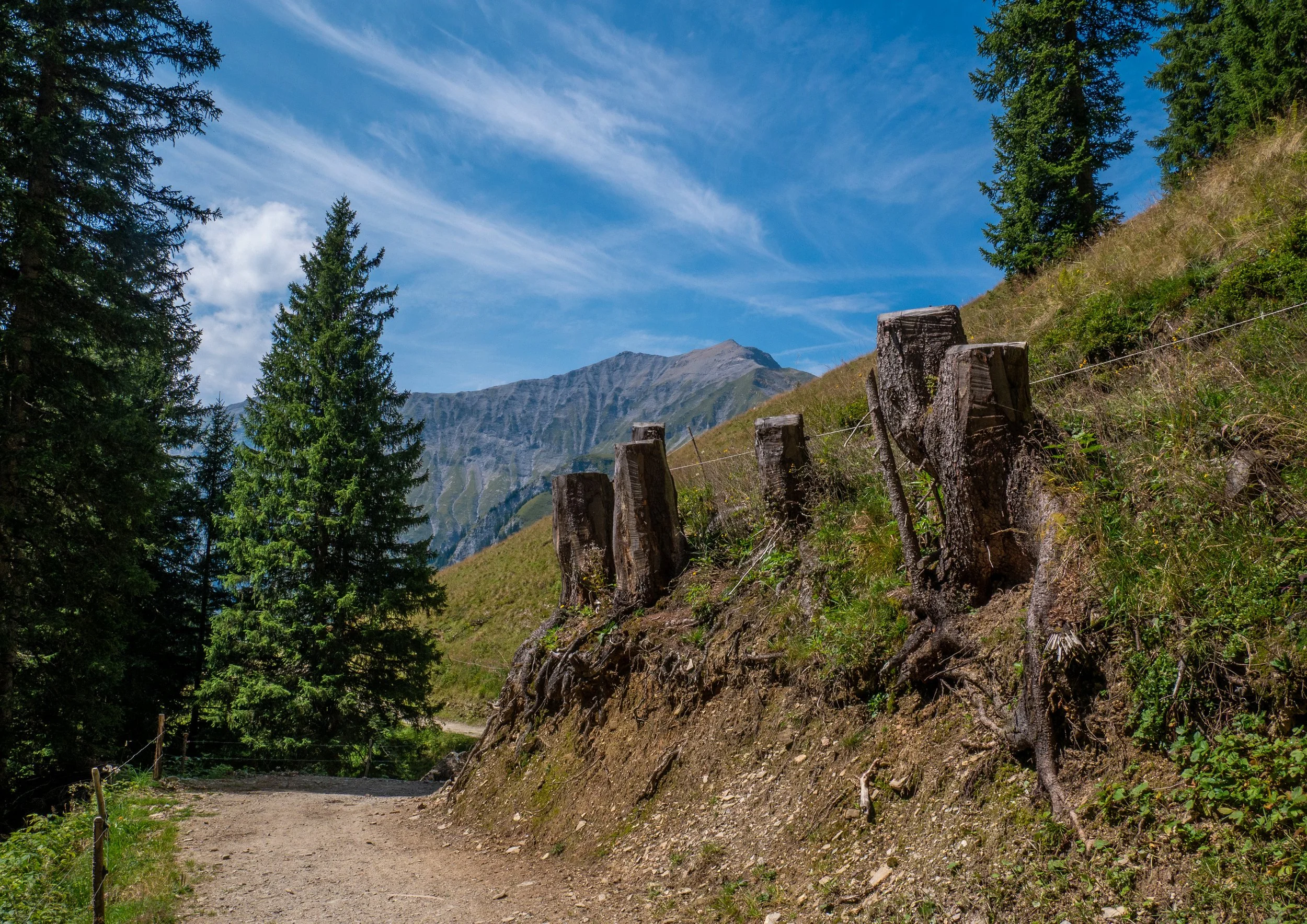
This striking image captures the rugged, functional beauty of the Swiss Alpine landscape. It highlights the intersection of wild nature and the careful mountain management that is characteristic of Switzerland.
Scene Breakdown
The Natural Majesty
The backdrop features a classic Alpine vista: a jagged, grey limestone peak rising against a vibrant blue sky streaked with cirrus clouds. The coniferous trees (likely Spruce or Fir) framing the left side of the image indicate a high-altitude environment, common in regions like the Bernese Oberland or the Valais.
Human Intervention
The most intriguing element of the photo is the row of tall tree stumps along the embankment. In Switzerland, these are often left intentionally high for several reasons:
Erosion Control: The deep root systems help stabilize the steep, loose soil of the embankment, preventing landslides onto the path below.
Avalanche Protection: In winter, these "high stumps" can help anchor the snowpack on steep slopes.
Fencing: You can see a wire fence running through or behind the stumps, suggesting they are being used as natural, sturdy fence posts for livestock grazing on the upper slopes.
The Hiking Culture
The dirt track in the foreground is a hallmark of the Swiss "Wanderweg" (hiking trail) system. These paths are meticulously maintained to allow locals and tourists alike to access the high pastures and peaks.
Mood and Composition
The photo exudes a sense of serenity and hardiness. The contrast between the soft, wispy clouds and the rough, exposed roots of the stumps tells a story of a landscape that is beautiful but demanding. The bright, saturated colors suggest a crisp summer day where the mountain air is thin and clear.
Fun Fact: Switzerland has over 65,000 kilometers of marked hiking trails—enough to circle the globe one and a half times!
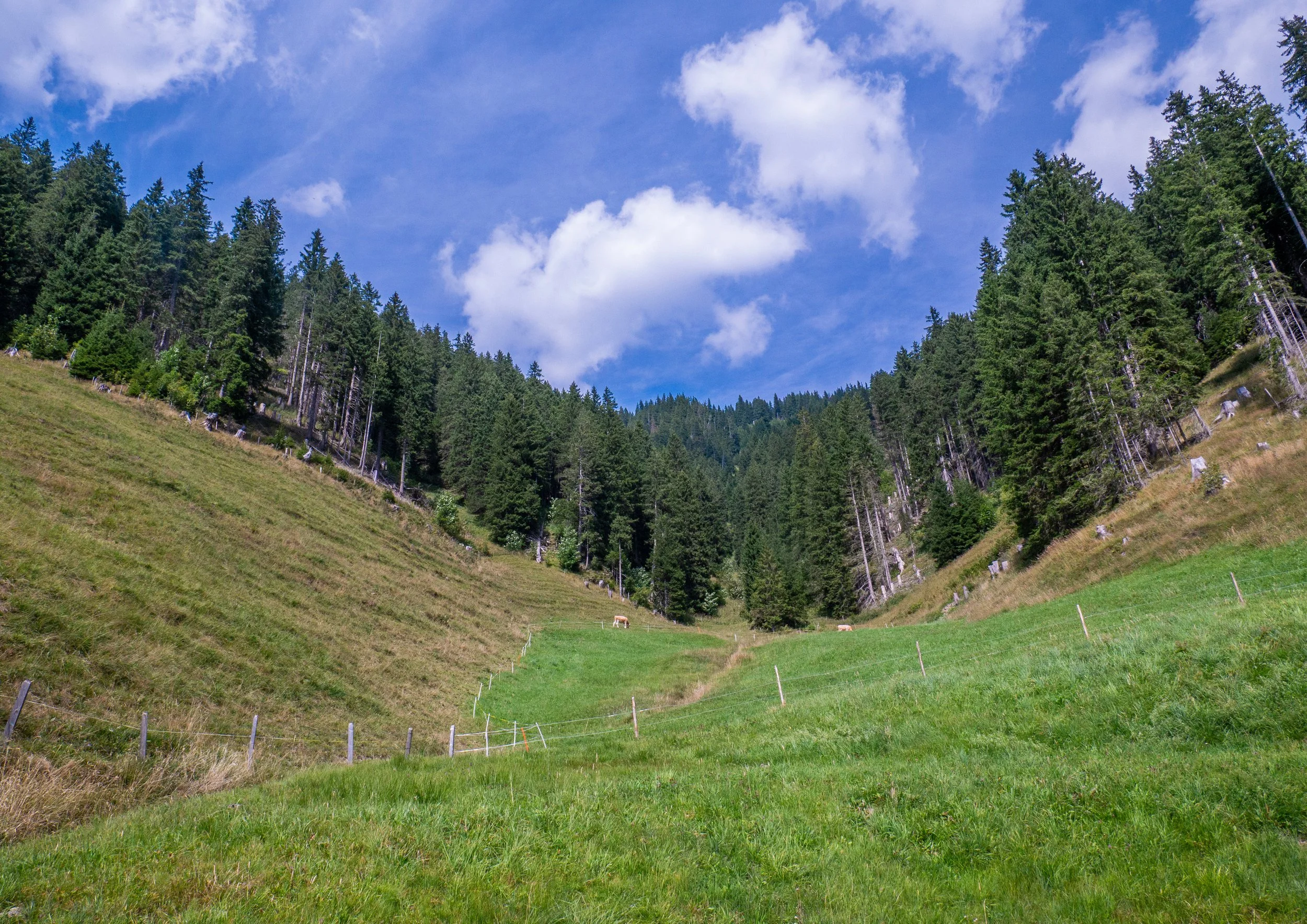
This image captures the quintessential, serene beauty of the Swiss Alps during the height of summer. The composition perfectly illustrates the harmonious relationship between the rugged forest and the managed alpine pastures (Alpweiden) that characterize the region.
Visual Breakdown
The Alpine Pasture: The foreground shows a vibrant green meadow, divided by a traditional post-and-wire fence. If you look closely toward the center, you can see a few cattle grazing in the distance—a classic sight in Switzerland, where cows are moved to higher elevations in the summer to graze on mineral-rich grass.
The Treeline: The slopes are flanked by dense stands of Norway Spruce and silver fir. The steep incline shows how the forest acts as a natural "protection forest" (Schutzwald), helping to prevent erosion and stabilize the soil on these dramatic gradients.
Atmosphere: The brilliant blue sky, dotted with soft cumulus clouds, suggests a crisp, high-altitude afternoon. The way the valley "Vs" toward the center draws the eye upward, emphasizing the height of the surrounding peaks.
Why This is "Typically Swiss"
In Switzerland, this type of landscape represents more than just a pretty view; it’s a working cultural landscape.
Biodiversity: These managed meadows are often home to hundreds of species of wildflowers and insects, maintained by centuries of sustainable grazing.
The Alpsegen: Scenes like this are where the tradition of the Alpsegen (prayer-call) and yodeling originated—the open space between the hills acts as a natural amphitheater for sound.
Hiking Culture: This terrain is a hiker’s paradise. The clear visibility and defined treelines are hallmarks of the Pre-Alps (regions like Appenzell, Glarus, or the Bernese Oberland), where the mountains begin their dramatic ascent.
Note on the light: The soft, cool tones in the shadows of the trees contrast beautifully with the warm, sun-drenched grass, giving the photo a fresh, "airy" feeling that is very characteristic of the mountain climate.
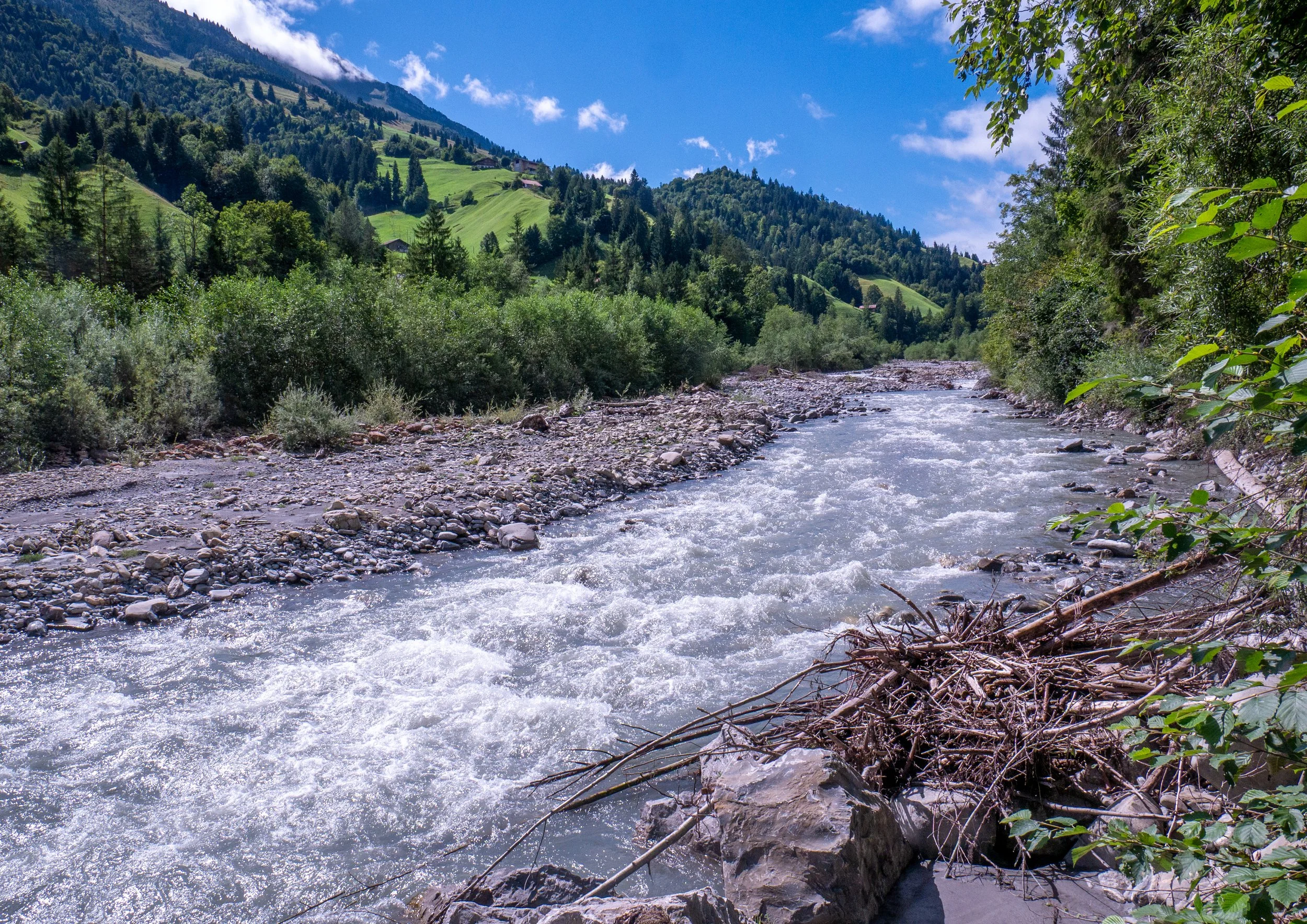
This image captures the quintessential, rugged beauty of the Swiss Alps during the summer months. It showcases a powerful alpine river, likely fed by glacial meltwater, carving its way through a lush valley.
Here is a breakdown of the elements that make this scene so characteristic of Switzerland:
The Dynamic River
The focal point is the braided riverbed, filled with grey and white limestone cobbles. The water has a milky, turquoise-grey tint—often called "glacier milk"—which is caused by fine rock flour suspended in the water from grinding glaciers upstream. The presence of driftwood and large branches along the banks suggests a high-energy environment where the water level fluctuates significantly with the seasons.
The Alpine Landscape
Verdant Slopes: The background features steep, vibrant green meadows (alps) that are iconic to Switzerland. These are often used as summer grazing pastures for cattle.
Diverse Forestry: The mix of dense coniferous forests and deciduous shrubs along the riverbank indicates a healthy, high-altitude ecosystem.
Traditional Dwellings: If you look closely at the upper slopes, you can spot small chalets or farm buildings nestled into the hillside. This high-altitude living is a staple of Swiss mountain culture.
Atmospheric Quality
The lighting suggests a bright, clear day with high-altitude clarity. The deep blue sky and scattered white clouds create a high-contrast look that brings out the textures of the stones and the movement of the rapids. It evokes a sense of purity, coolness, and the untamed power of nature.
Interesting Fact: Rivers like this are vital to Switzerland’s infrastructure; the country’s topography allows it to generate nearly 60% of its electricity from hydropower.
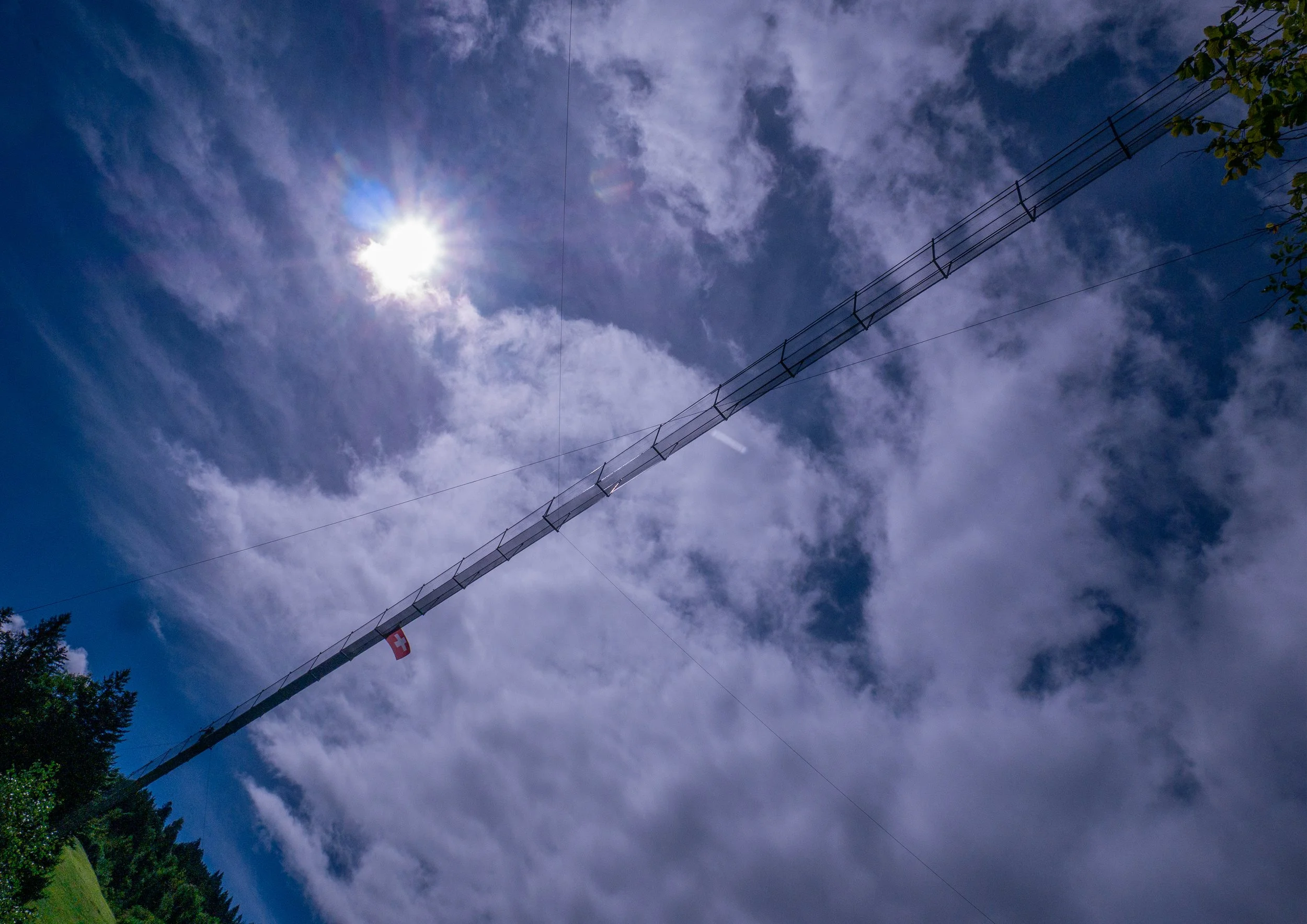
This striking low-angle shot captures one of Switzerland's engineering marvels: a pedestrian suspension bridge (Hängebrücke) stretching across a deep alpine valley.
Based on the design and the small Swiss flag visible on the left side, this is likely the Charles Kuonen Suspension Bridge near Randa or the Trift Bridge, both of which are iconic symbols of Swiss hiking culture.
The Perspective
The photographer has chosen a dramatic upward angle that emphasizes the bridge's height and the thin, almost fragile-looking line it cuts through the sky. By placing the sun directly behind the clouds, the bridge is rendered as a dark silhouette, highlighting its structural geometry against the soft, expansive clouds.
Key Elements of the Image
The Swiss Flag: A small but vital detail. It grounds the image in its location and serves as a point of pride for the local craftsmanship required to build such a structure in rugged terrain.
Engineering vs. Nature: The contrast between the rigid, man-made lines of the steel cables and the organic, swirling shapes of the clouds creates a sense of tension and awe.
The Scale: The bridge appears to disappear into the sky, giving the viewer a sense of the "vertigo" hikers feel when crossing these spans, which can hang hundreds of meters above the valley floor.
Cultural Context
In Switzerland, these bridges are more than just shortcuts; they are destinations in themselves. They allow hikers to traverse difficult terrain without descending into deep gorges, offering views that were previously only accessible to mountain climbers or birds. Crossing one is often described as a "thrill-seeking" rite of passage for tourists and locals alike.
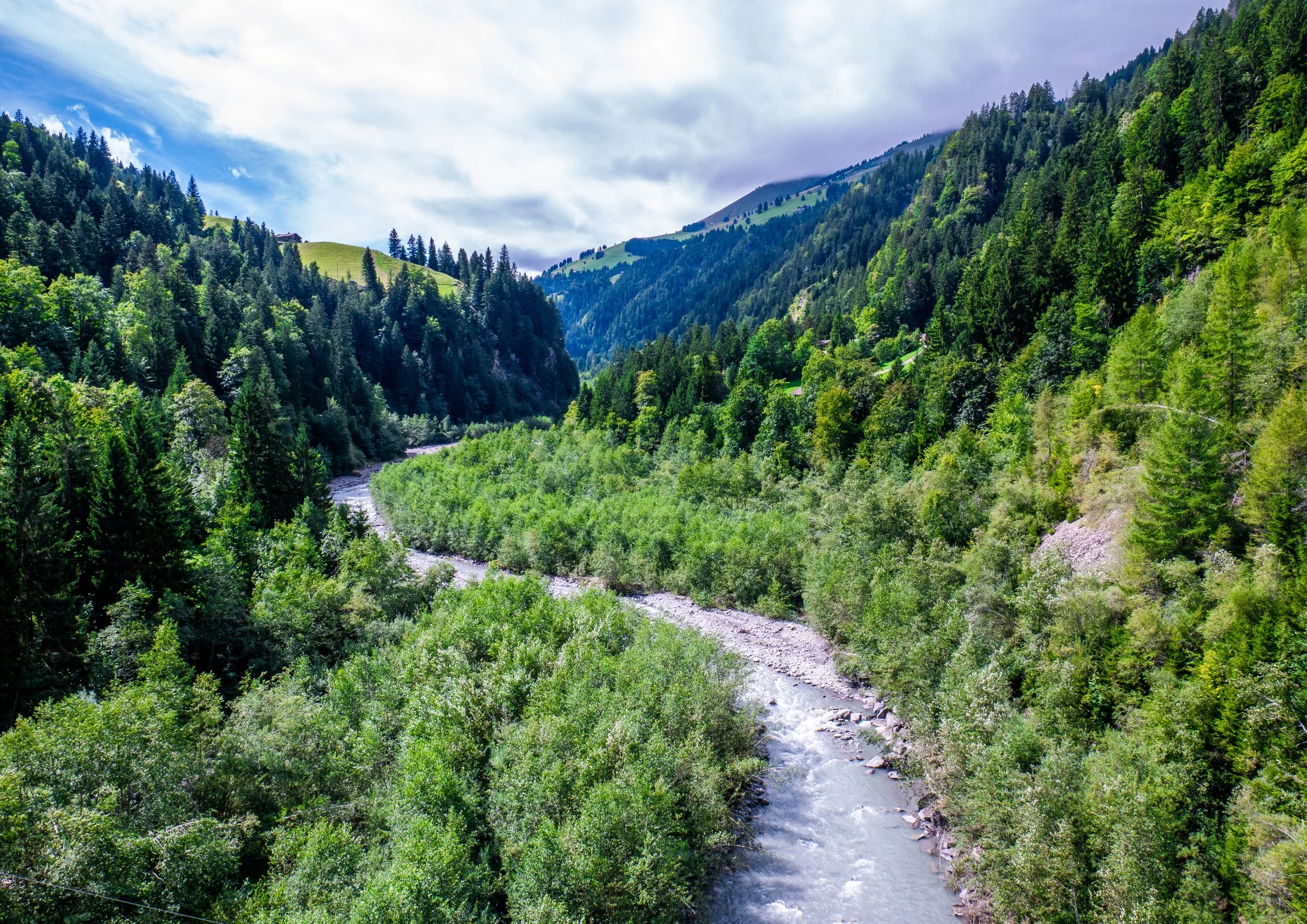
This photo captures the quintessential natural beauty of the Swiss countryside, likely taken from an elevated position such as a bridge (as suggested by your file name). It showcases the lush, rugged geography that defines the alpine regions of Switzerland.
Landscape Highlights
Glacial Waters: The river flowing through the center has a distinct milky, grayish-blue tint. This is often caused by "rock flour"—fine sediment from glaciers grinding against stone—which is a common sight in Swiss mountain streams.
Verdant Slopes: The steep valley walls are covered in a mix of dense coniferous and deciduous forests. The vibrant green patches at the higher elevations suggest alpine pastures used for summer grazing.
Traditional Architecture: If you look closely at the mid-ground on the left, you can see a glimpse of a dark wooden structure with a gabled roof, typical of the rustic chalets found in the Swiss Alps.
Composition and Mood
The perspective creates a strong sense of depth, leading the eye along the curve of the river into the heart of the valley. The bright, slightly overcast sky provides soft lighting that emphasizes the different shades of green in the foliage, giving the scene a serene and refreshing atmosphere.
Regional Possibilities
While this specific type of valley can be found in many parts of the country, this scenery is very characteristic of regions like:
The Bernese Oberland: Known for deep valleys and dramatic river paths.
Graubünden: Famous for its wilder, more forested river gorges.
Central Switzerland: Specifically the areas leading toward the Gotthard Pass.
378x210 mm photo printed on A3 (420x297 mm) premium glossy photo paper (frame and mount not included).
No results found
No results match your search. Try removing a few filters.