
London Roads Prints 1
London Roads Prints 1
Filters
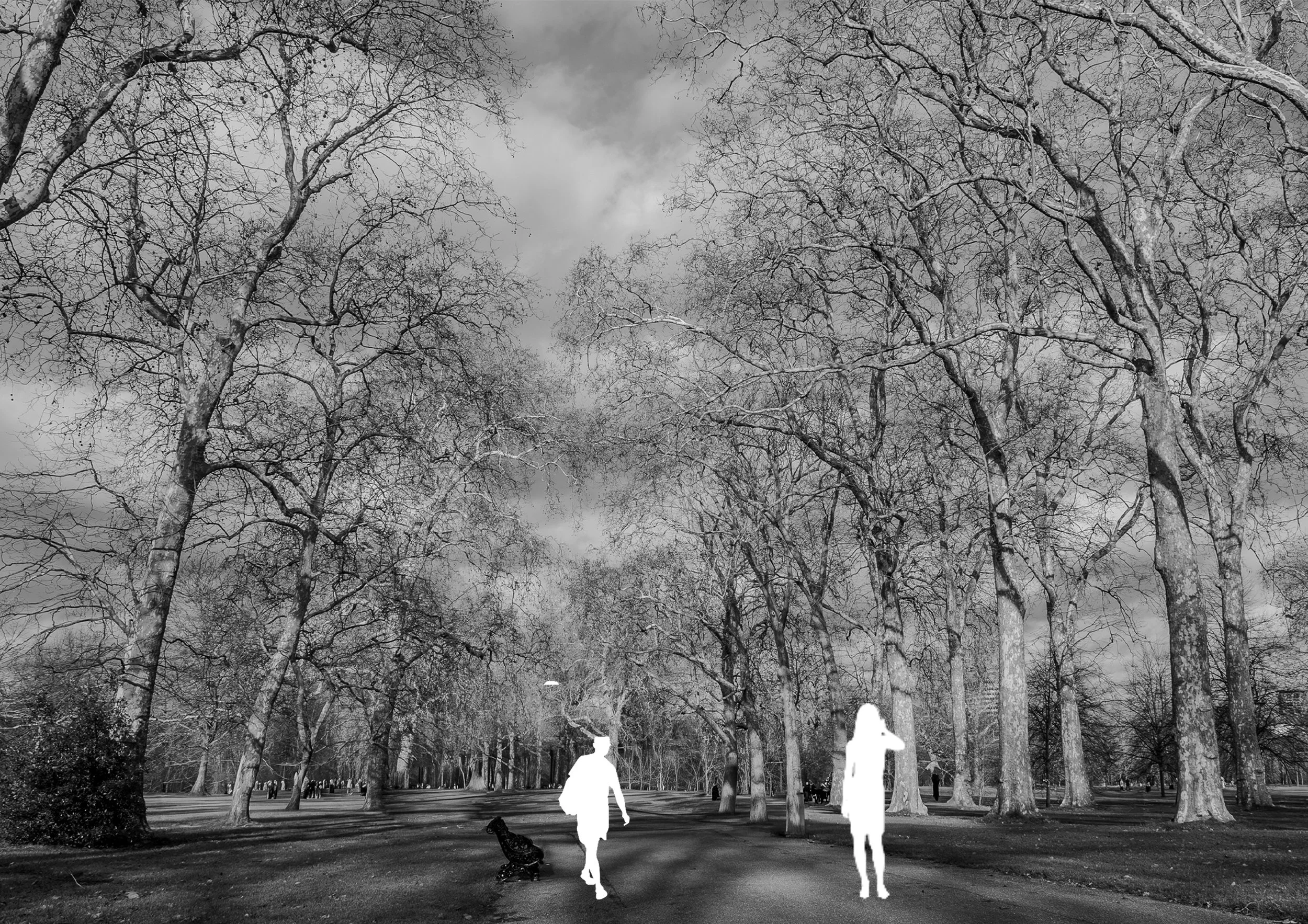
This striking black-and-white print captures a winter scene in Hyde Park, London, balancing a classic landscape aesthetic with a modern, surrealist twist.
Visual Composition
The image is dominated by the intricate, skeletal forms of London Plane trees. Their interlocking branches create a natural cathedral ceiling over the broad pathways, a hallmark of the park’s Victorian-era design. The high-contrast black and white palette emphasizes the textures of the bark and the dramatic, clouded sky, giving the scene a timeless, almost archival quality.
The Artistic Intervention
The most compelling aspect of this piece is the digital silhouette technique. By "cutting out" the figures of two people walking, the artist creates a void—a stark, pure white space where human detail should be.
Absence vs. Presence: The figures are physically gone, yet their shapes remain. This invites the viewer to project themselves, or perhaps a memory of someone, into the frame.
The "Ghost" Effect: The silhouettes give the park a haunted or dreamlike atmosphere, suggesting that while the people are transient, the landscape remains constant.
Visual Balance: The brightness of the white cut-outs draws the eye immediately to the center of the path, creating a focal point that contrasts with the dark, heavy texture of the trees.
Mood and Interior Style
This print evokes a sense of solitude and reflection. It’s an ideal piece for a space that values minimalism or architectural detail.
Modern Framing: The thick black frame and wide white mat (pas-partout) enhance the gallery-like feel, making it a sophisticated choice for an office, hallway, or living room.
Theme: It speaks to the urban experience—the feeling of being "alone together" in a massive public space.
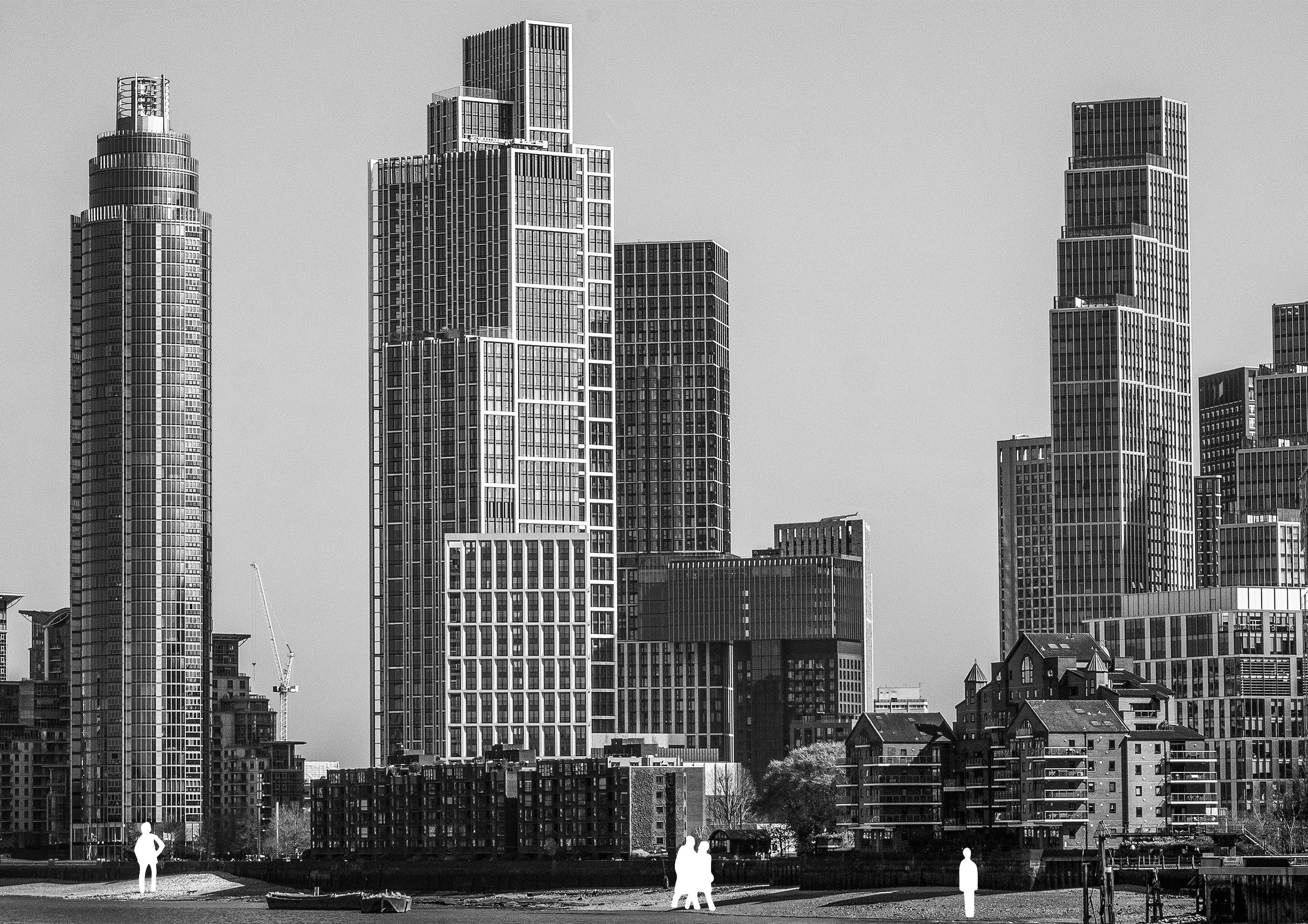
This framed black-and-white print offers a striking, contemporary perspective of the London skyline, captured from the south bank of the Thames near Battersea. It showcases the rapid architectural transformation of the Vauxhall and Nine Elms districts.
Visual Composition
The image is a study in verticality and texture. By stripping away color, the focus shifts entirely to the geometric silhouettes and the interplay of light on glass and steel.
The Skyline: The composition is dominated by iconic new landmarks, including the cylindrical St George Wharf Tower (the Tower) on the left and the staggered, rectilinear forms of the Damac Tower and surrounding developments.
The Contrast: There is a compelling juxtaposition between the sleek, high-rise luxury towers and the lower-profile, industrial-style brick buildings in the foreground, nodding to the area's dockside history.
Human Element: The most intriguing feature is the inclusion of stylized white silhouettes of people on the riverbank. This artistic choice provides a sense of scale and adds a surreal, almost ghostly layer to the urban landscape.
Style and Presentation
Monochrome Aesthetic: The high-contrast black-and-white finish emphasizes the "Concrete Jungle" feel, making it a sophisticated piece for modern interior design.
Framing: The thick black frame and wide white matting (pass-partout) act as a window, drawing the viewer’s eye inward and giving the architectural subject matter a formal, gallery-quality presence.
Atmosphere
The print captures a moment of stillness in a city known for its frantic pace. The clear sky and calm water create a minimalist backdrop that allows the complex details of the building facades to stand out. It feels less like a traditional postcard and more like a tribute to modern engineering and urban evolution.
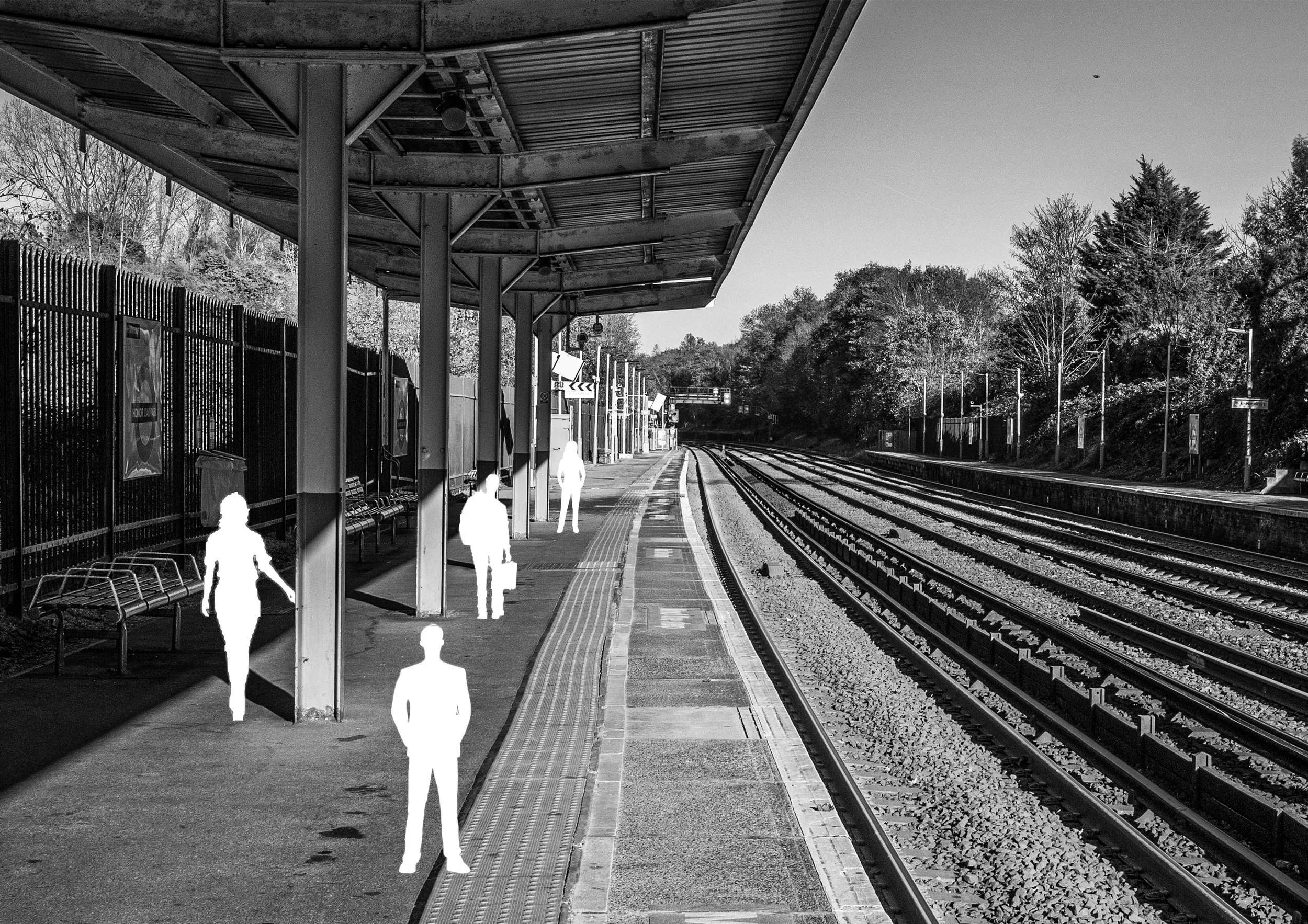
This print is a striking piece of conceptual photography that uses high-contrast black-and-white tones to explore themes of absence, anonymity, and the urban experience.
The image depicts a quiet train platform, but it subverts traditional street photography by replacing the human subjects with stark, solid white silhouettes.
Visual Analysis
The Silhouette Effect: By "cutting out" the people, the artist shifts the focus from individual identities to the spaces they occupy. These figures look like ghosts or "missing data," suggesting a sense of detachment or the feeling of being a stranger in a crowd.
Composition and Perspective: The strong diagonal lines of the tracks and the platform roof create a powerful vanishing point. This draws the eye deep into the background, emphasizing the linear, rhythmic nature of transit.
Lighting and Texture: The high-contrast edit brings out grit and detail in the concrete, the metal pillars, and the gravel of the tracks. The harsh shadows on the platform ground the scene in reality, making the glowing white figures feel even more surreal.
Key Themes
The "Invisible" Commute: It captures the feeling of the daily grind—being physically present in a public space while mentally or emotionally elsewhere.
Isolation in Public: Despite being a shared space, the platform feels lonely. The figures do not interact; they are isolated icons within a rigid architectural frame.
The Passage of Time: The tracks represent a journey and the "waiting" inherent in travel. The silhouettes suggest that while the station remains permanent, the people passing through are merely temporary.
Style and Setting
The architecture and station layout suggest a UK suburban rail station (likely National Rail or London Overground). The framing—a thick black wooden frame with a wide white mat elevates the gritty subject matter into a piece of fine art suitable for modern minimalist or industrial-style interiors.
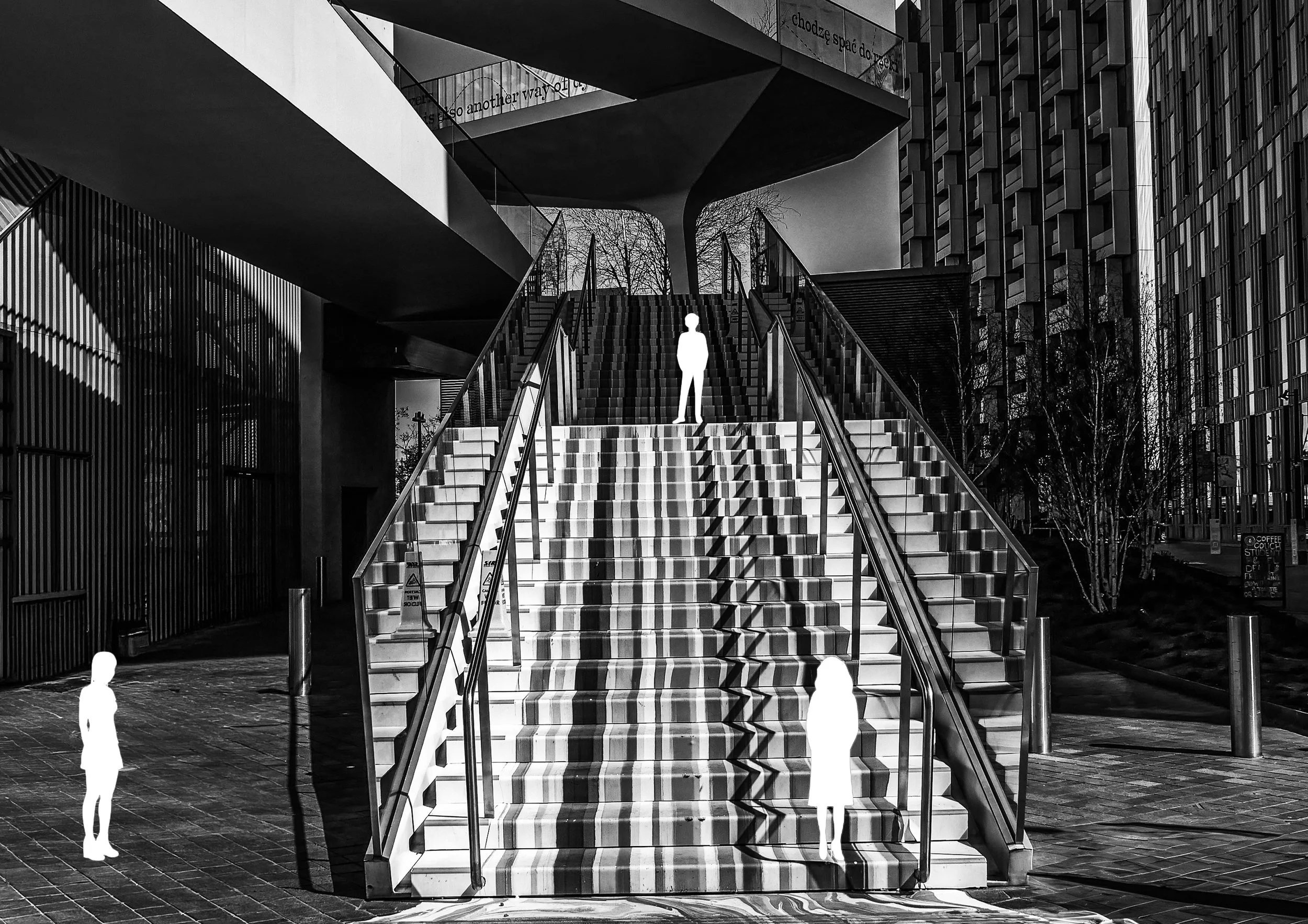
This striking black-and-white print captures a moment near the North Greenwich Pier, just outside the O2 Arena in London. It is a masterclass in urban geometry, utilizing the bold architectural lines of the area to create a sense of both grandeur and isolation.
Architectural Drama
The composition is dominated by the Tide, London's first elevated linear park. The sweeping, cantilevered concrete structures create deep shadows and sharp angles that cut across the frame. The play of light on the staircase creates a rhythmic, almost hypnotic pattern of "zebra stripes," drawing the eye upward toward the silhouette at the top.
The "Ghost" Figures
The most compelling aspect of this piece is the artistic choice to render the human figures as solid white silhouettes.
Anonymity: By stripping away detail, the figures become universal symbols of the "urban dweller."
Contrast: The stark white against the deep blacks and textured greys of the concrete makes the figures pop, giving the image a surreal, dreamlike quality.
Narrative: It feels like a "long exposure" of memory—the people are present, yet ephemeral, as if they are passing through the landscape without leaving a physical trace.
Why It Works
North Greenwich is often a bustling hub for commuters and concert-goers. This print reinterprets that frantic energy as a still, sculptural moment. The balance between the massive, permanent weight of the architecture and the glowing, weightless presence of the people creates a beautiful tension.
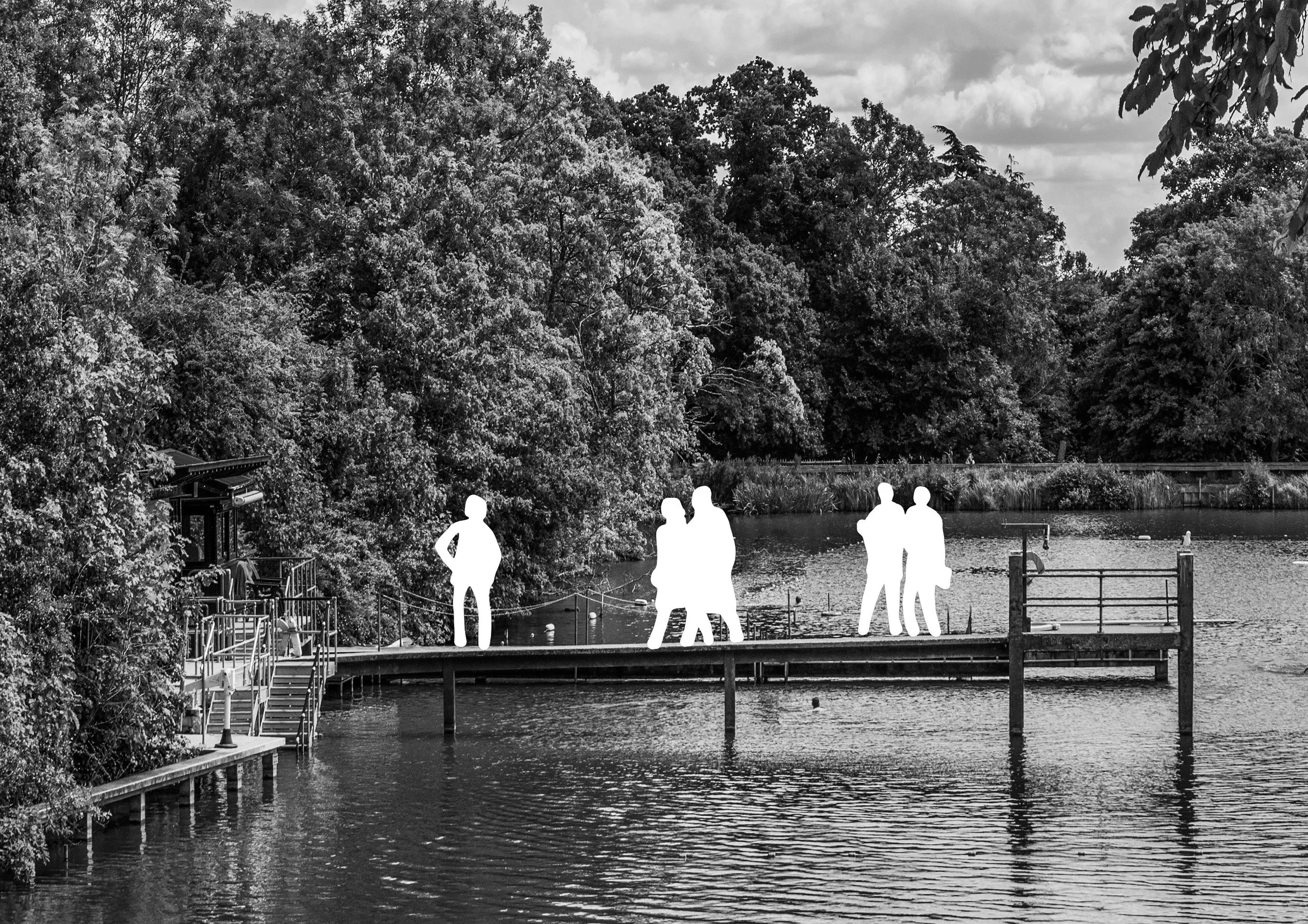
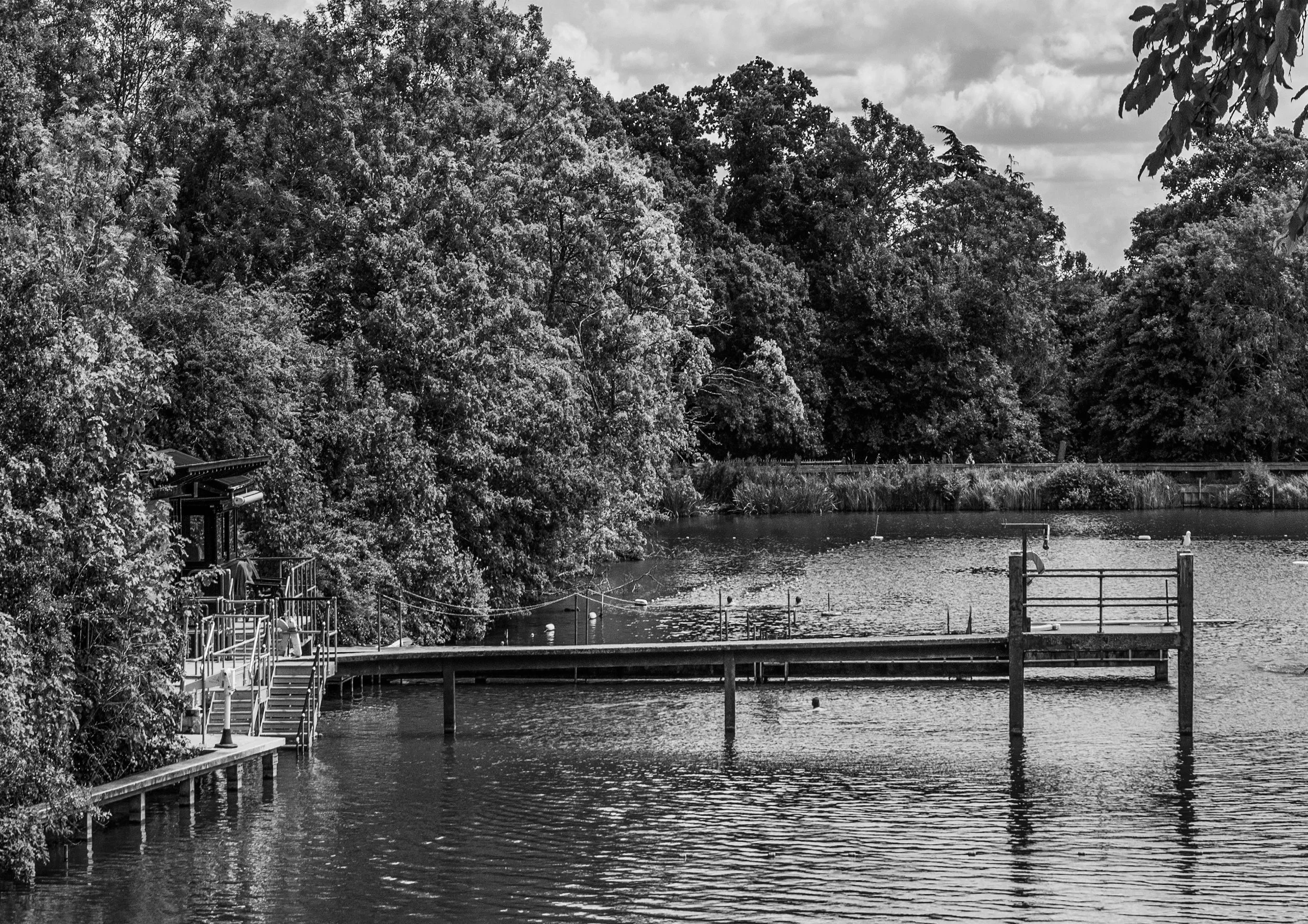
This framed print captures a serene, atmospheric scene at the Hampstead Mixed Bathing Pond (often referred to as part of the Hampstead Ponds) in Hampstead Heath, London.
While the user mentioned "Hampton Pond Hempstead," the visual details—specifically the wooden jetty, the dense deciduous treeline, and the "Mixed Pond" pier—confirm this is a depiction of the famous North London swimming spot.
About the Artwork
The print is a striking black-and-white photograph or digital composition that uses a high-contrast silhouette effect.
The Subject: It depicts a group of people standing on the wooden pier that extends into the water. In a creative twist, the figures are rendered as solid white silhouettes against the grayscale background of the water and trees.
The Setting: The Mixed Bathing Pond is one of three swimming ponds on the Heath. It is known for its "wild swimming" culture and the sense of being deep in nature despite being in the middle of a bustling city.
Composition: The reflection of the trees in the water and the textures of the rippling surface create a moody, timeless feel. The black frame and white mount (matting) enhance the contemporary, minimalist aesthetic of the piece.
Symbolic Meaning
The use of white silhouettes often represents a sense of anonymity and universality. By stripping away the specific details of the people, the artist focuses on the shared human experience of enjoying the Heath—the quiet anticipation before a swim or the communal feeling of standing together by the water.
Display Tips
Lighting: Because this is a high-contrast B&W print, it looks best under directed gallery lighting or in a room with plenty of natural light to make the white silhouettes "pop."
Pairing: It works well in a gallery wall focused on London landmarks, nature, or minimalist photography.
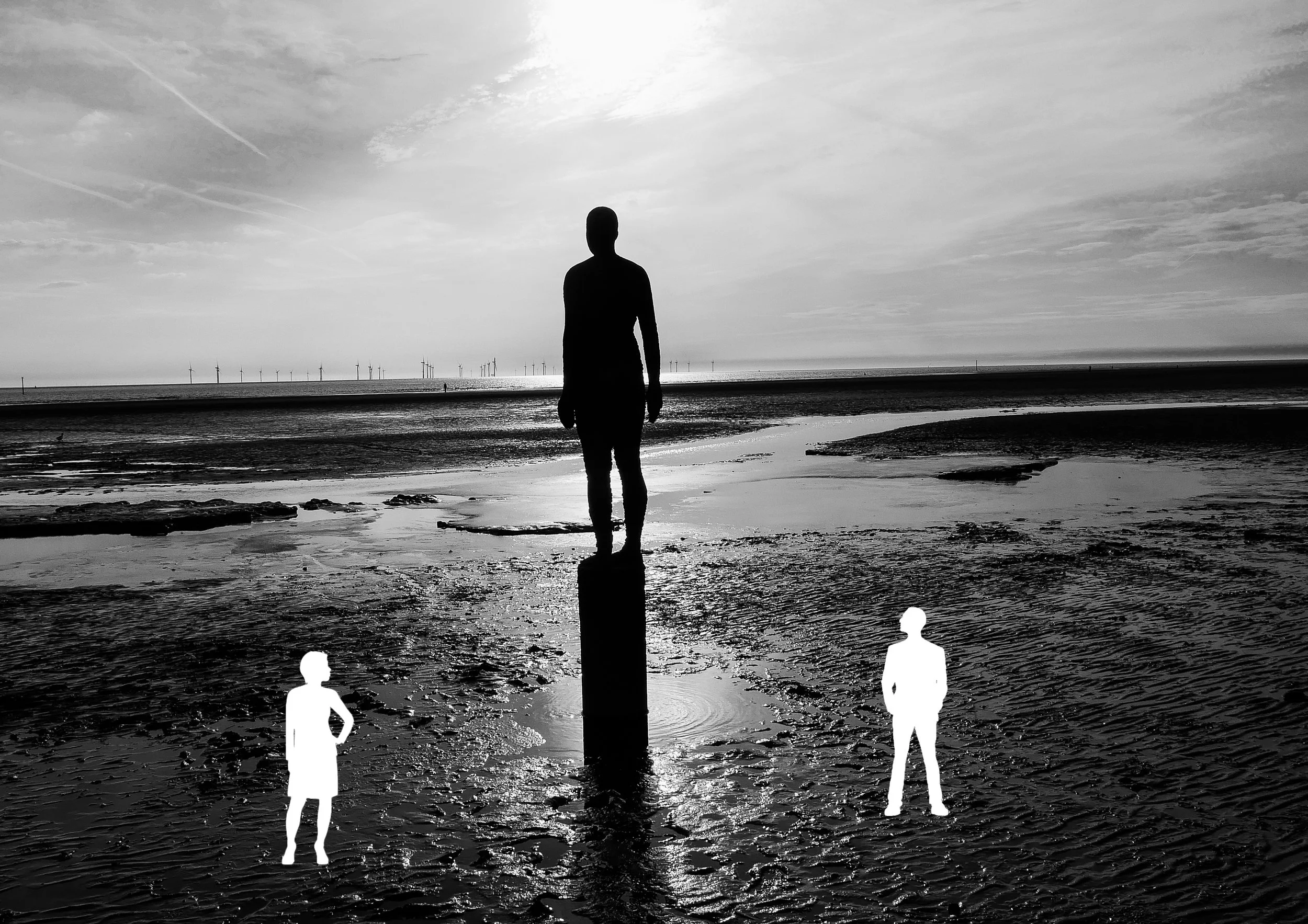
This framed black-and-white photograph presents a striking, minimalist scene that captures a sense of solitude and modern artistry. The central focus is a lone figure standing atop a post, silhouetted against a vast, shimmering coastal landscape.
Composition and Subject
The image features a high-contrast aesthetic, likely captured at Crosby Beach in Liverpool, home to Antony Gormley’s famous "Another Place" installation.
The Silhouette: The dark figure stands rigid and upright, serving as a vertical anchor in an otherwise wide, horizontal landscape.
The Foreground: The beach appears wet and textured, reflecting the bright sky and creating a metallic, high-shine effect on the sand.
The Cutouts: There are two bright white, person-shaped silhouettes added to the foreground. These stark, flat shapes contrast sharply with the detailed, photographic background, adding a surreal or graphic-design element to the piece.
Mood and Atmosphere
The use of monochrome enhances the contemplative and atmospheric quality of the print. The bright sky, with light breaking through the clouds, creates a "path" of light on the water and sand that leads the eye directly to the central figure.
Solitude: The vastness of the horizon and the stillness of the figure evoke feelings of isolation or quiet reflection.
Modern Framing: The piece is presented in a clean, black frame with a wide white mat (mount), which focuses the viewer's attention and gives the artwork a gallery-ready, contemporary look.
Potential Interpretations
The inclusion of the white cutouts alongside the realistic silhouette suggests a dialogue between the digital and the physical, or perhaps a representation of "missing" people. It transforms a standard landscape photograph into a piece of conceptual art.
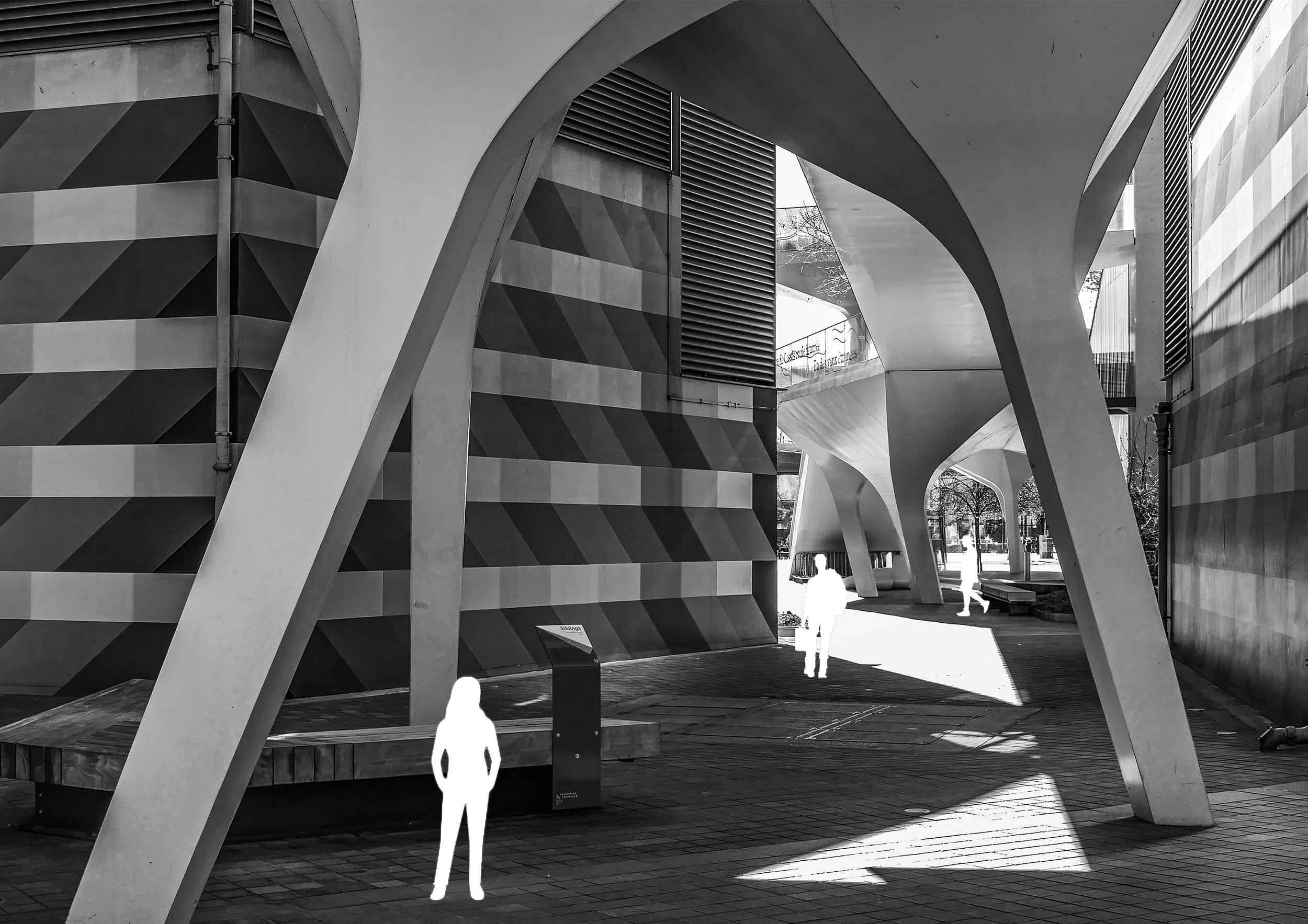
This striking black-and-white print captures a unique perspective of the North Greenwich Peninsula in London, an area world-renowned for its bold, futuristic architecture and its proximity to the O2 Arena.
The image focuses on the interplay between organic, flowing structures and the rigid, geometric patterns of the surrounding urban landscape.
Visual Analysis
The composition is a study in contrast and geometry:
The "Tide" Influence: The prominent, sweeping white columns are part of The Tide, London's first elevated linear park designed by Diller Scofidio + Renfro (the same architects behind New York’s High Line). These "islands" of structure provide a soft, sculptural counterpoint to the sharp edges of the buildings.
Geometric Patterns: The background features the distinctive "zig-zag" or chevron-patterned cladding of the Optic Cloak or nearby energy centers. This creates a rhythmic, almost optical-illusion effect that adds depth and texture to the frame.
Human Elements: The silhouettes of people—rendered as stark white cutouts—transform the image from a standard architectural photograph into a piece of surrealist art. They emphasize the scale of the architecture while adding a ghostly, ethereal quality to the public space.
Mood and Style
By stripping away color, the print emphasizes form, light, and shadow. The high-contrast black-and-white treatment highlights the bright sunlight hitting the pavement, creating sharp, angular shadows that mirror the shapes of the structures above. It feels modern, clean, and slightly cinematic—evoking the feeling of a quiet moment in a busy metropolis.
Why It Works for Decor
Modern Sophistication: The monochromatic palette makes it an incredibly versatile piece for contemporary interiors, particularly those with minimalist or industrial aesthetics.
Architectural Interest: For those who love London or urban design, it’s a sophisticated nod to the city’s constant evolution beyond its historic landmarks.
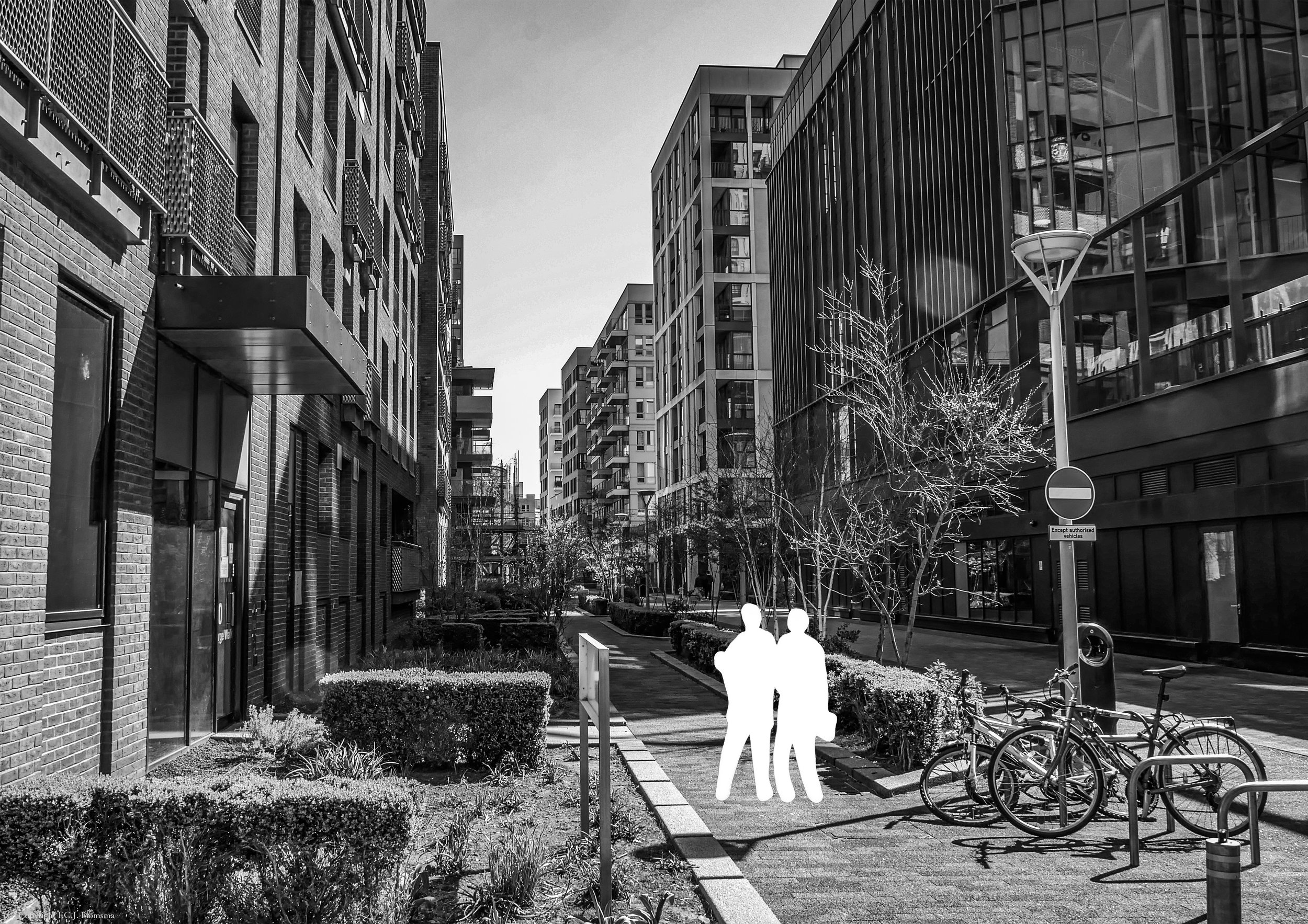
This framed black-and-white print captures the modern, architectural spirit of North Greenwich, London. It focuses on the pedestrian-friendly corridors and sleek residential developments that have transformed the Greenwich Peninsula into a hub of contemporary design.
Composition and Style
The image utilizes a dramatic one-point perspective, with the lines of the buildings, the sidewalk, and the manicured hedges all converging toward a distant vanishing point. This creates a strong sense of depth and guides the eye through the urban canyon.
Architectural Contrast: The photo highlights the juxtaposition between the textured brickwork of the residential blocks on the left and the glass-heavy, industrial-modern aesthetic of the buildings on the right.
The "Silhouetted" Figures: The most striking element is the white, cut-out silhouettes of two people walking. This artistic choice strips away individual identity, making the figures feel like "everyman" characters navigating a clean, futuristic landscape.
Urban Details: The inclusion of parked bicycles and the minimalist street lamp grounds the scene in the reality of London’s high-density, eco-conscious living.
The Atmosphere
The high-contrast black-and-white edit emphasizes texture and geometry. Without the distraction of color, the viewer focuses on the patterns of the windows, the shadows cast by the buildings, and the organized greenery of the planters. It portrays North Greenwich as a calm, orderly, and sophisticated environment—a departure from the historical bustle of Greenwich Village nearby.
Display Tips
Because of its monochrome palette and clean lines, this print would work exceptionally well in:
Minimalist Offices: To inspire a sense of structure and modern progress.
Industrial Lofts: Complementing materials like concrete, steel, and exposed brick.
Gallery Walls: It acts as a perfect "anchor" piece when paired with more colorful or abstract works.
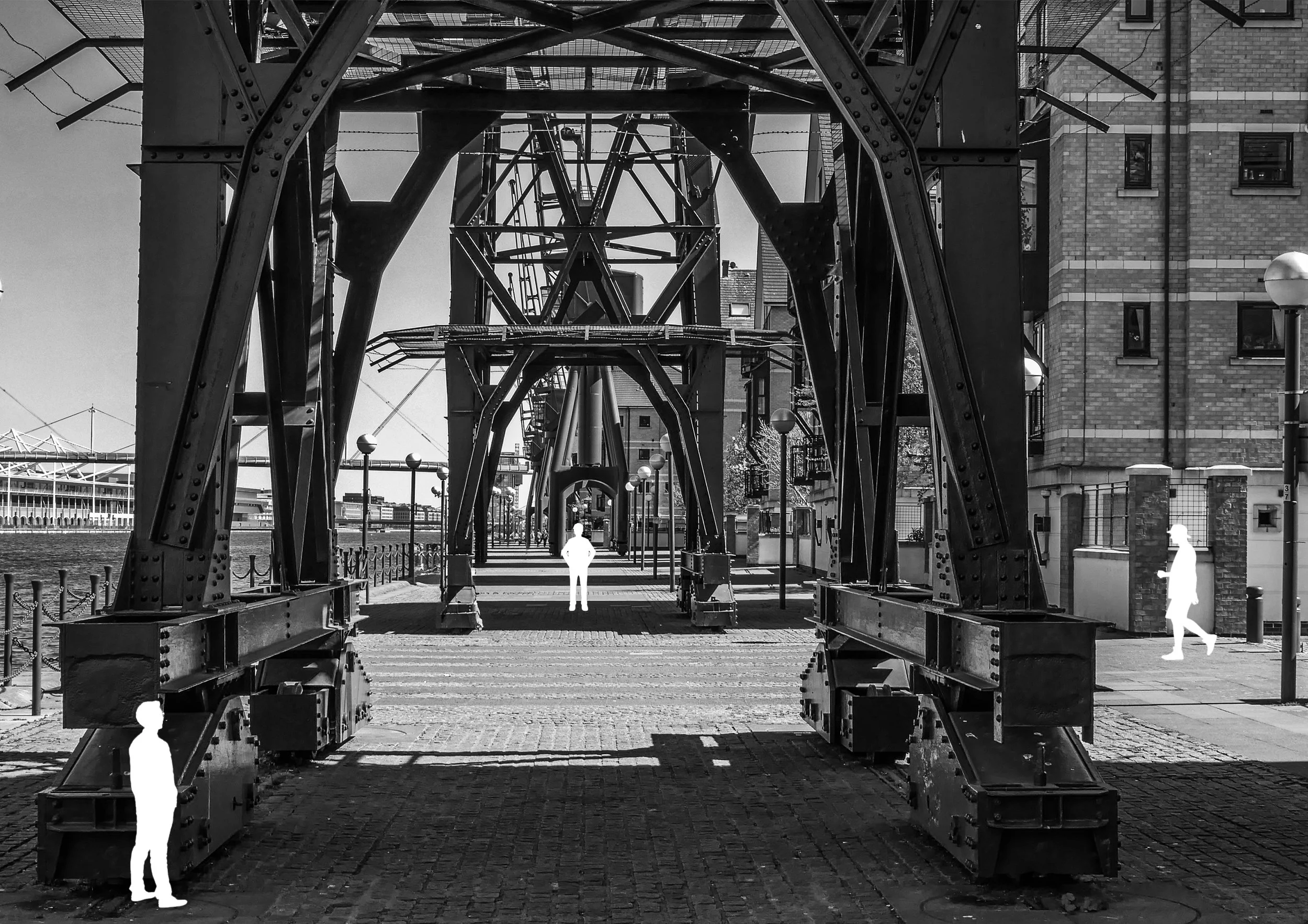
This striking black-and-white print captures a unique perspective of the industrial heritage at North Greenwich, specifically the massive legs of the historic cranes that line the Royal Victoria Dock (located just across the water from the O2/Greenwich Peninsula).
The image is a study in geometry, contrast, and the relationship between human presence and urban scale.
Visual Analysis
1. Architectural Symmetry
The composition utilizes the massive steel structure of a "Stothert & Pitt" crane to create a one-point perspective. The repetitive triangular bracing of the crane legs draws the viewer’s eye deep into the frame, creating a tunnel-like effect that feels both monumental and grounded.
2. The "Ghost" Figures
The most distinctive element of this print is the use of stark white silhouettes in place of people.
Contrast: These bright, detail-free shapes pop against the gritty, textured grays of the steel and cobblestones.
Thematic Depth: By stripping away the identity of the figures, the artist emphasizes the scale of the environment. The people appear as "ghosts of the docklands," perhaps a nod to the area’s transition from a bustling industrial hub to a modern residential and leisure district.
3. Texture and Tone
The high-contrast black-and-white treatment highlights the industrial textures:
The rivets and weathered plates of the steelwork.
The patterned cobblestones of the walkway.
The modern brickwork of the background buildings, providing a timeline of London’s architectural evolution.
The Setting: North Greenwich / Royal Docks
While these specific cranes are iconic to the Royal Victoria Dock area (accessible via the IFS Cloud Cable Car from North Greenwich), they represent the broader aesthetic of East London’s riverside. This area has been transformed from the world’s largest enclosed docks into a space where industrial skeletons are preserved as public art.
Why it Works as a Print
Modern Minimalism: The clean lines and white silhouettes make it a versatile piece for contemporary interiors.
Sense of Place: For anyone who has walked the Thames Path or visited the Excel Centre area, the image evokes a strong sense of London’s "New East."
Framing: The thick black frame and white matting (as shown in your image) complement the monochromatic theme, making the blacks in the photograph appear deeper and more impactful.
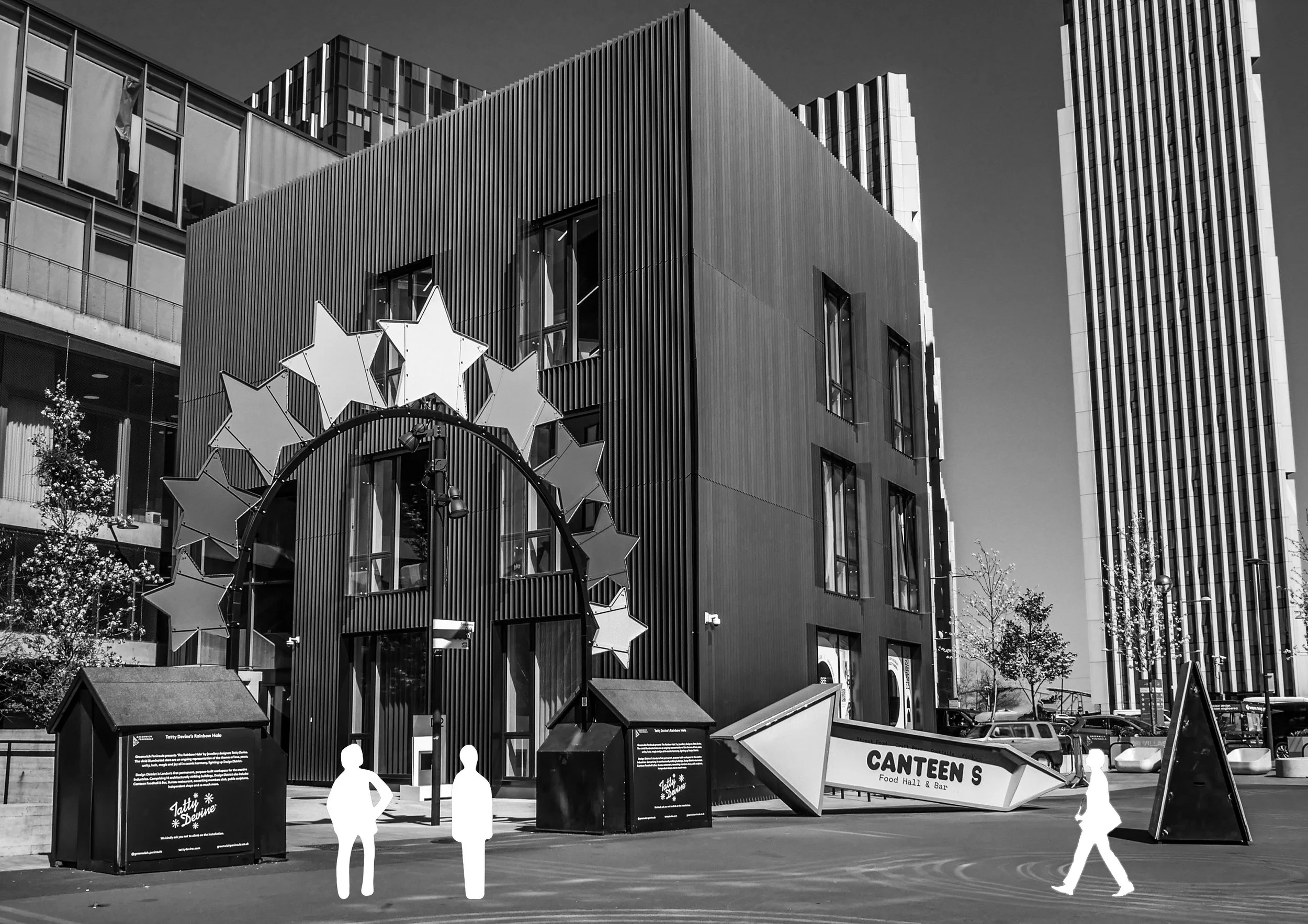
This striking black-and-white print captures the modern, artistic energy of North Greenwich, specifically the area around the Design District and the O2 Arena.
The image highlights the intersection of bold architecture and graphic street art, creating a scene that feels both futuristic and grounded in London’s urban evolution.
Key Features of the Print
Architectural Contrast: The central corrugated building, with its sharp angles and vertical lines, represents the innovative spirit of the Greenwich Peninsula. In the background, the soaring verticality of the residential towers provides a sense of scale and depth.
The "Canteen" Arch: The star-studded archway is a recognizable landmark for visitors to Canteen Food Hall & Bar. It acts as a whimsical frame within the photograph, drawing the eye toward the center of the composition.
Minimalist Figures: The use of white, silhouette-style cutouts for the people adds a surreal, high-contrast element. It strips away individual detail to focus on the human movement and flow through the space, making the viewer feel like an observer of a "living" architectural model.
Monochrome Palette: By removing color, the photographer emphasizes texture and form. The play of light on the metal siding and the harsh shadows on the pavement give the piece a sophisticated, cinematic quality.
Atmosphere and Style
This print perfectly encapsulates the "new" London—clean, curated, and intentionally designed. It would be a great fit for an interior that favors Industrial, Scandi, or Modernist styles. The black frame with the white mat (passe-partout) enhances the "gallery" feel, making the dark tones of the building pop.
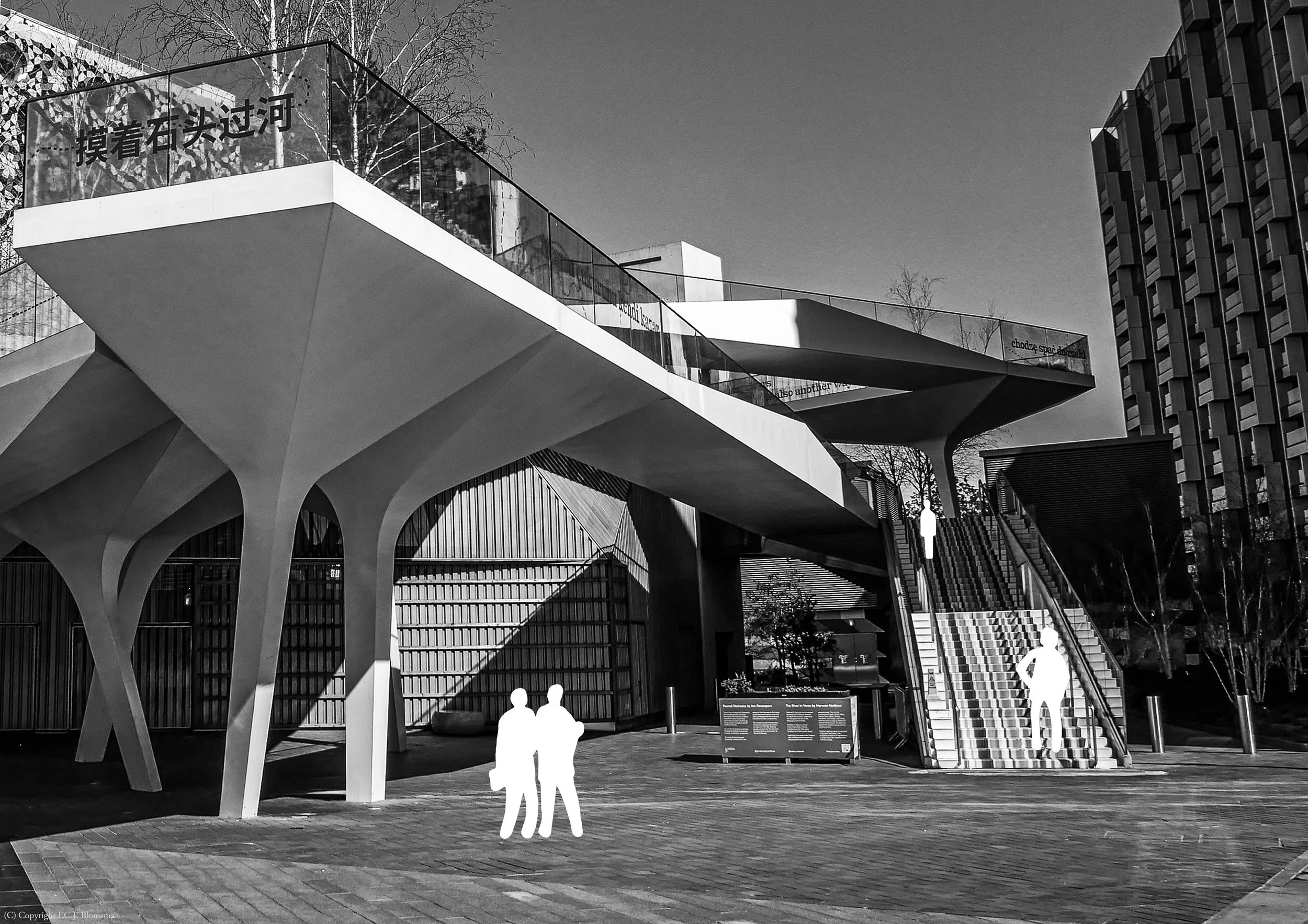
This print is a striking black-and-white architectural study that blends modern design with a surrealist touch. The image captures a complex, multi-level elevated walkway likely part of an urban development or transport hub—defined by sharp angles, sweeping concrete supports, and glass balustrades.
Key Visual Elements
Architectural Brutalism: The structures are characterized by organic yet stark concrete "piers" that fan out to support the walkways. The high-contrast black and white emphasizes the geometry and the interplay of deep shadows against bright, sunlit surfaces.
Surreal Figures: The most distinctive feature is the treatment of the human figures. Rather than being photographed normally, they appear as stark white silhouettes (two walking in the foreground and one ascending the stairs). This "ghostly" effect strips away individual identity, turning the people into symbols of scale or anonymous urban wanderers.
Cultural Context: On the glass railing of the upper deck, there is Chinese text: “摸着石头过河” (mōzhe shítou guò hé). This translates to "Crossing the river by feeling the stones," a famous metaphorical phrase often associated with pragmatic reform and navigating unknown territory.
Artistic Impression
The composition creates a sense of quietude and isolation despite the grand scale of the environment. The juxtaposition of the modern, perhaps even futuristic, architecture with the traditional Chinese proverb suggests a dialogue between rapid physical progress and the careful, step-by-step nature of human experience.
The framing (a thick black frame with a white mat) enhances the "gallery" feel of the piece, making it a sophisticated choice for minimalist or modern interior decor.
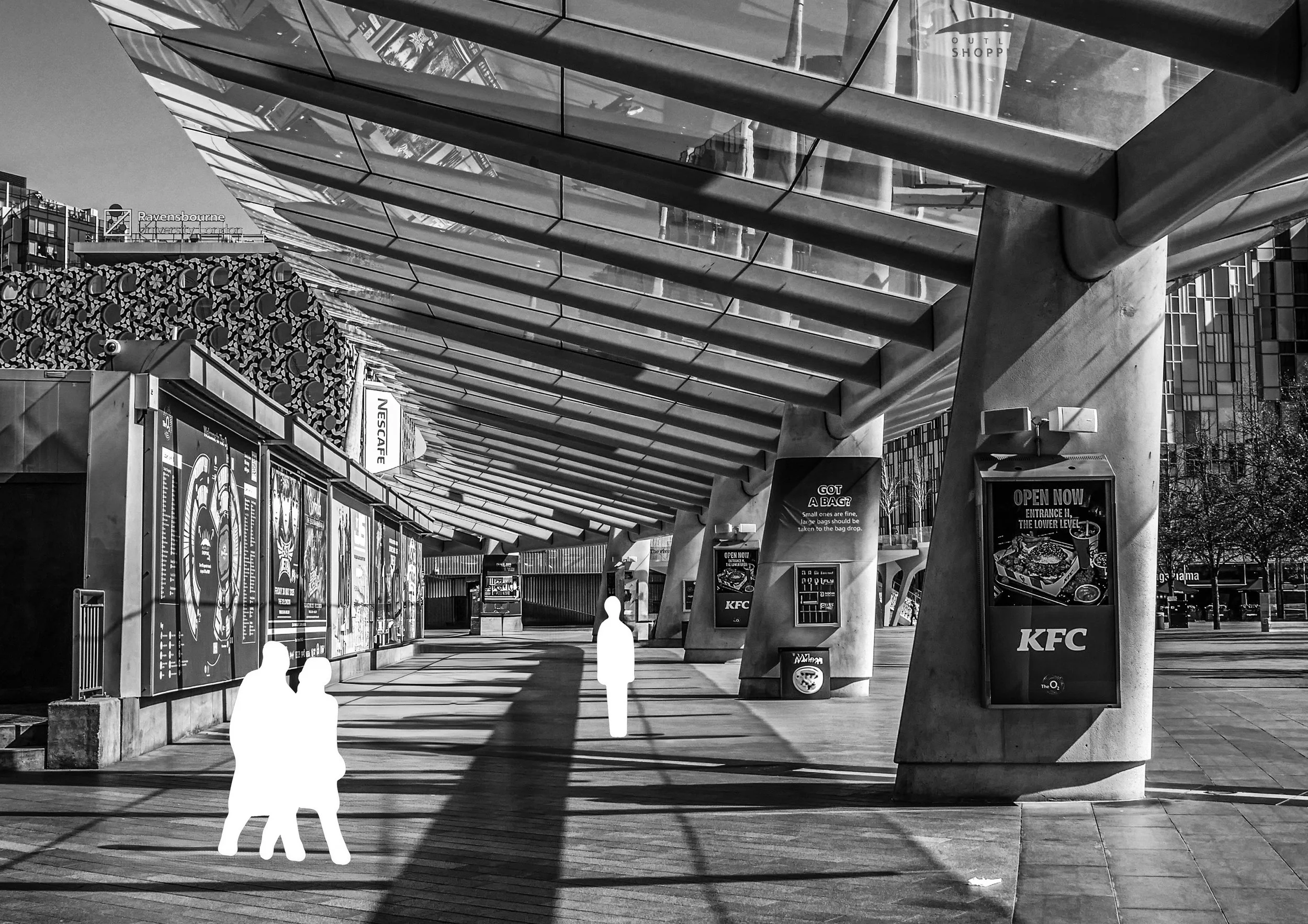
This striking monochrome print captures the architectural grandeur of the North Greenwich Transport Interchange in London. Specifically, it highlights the iconic glass-and-steel canopy of the bus station, designed by Foster + Partners, which serves as the gateway to the O2 Arena and the North Greenwich Underground station.
Architectural Context
The print emphasizes the dramatic, rhythmic geometry of the station's exterior.
The Canopy: The soaring glass roof is held up by raked concrete columns. In this black-and-white treatment, the interplay of light and shadow creates a "slashed" pattern across the pavement, mirroring the structural ribs above.
The Vibe: While the interior of the station (designed by Will Alsop) is famous for its vibrant "Jubilee Blue" tiles, this print strips away the color to focus on form and texture. It transforms a busy transit hub into a minimalist, almost cinematic landscape.
Artistic Interpretation
The most unique feature of this specific print is the treatment of the figures:
Negative Space Silhouettes: The people in the frame are rendered as solid white cutouts. This artistic choice turns everyday commuters into "ghosts" or anonymous observers, emphasizing the scale of the architecture over the individuals within it.
The "Framed" Aesthetic: The composition uses the dark structural pillars and the heavy black frame to create a "picture within a picture," drawing your eye down the long perspective of the walkway toward the horizon.
Why It Works
This piece is a favorite for lovers of London architecture and minimalist street photography. It captures the "Space Age" optimism of the Greenwich Peninsula—originally developed for the Millennium celebrations—and reimagines it as a timeless, high-contrast study in perspective.
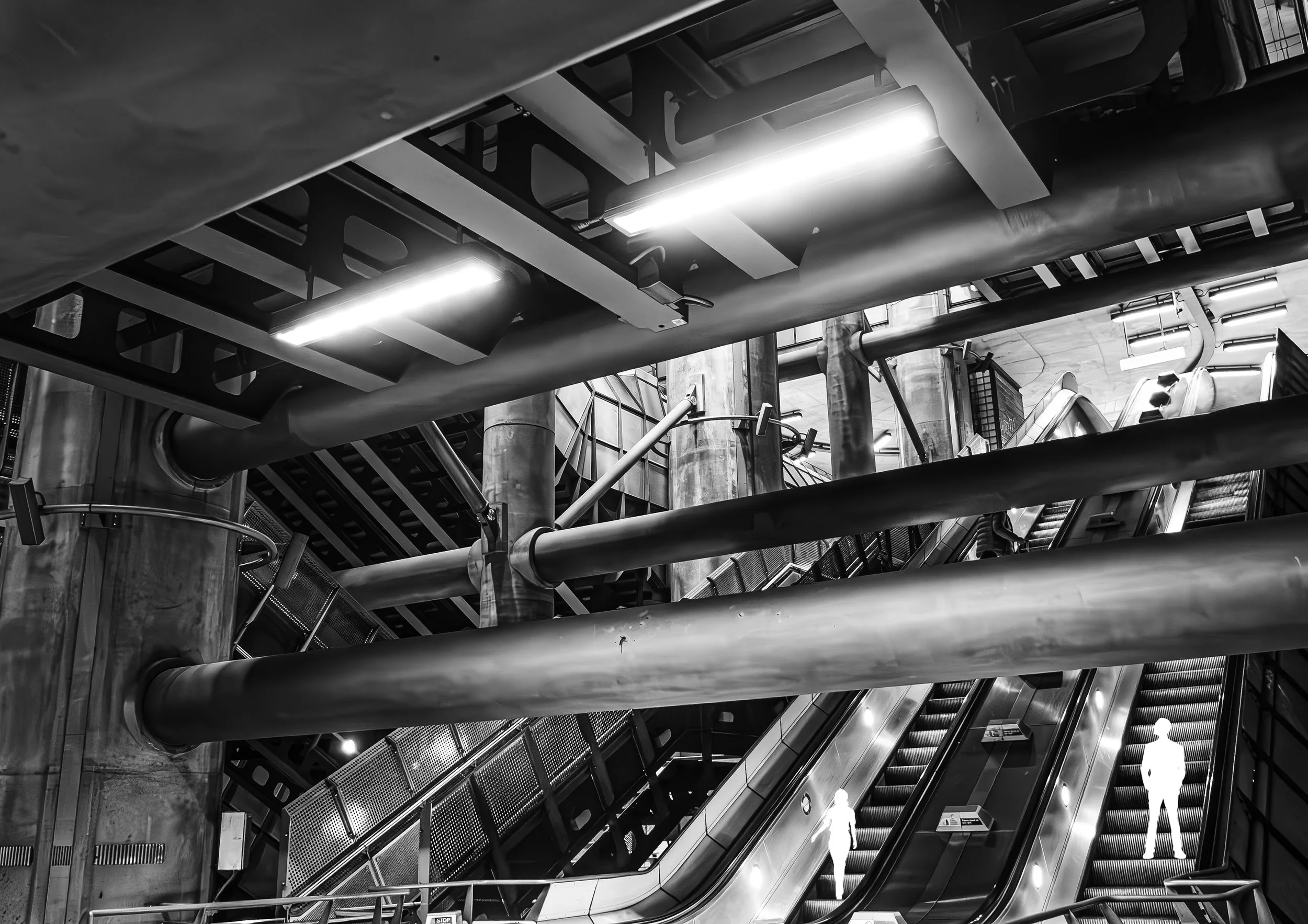
This striking black-and-white print captures the subterranean "brutalist" grandeur of Westminster Station in London, specifically the Jubilee Line extension designed by Hopkins Architects.
Opened in 1999, this part of the station is famous for its vast, cavernous design that looks more like a sci-fi film set or an industrial powerhouse than a typical subway stop.
Key Visual Elements
Industrial Scale: The image highlights the massive concrete beams and giant steel "buttress" tubes. These aren't just for show—they are structural necessities designed to support the immense weight of the buildings above (including Portcullis House) while keeping the station hollowed out and open.
The Contrast of Light: The use of monochrome emphasizes the play between the harsh artificial glow of the linear light fixtures and the deep, metallic shadows of the escalator shafts.
Human Scale: Note the white, silhouette-like figures on the escalators. They provide a vital sense of scale, showing just how dwarfed commuters are by the sheer magnitude of the engineering.
Leading Lines: The diagonal lines of the escalators and the horizontal thrust of the piping create a sense of constant movement and architectural depth.
Why This Print Works
This piece is a celebration of High-Tech Architecture. By stripping away color, the focus shifts entirely to texture—the coldness of the steel, the roughness of the concrete, and the geometric precision of the trusses. It transforms a daily commute into a dramatic, atmospheric experience.
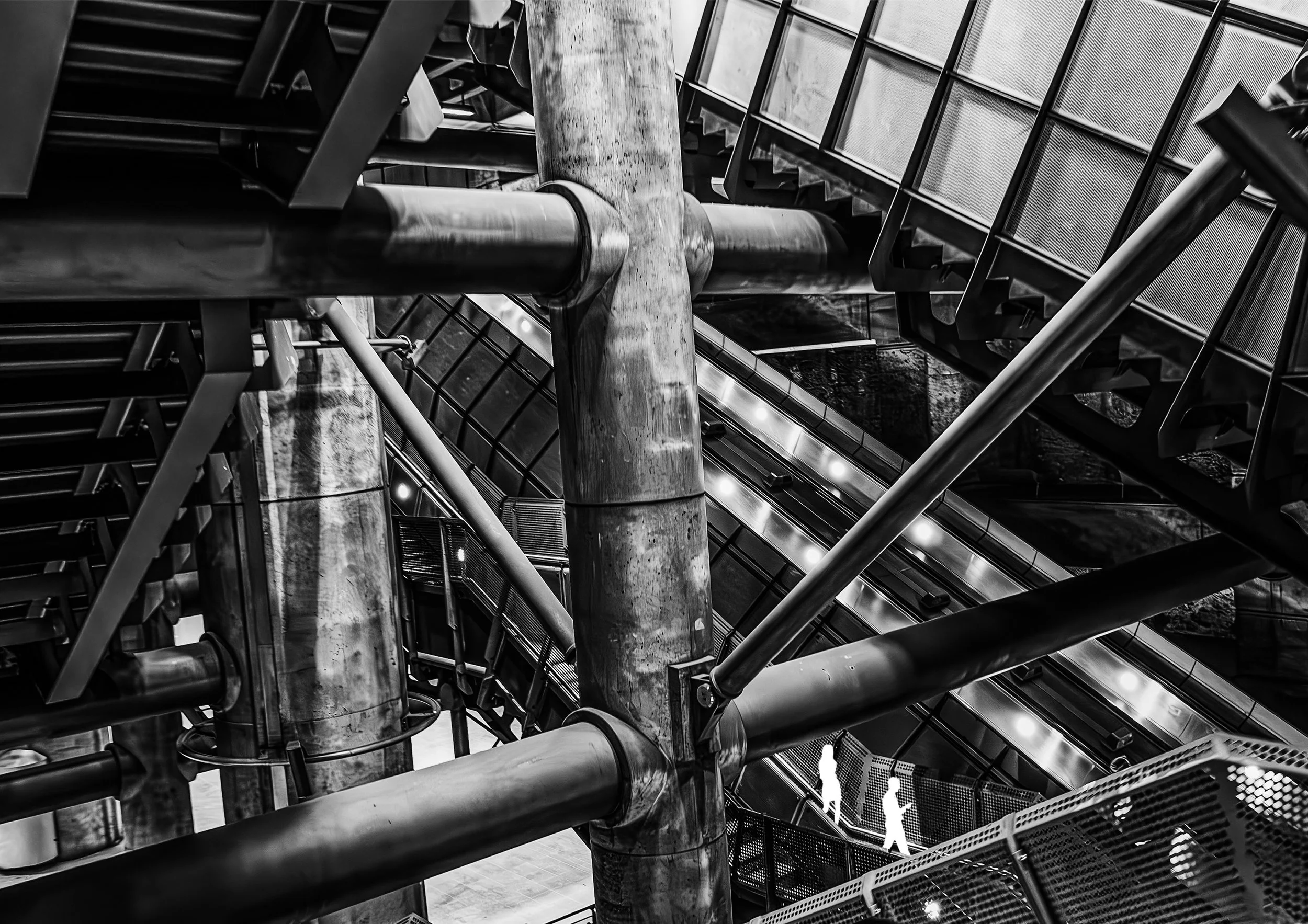
This framed print captures the industrial, almost cinematic atmosphere of Westminster Underground Station in London. Often described as "Brutalist" or "dystopian," the station's architecture is a celebrated example of high-tech engineering.
The Architecture: Michael Hopkins' Masterpiece
Designed by Hopkins Architects (led by Michael Hopkins) and completed in 1999 as part of the Jubilee Line Extension, the station is famous for its "box" design. This print highlights several key architectural features:
The "Station Box": To create the station, engineers excavated one of the deepest voids in central London (about 39 meters deep). The result is a massive, cathedral-like underground cavern.
Exposed Structural Elements: Unlike most tube stations that hide their workings behind tiles or panels, Westminster celebrates its skeleton. The large cylindrical pillars and diagonal "diagrid" beams you see in the print aren't just for show—they provide the lateral support needed to keep the walls of the box from collapsing inward.
Portcullis House Foundations: Interestingly, some of the massive columns visible in the station actually serve as the foundations for Portcullis House, the parliamentary office building located directly above the station.
Artistic Style and Mood
The choice of black and white photography emphasizes the textures of the materials:
The Concrete: The rough-hewn, bush-hammered concrete walls provide a "tough" backdrop.
The Steel: The sleek, metallic sheen of the escalators and support pipes creates a futuristic contrast against the heavy concrete.
The Scale: By including small, ghostly figures of commuters on the escalators, the print emphasizes the sheer, overwhelming scale of the engineering.
The composition feels reminiscent of Piranesi’s Carceri (Prisons)—an 18th-century series of etchings featuring vast, labyrinthine structures—or perhaps a scene from a science fiction film like Blade Runner.
This print serves as a striking reminder of how infrastructure can be transformed into a work of art.
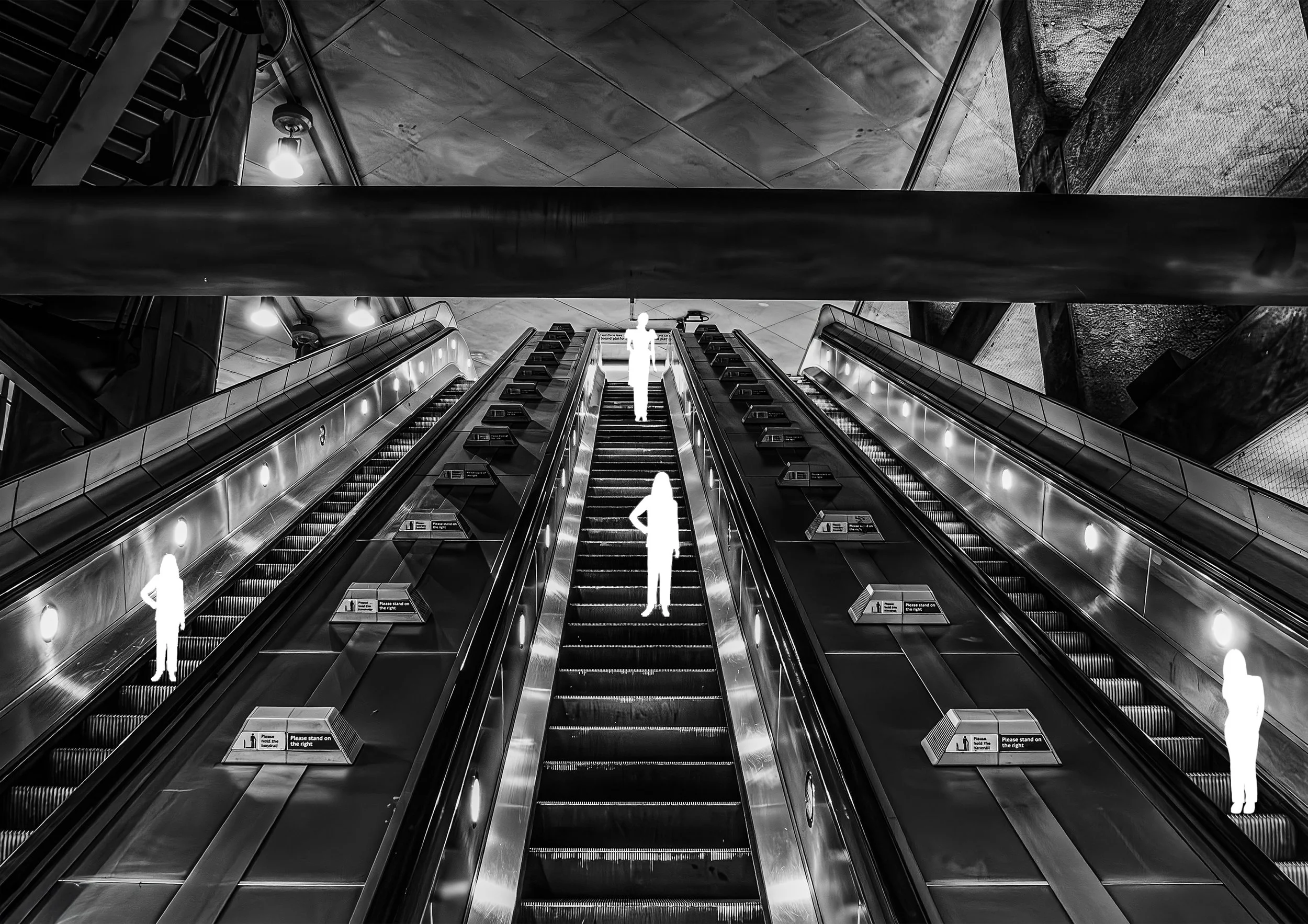
This striking black-and-white print offers a surreal, high-contrast take on urban transit. It captures an upward-facing perspective of multiple escalators—likely within the London Underground, given the iconic "Stand on the Right" signage—but transforms a mundane commute into a ghostly, architectural study.
Visual Analysis
The image is defined by a heavy industrial aesthetic and a unique digital intervention:
Symmetry and Scale: The composition uses strong converging lines that pull the viewer's eye toward a central vanishing point at the top of the stairs. The massive cross-beams and textured ceiling add a sense of weight and enclosure.
The "Silhouettes": The most arresting feature is the treatment of the commuters. Rather than natural figures, they appear as stark white, featureless cutouts. This stylistic choice strips away their individuality, turning them into glowing avatars that haunt the mechanical space.
Monochrome Palette: By removing color, the artist emphasizes the metallic textures, the rhythmic patterns of the escalator steps, and the interplay between deep shadows and artificial light.
Mood and Themes
The print evokes several powerful themes common in contemporary urban photography:
Urban Anonymity: The glowing white figures represent the "ghosts" of the city—people who occupy the same space but remain entirely disconnected and anonymous to one another.
Man vs. Machine: The scale of the escalators and the heavy industrial beams dwarf the human figures, highlighting the massive infrastructure required to move populations through a metropolis.
Modern Isolation: Despite being in a public hub, there is a profound sense of solitude. Each figure stands alone on their own path, encased in a vacuum of light.
Framing and Display
The piece is presented in a black gallery frame with a wide white mat (mount). This professional framing provides "breathing room" for the dark, dense image, making the blacks appear deeper and the white silhouettes pop with more intensity. It is a sophisticated choice for a modern interior, particularly one with a minimalist or industrial design.
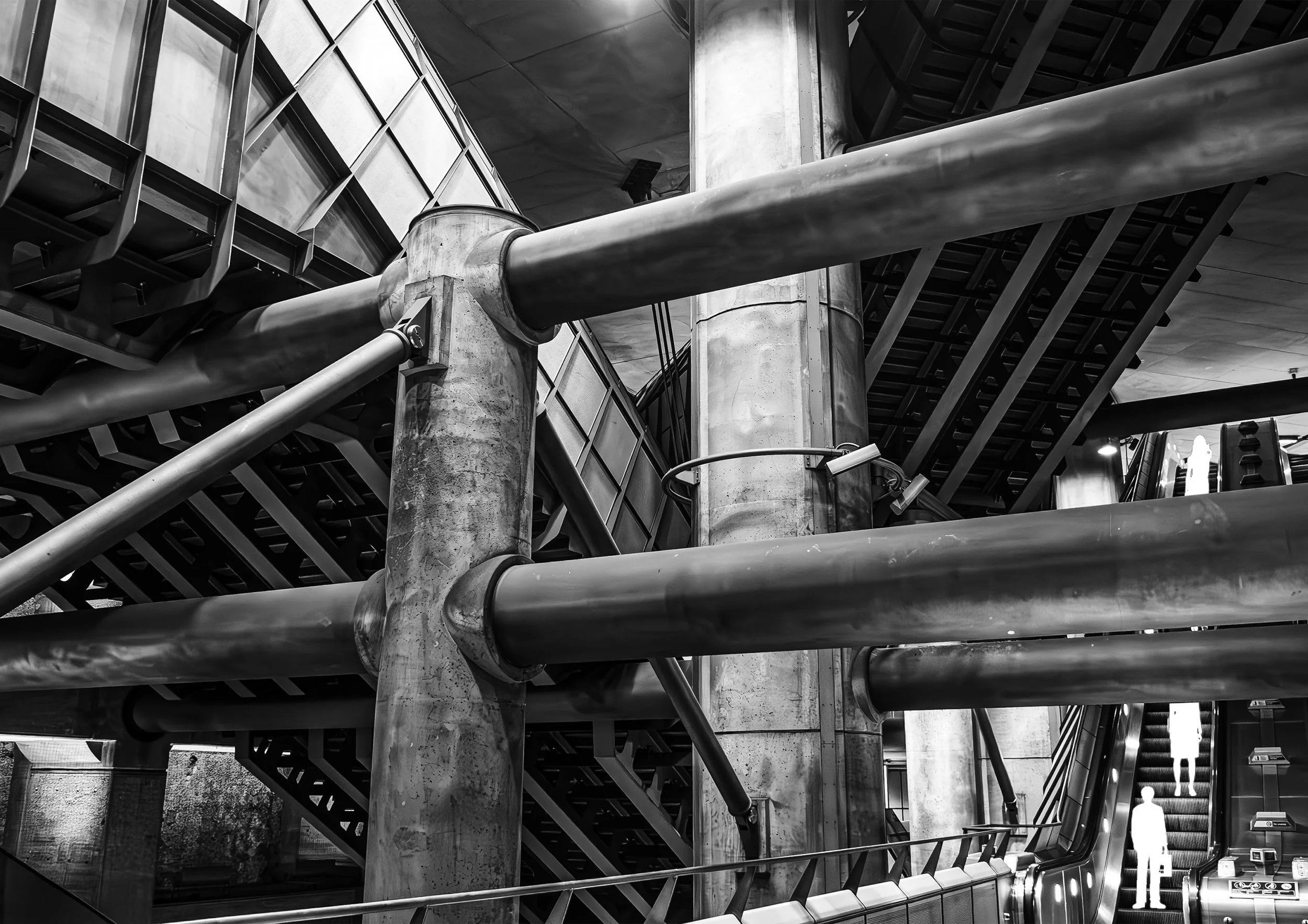
This striking black-and-white print captures the raw, industrial soul of modern transit architecture. The image features a complex network of heavy-duty support beams and massive cylindrical columns, likely within a major metropolitan train station.
Visual Narrative
The photograph thrives on geometric tension. The diagonal thrust of the piping and structural supports creates a sense of dynamic movement, echoing the constant flow of commuters. The high-contrast monochrome palette emphasizes the textures of the concrete and metal, making the scene feel both monumental and slightly gritty.
Key Compositional Elements
Industrial Brutalism: The sheer scale of the columns and the "bolted-together" aesthetic highlight the functional beauty of modern engineering.
The Human Element: In the lower-right quadrant, ghostly, overexposed figures appear on an escalator. These "light-forms" provide a stark contrast to the heavy, dark shadows of the architecture, suggesting the fleeting nature of people passing through a permanent, iron-clad space.
Vanishing Lines: The intersecting pipes guide the viewer's eye across the frame, creating a deep sense of three-dimensional space within a two-dimensional print.
Artistic Impact
This piece is ideal for a space that celebrates contemporary urbanism or minimalist design. It transforms a mundane piece of infrastructure into a dramatic study of light and form. It doesn't just show a station; it captures the "weight" of the city.
Note on Framing: The use of a thick black frame with a wide white mat (as shown) provides "breathing room" for the busy composition, focusing the viewer’s attention on the intricate details of the metalwork.
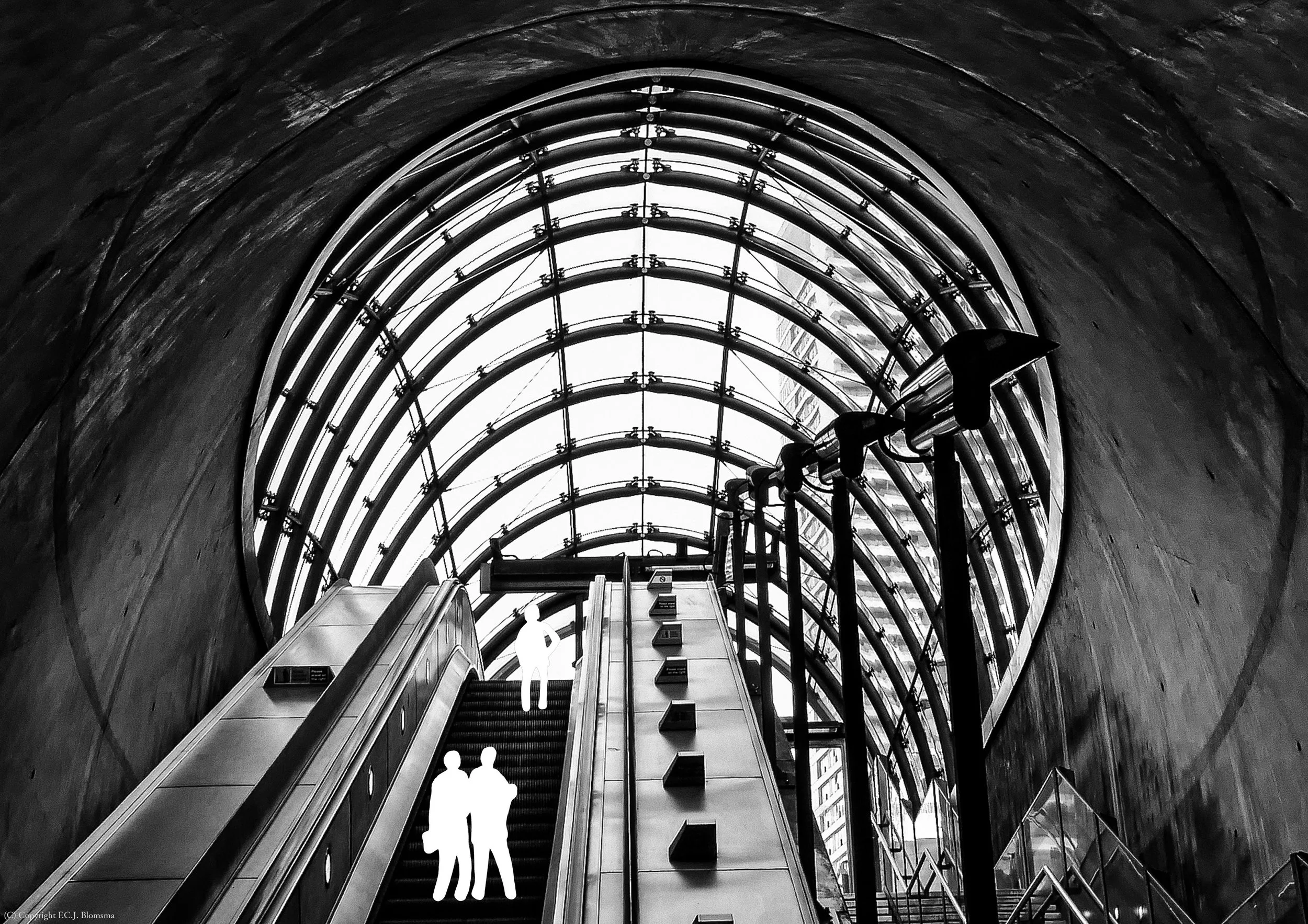
This striking black-and-white print captures a moment of modern urban transit, likely at the Canary Wharf Jubilee Line station in London. The piece blends architectural precision with a ghostly, surrealist touch, making it a compelling choice for contemporary interior design.
Composition and Style
The image is anchored by a powerful central perspective. The arched, ribbed glass canopy creates a "tunnel" effect that draws the eye upward and outward toward the light. The high contrast of the monochrome palette emphasizes the textures of the cold concrete walls against the intricate geometry of the steel and glass.
Key Artistic Elements
The Silhouette Effect: The most arresting feature is the treatment of the commuters. By rendering the figures as solid, glowing white silhouettes, the artist strips away their individuality. This turns them into universal symbols of the "urban ghost"—the anonymous people we pass every day in transit.
Geometric Rhythm: The repetitive lines of the escalator steps and the vaulted ceiling create a sense of mechanical rhythm and order, reflecting the structured nature of city life.
Atmosphere: There is a tension between the massive, heavy architecture and the weightless, ethereal appearance of the people. It feels both futuristic and slightly haunting.
Framing and Presentation
The print is showcased in a modern black frame with a wide white mat. This presentation does two things:
Enhances Contrast: The white matting allows the deep blacks of the concrete to pop, preventing the image from feeling too dark on a wall.
Gallery Aesthetic: The clean lines of the frame mirror the architectural lines within the photo, giving the piece a professional, curated feel suitable for a home office, hallway, or minimalist living room.
Design Tip: Because of its strong vertical lines and "vanishing point," this piece works exceptionally well at the end of a hallway or above a console table to create a sense of added depth in a room.
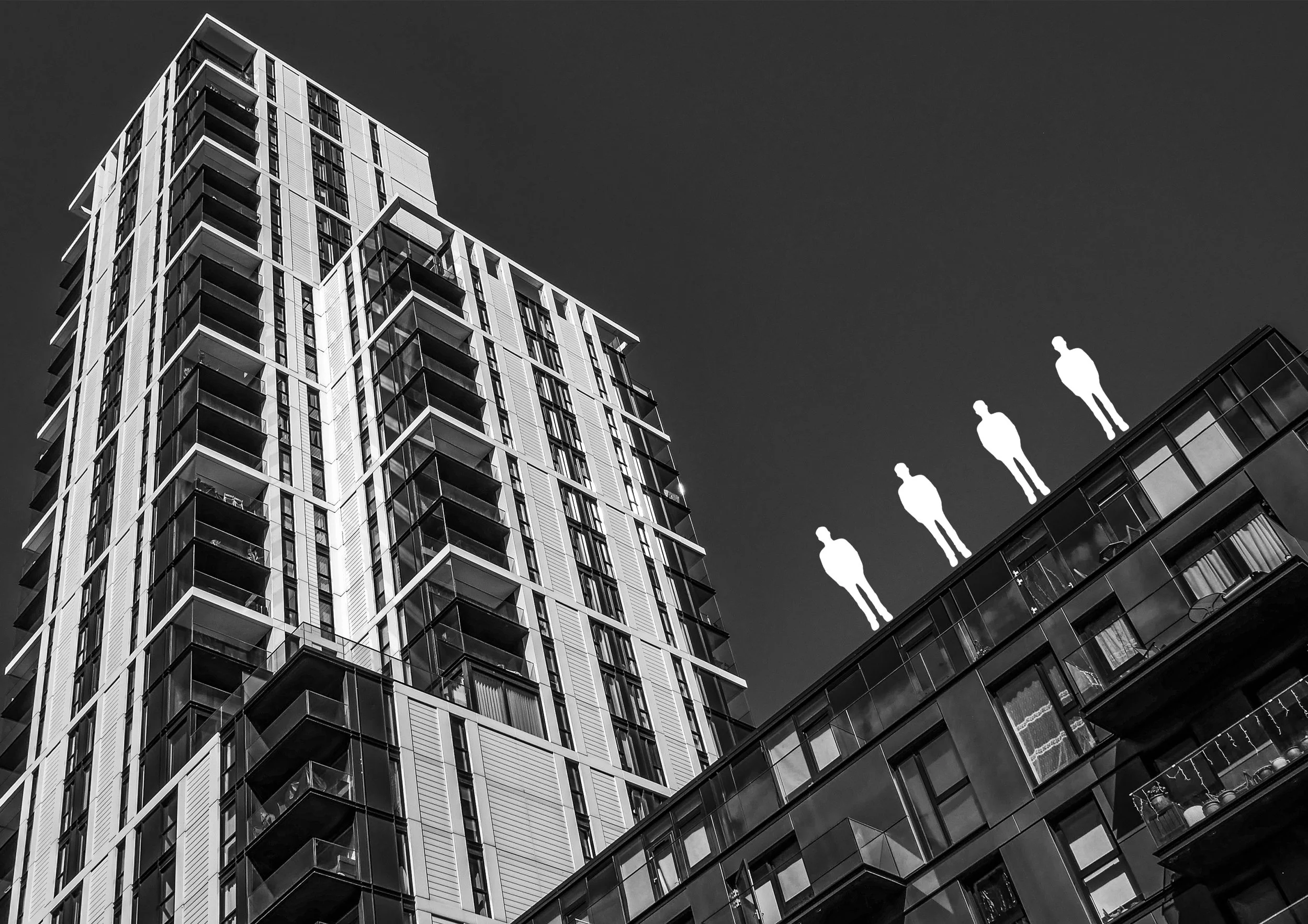
This striking black-and-white print captures a surreal, minimalist moment within an urban landscape. By stripping away color, the image emphasizes the geometric precision of the architecture and the stark contrast between the physical world and the ethereal figures perched upon it.
Visual Breakdown
Architecture: The composition features two contrasting buildings. On the left, a tall, modern skyscraper with repetitive glass balconies reaches toward the sky, creating a sense of verticality and order. To the right, a darker, lower-profile building provides a solid base for the focal point.
The Figures: The most captivating element is the row of four glowing, white silhouettes standing on the edge of the rooftop. Their minimalist, featureless forms give them an otherworldly quality—appearing as "beings of light" or ghosts within the machine of the city.
Contrast and Tone: The deep, near-black sky creates a heavy negative space that makes both the buildings and the white figures pop. This high-contrast approach gives the print a "Noir" or "Cyberpunk" aesthetic.
Themes and Interpretation
The print evokes a sense of urban solitude and the intersection between humanity and the monolithic structures we inhabit. It asks the viewer to consider:
Presence vs. Absence: Are these figures protectors of the city, or are they representative of the "invisible" people living within it?
Modernity: The sharp lines and cold materials of the buildings reflect the efficiency of modern life, while the organic (though stylized) shapes of the figures introduce a touch of mystery.
Perfect For...
This piece is an excellent choice for a contemporary living space, a minimalist office, or an entryway. It bridges the gap between architectural photography and surreal digital art, making it a versatile conversation starter.
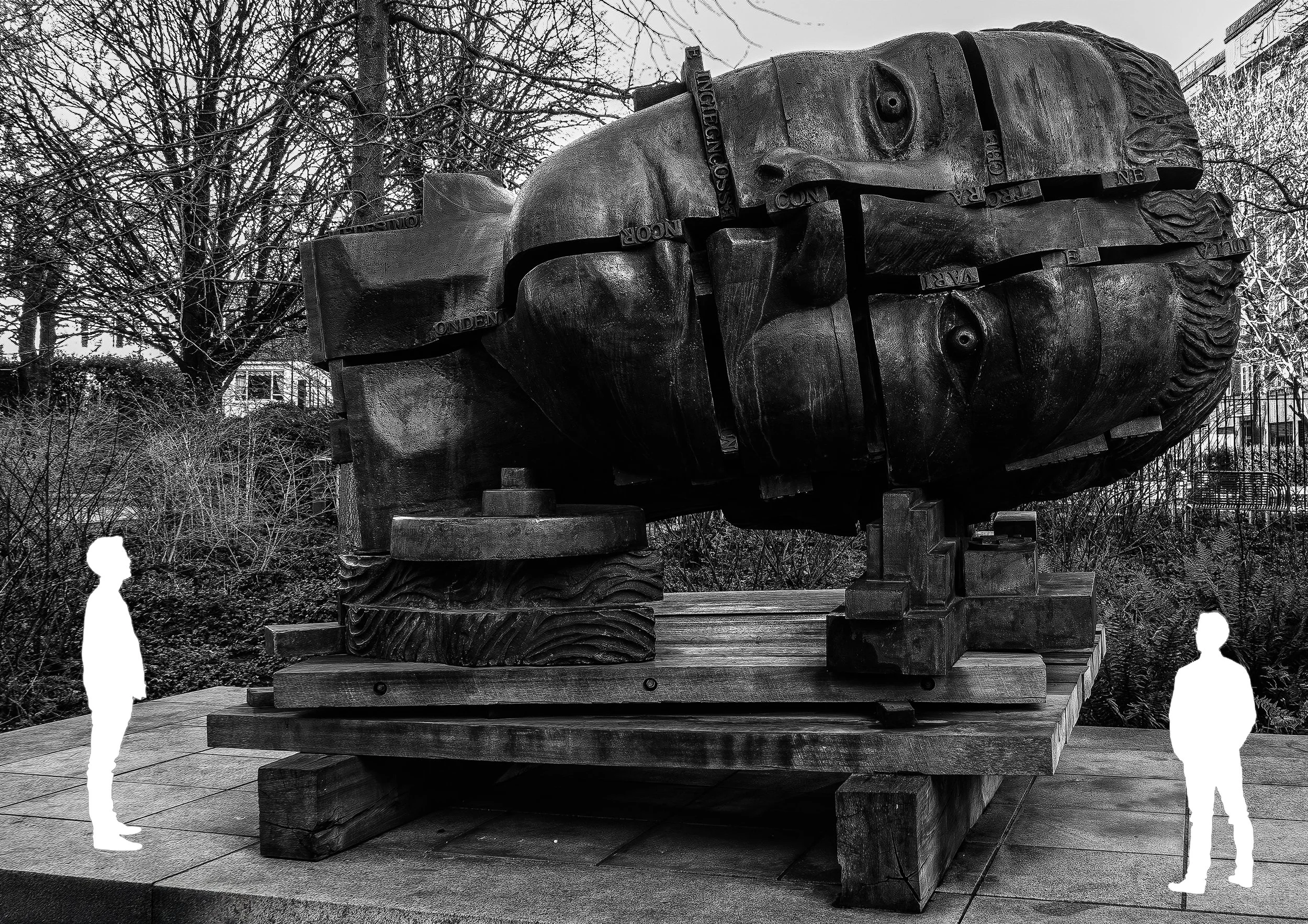
This striking monochrome print captures a sense of modern antiquity, blending classical sculpture with industrial deconstruction. The piece is a study in scale, texture, and the fragmentation of the human identity.
Visual Breakdown
The central focus is a massive, bronze-like sculptural head, resting horizontally on a heavy timber plinth. The head is not a solid mass but is fragmented into horizontal slices, held together by internal structural supports. This "deconstructed" look suggests a person being examined, dismantled, or perhaps struggling to stay whole.
Scale and Contrast: The inclusion of two white, silhouetted human figures provides a vital sense of scale. They appear dwarfed by the sculpture, emphasizing the monumental nature of the "head" and inviting the viewer to imagine standing in that space.
Monochrome Palette: The high-contrast black and white photography highlights the weathered texture of the metal and the grain of the wood. The absence of color forces the eye to focus on the interplay of light and shadow across the crevices of the face.
The Setting: Set against a backdrop of bare winter trees, the image feels quiet and somber. The organic shapes of the trees contrast with the heavy, geometric lines of the sculpture’s base.
Possible Themes
Fragmentation of the Self: The sliced nature of the face can be read as a metaphor for the many layers of human consciousness or the feeling of being "broken" in a modern, mechanical world.
The Weight of History: The classical features of the face evoke Greco-Roman statues, but the industrial presentation suggests that history is being repurposed or analyzed through a 21st-century lens.
Observation: The two silhouettes act as surrogates for us. They are witnesses to this giant, silent entity, reflecting our own curiosity when faced with large-scale art.
This print would serve as a powerful focal point in a minimalist or industrial-style interior, offering a deeply intellectual and contemplative atmosphere.
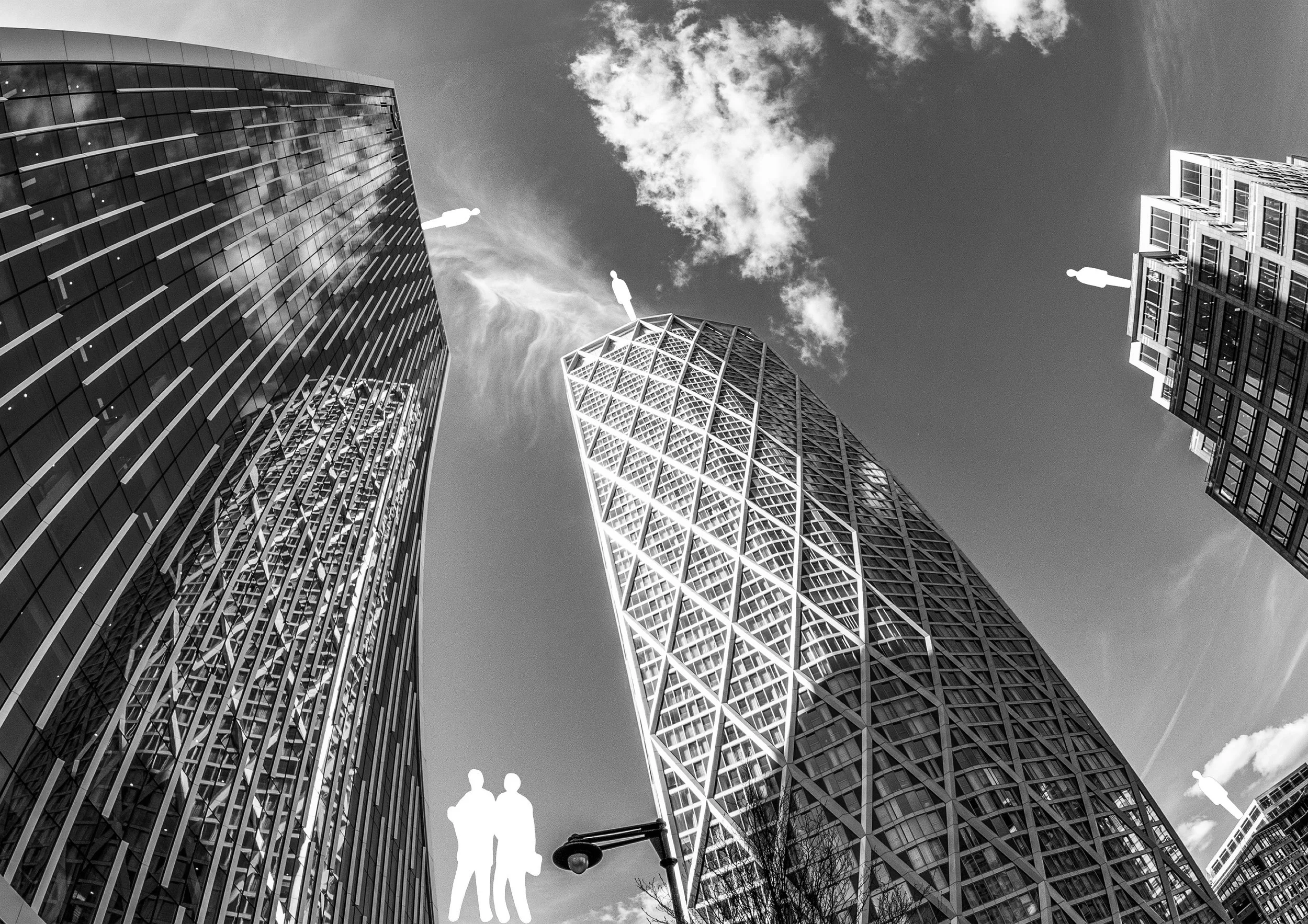
This framed print is a striking piece of contemporary architectural photography that utilizes a dramatic low-angle perspective to transform city structures into a surreal, high-contrast landscape.
By shooting from the ground looking straight up, the photographer creates a "worm's-eye view" that makes the skyscrapers appear to converge toward the center of the frame, emphasizing their immense scale and the power of urban design.
Key Visual Elements
Architectural Contrast: The image captures a fascinating juxtaposition of textures. On the left, we see a sleek, glass-paneled building reflecting the sky. In the center, a tower with a distinctive diagonal grid (diagrid) exoskeleton dominates the view, providing a complex geometric rhythm.
The "Human" Element: Scattered throughout the image are small, ghostly white silhouettes of figures. Some are perched precariously on the edges of the buildings, while a pair stands at the bottom of the frame. These figures add a surreal, narrative quality, highlighting the relationship between humanity and the massive structures we build.
Monochromatic Depth: The use of black and white strips away the distraction of color, forcing the viewer to focus on form, light, and shadow. The deep blacks of the sky provide a stark backdrop that makes the white clouds and the metallic details of the buildings pop.
Framing and Presentation: The print is showcased in a clean white mat and a thick black frame. This "gallery-style" presentation reinforces the artwork’s modern aesthetic and makes it ready for a minimalist or professional interior.
Artistic Mood
The piece feels aspirational and slightly otherworldly. It captures the energy of a bustling metropolis like London or New York but renders it as a dreamscape. It would be an excellent focal point for an office, a modern living room, or an architectural studio.
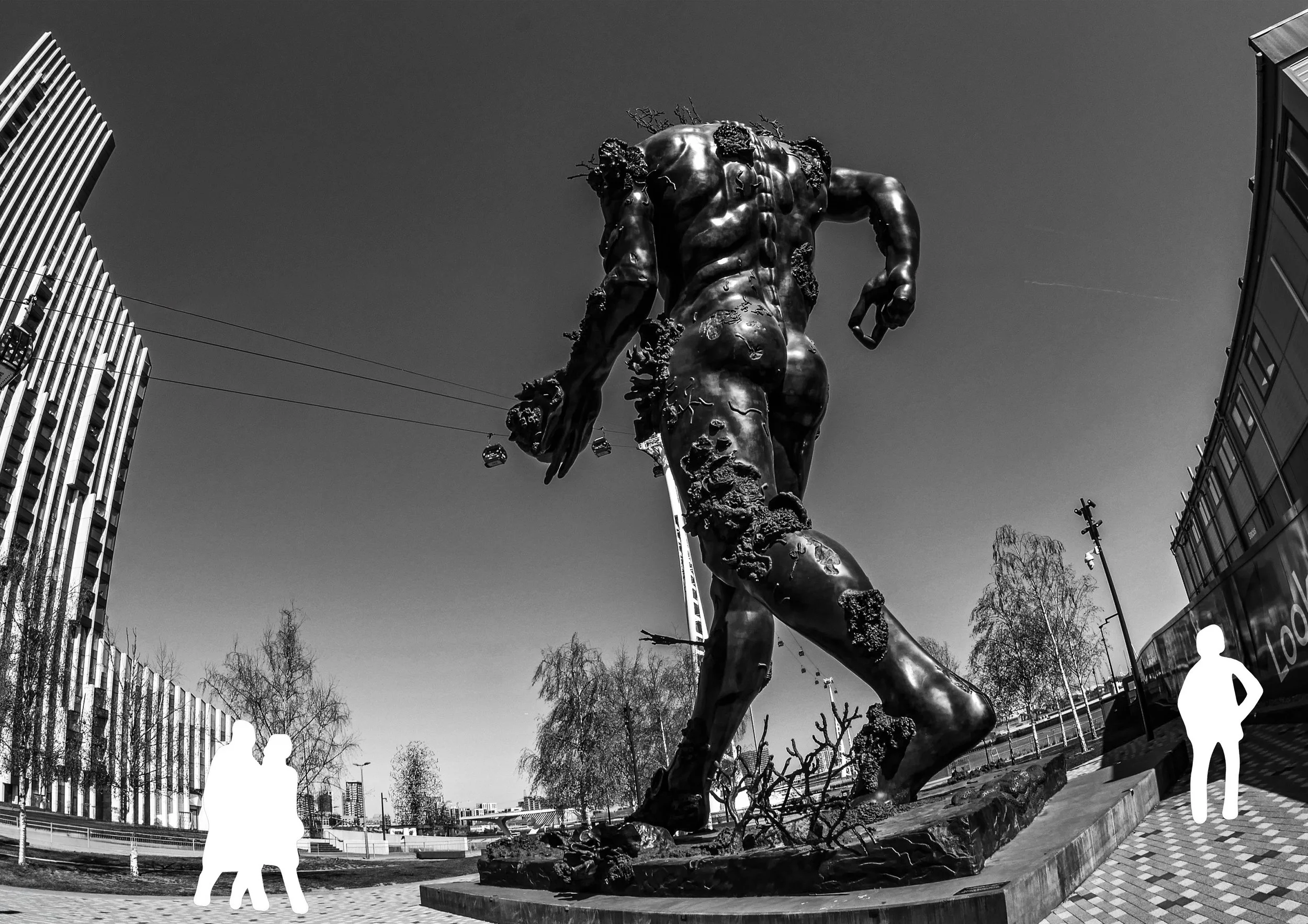
This striking black-and-white print captures a dramatic, low-angle perspective of Damien Hirst’s "Demon with Bowl," a monumental bronze sculpture situated on the Greenwich Peninsula in London.
The photograph uses a wide-angle, almost fisheye lens to create a sense of overwhelming scale and distortion, emphasizing the raw power of the figure.
Composition and Atmosphere
The Subject: The sculpture is depicted from behind, highlighting the muscular, "corroded" texture of the bronze, which is encrusted with barnacles and coral. This gives the figure an ancient, "risen from the depths" quality.
Urban Contrast: The organic, jagged form of the demon stands in sharp contrast to the modern, geometric lines of the Upper Riverside architecture on the left and the sleek IFS Cloud Cable Car lines cutting across the sky.
The Silhouettes: The artist has added stylized white silhouettes of people in the foreground and mid-ground. This serves two purposes: it provides a clear sense of scale against the massive sculpture and adds a layer of surreal, contemporary graphic design to the gritty photographic texture.
Narrative Theme
The print explores the intersection of the ancient and the modern. By stripping away color, the image focuses on form and texture, making the London landscape feel like a scene from a dystopian or mythological epic. The "fossilized" look of the demon suggests a forgotten history emerging into a hyper-modern urban environment.
Key Details
ElementDescriptionSculptureDemon with Bowl by Damien Hirst (originally for Treasures from the Wreck of the Unbelievable)LocationGreenwich Peninsula, LondonTechniqueHigh-contrast black and white with digital silhouette overlaysPerspectiveExtreme low-angle / Wide-angle
No results found
No results match your search. Try removing a few filters.