
 Image 1 of 1
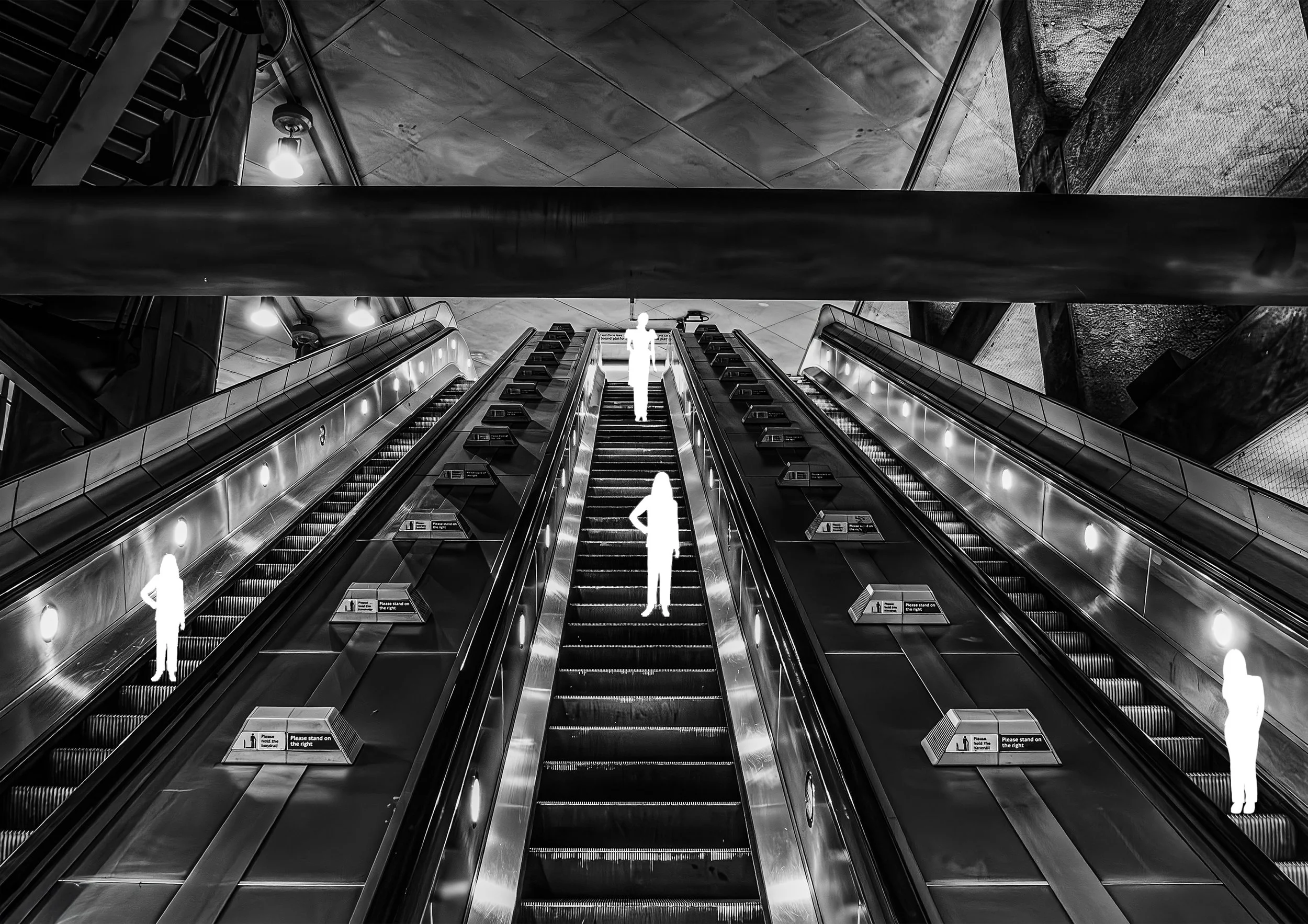
This striking black-and-white print offers a surreal, high-contrast take on urban transit. It captures an upward-facing perspective of multiple escalators—likely within the London Underground, given the iconic "Stand on the Right" signage—but transforms a mundane commute into a ghostly, architectural study.
The image is defined by a heavy industrial aesthetic and a unique digital intervention:
Symmetry and Scale: The composition uses strong converging lines that pull the viewer's eye toward a central vanishing point at the top of the stairs. The massive cross-beams and textured ceiling add a sense of weight and enclosure.
The "Silhouettes": The most arresting feature is the treatment of the commuters. Rather than natural figures, they appear as stark white, featureless cutouts. This stylistic choice strips away their individuality, turning them into glowing avatars that haunt the mechanical space.
Monochrome Palette: By removing color, the artist emphasizes the metallic textures, the rhythmic patterns of the escalator steps, and the interplay between deep shadows and artificial light.
The print evokes several powerful themes common in contemporary urban photography:
Urban Anonymity: The glowing white figures represent the "ghosts" of the city—people who occupy the same space but remain entirely disconnected and anonymous to one another.
Man vs. Machine: The scale of the escalators and the heavy industrial beams dwarf the human figures, highlighting the massive infrastructure required to move populations through a metropolis.
Modern Isolation: Despite being in a public hub, there is a profound sense of solitude. Each figure stands alone on their own path, encased in a vacuum of light.
The piece is presented in a black gallery frame with a wide white mat (mount). This professional framing provides "breathing room" for the dark, dense image, making the blacks appear deeper and the white silhouettes pop with more intensity. It is a sophisticated choice for a modern interior, particularly one with a minimalist or industrial design.
This striking black-and-white print offers a surreal, high-contrast take on urban transit. It captures an upward-facing perspective of multiple escalators—likely within the London Underground, given the iconic "Stand on the Right" signage—but transforms a mundane commute into a ghostly, architectural study.
The image is defined by a heavy industrial aesthetic and a unique digital intervention:
Symmetry and Scale: The composition uses strong converging lines that pull the viewer's eye toward a central vanishing point at the top of the stairs. The massive cross-beams and textured ceiling add a sense of weight and enclosure.
The "Silhouettes": The most arresting feature is the treatment of the commuters. Rather than natural figures, they appear as stark white, featureless cutouts. This stylistic choice strips away their individuality, turning them into glowing avatars that haunt the mechanical space.
Monochrome Palette: By removing color, the artist emphasizes the metallic textures, the rhythmic patterns of the escalator steps, and the interplay between deep shadows and artificial light.
The print evokes several powerful themes common in contemporary urban photography:
Urban Anonymity: The glowing white figures represent the "ghosts" of the city—people who occupy the same space but remain entirely disconnected and anonymous to one another.
Man vs. Machine: The scale of the escalators and the heavy industrial beams dwarf the human figures, highlighting the massive infrastructure required to move populations through a metropolis.
Modern Isolation: Despite being in a public hub, there is a profound sense of solitude. Each figure stands alone on their own path, encased in a vacuum of light.
The piece is presented in a black gallery frame with a wide white mat (mount). This professional framing provides "breathing room" for the dark, dense image, making the blacks appear deeper and the white silhouettes pop with more intensity. It is a sophisticated choice for a modern interior, particularly one with a minimalist or industrial design.