
Lake District Part 1
Lake District Part 1
Filters
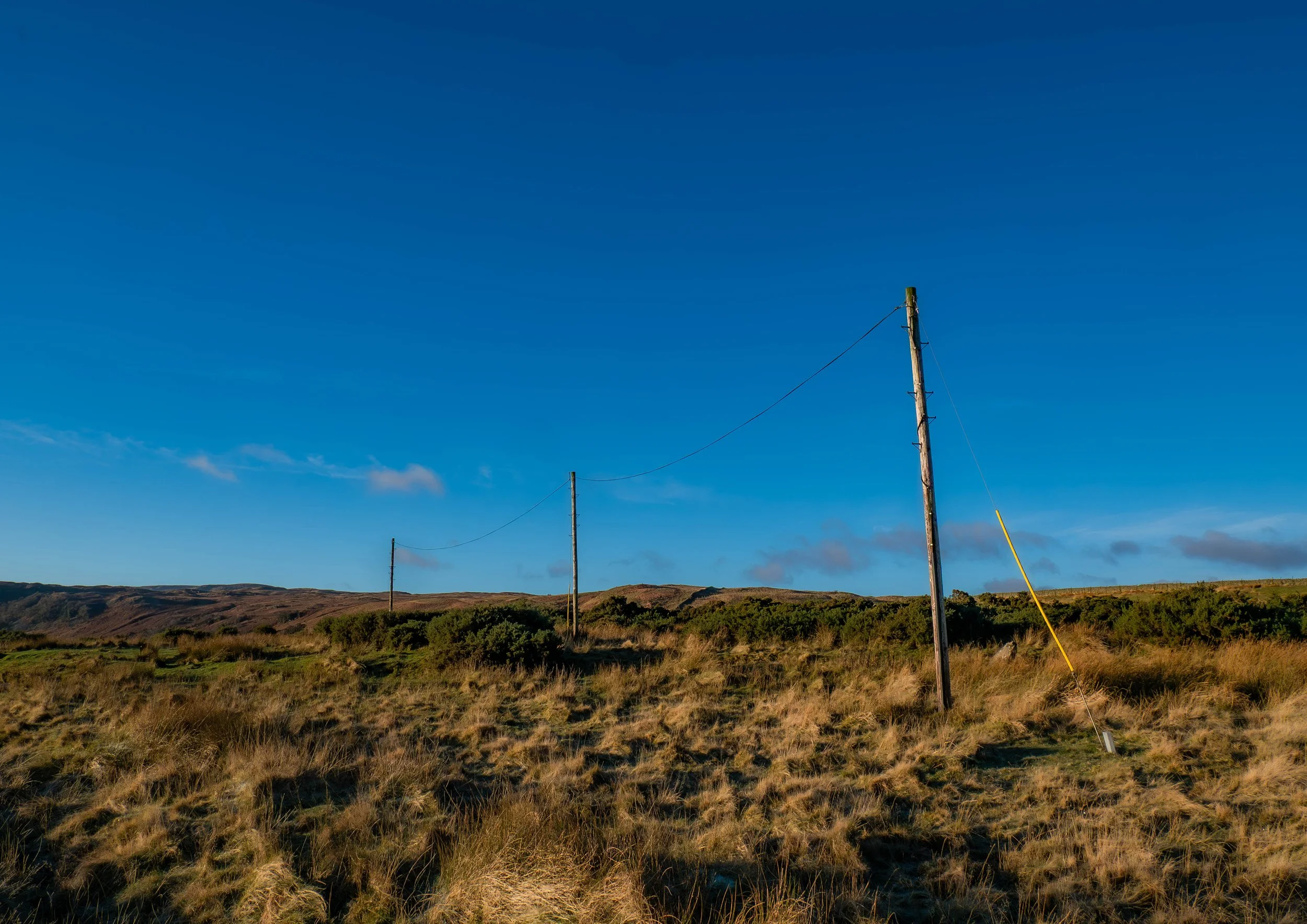
This image captures a quiet, rugged corner of the Lake District in Cumbria, likely away from the high peaks and closer to the undulating moorland fringes. It perfectly illustrates the "backbone" of rural life—where modern utility meets ancient landscape.
A Study in Stillness
The composition is dominated by a vast, deep blue sky that takes up the top two-thirds of the frame, emphasizing the openness of the Cumbrian fells. The low sun creates long, soft shadows across the tawny grasses and dark green gorse bushes, suggesting either a crisp autumn morning or a late winter afternoon.
Key Elements
The Utility Line: A row of weathered wooden telegraph poles marches across the frame. Their slight lean and the sagging wires provide a sense of scale and human presence in an otherwise wild-looking environment.
The Landscape: The foreground is a texture-rich mix of dry moorland grass and scrub. In the distance, the rolling hills (or fells) turn a hazy purple-brown, characteristic of the Lake District's volcanic geology and peat-rich soil.
The Light: The golden-hour lighting highlights the "stay wire" (the yellow-capped cable on the right), which glows against the darker landscape, drawing the eye into the scene.
The Mood
There is a profound sense of isolation and utility. Unlike the "chocolate box" postcard views of Lake Windermere or Derwentwater, this photo celebrates the functional beauty of the Cumbrian uplands. It’s a reminder that even in one of England's most famous national parks, there are vast stretches of quiet land where the only sound is the wind whistling through those very wires.
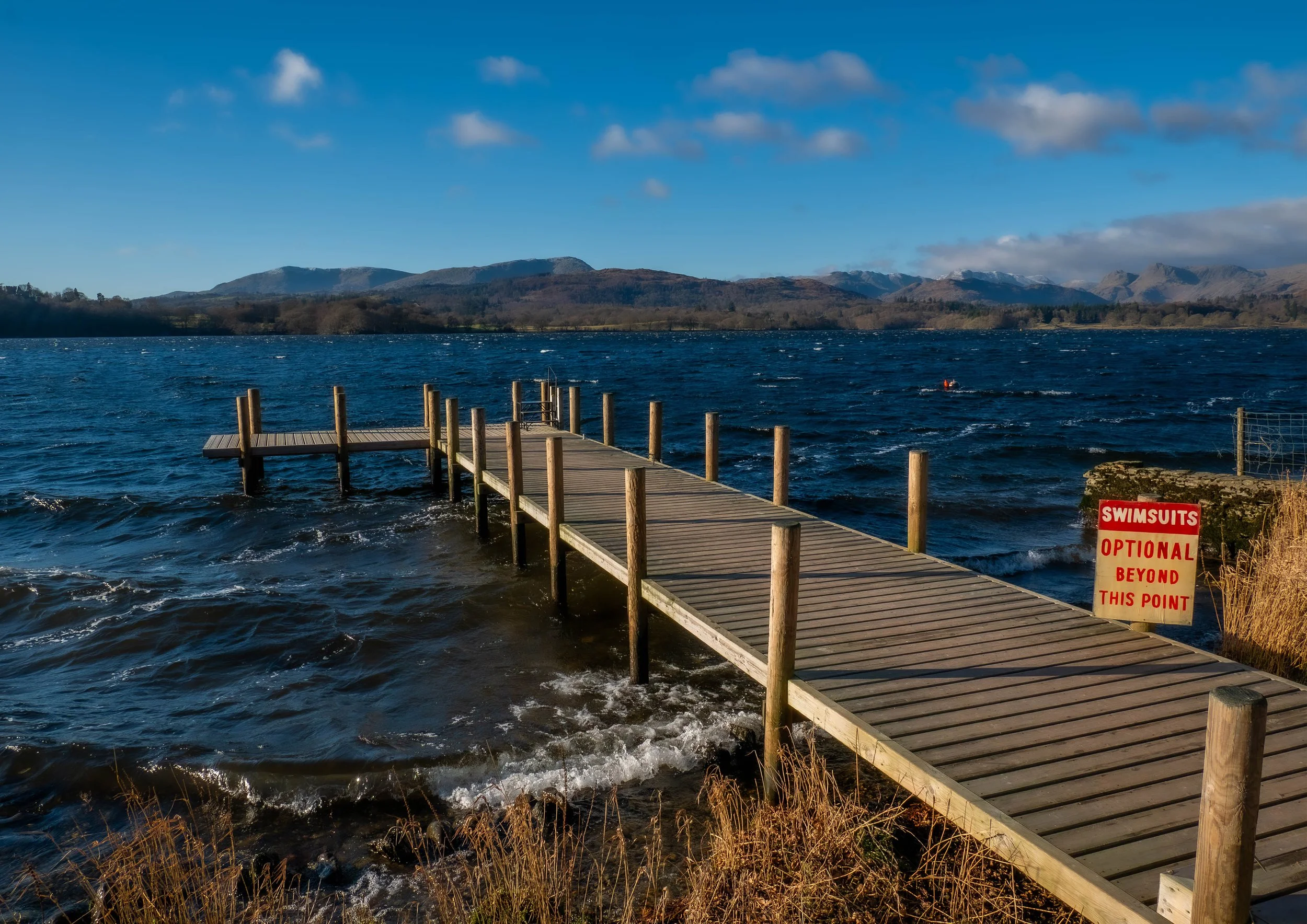
This image captures a crisp, bright day at Windermere, the largest natural lake in England's Lake District. The photograph appears to be taken from the western shore, likely near the Low Wray area, looking across toward the fells.
The combination of the rustic wooden jetty and the rolling mountains in the distance perfectly encapsulates the "quiet" side of the Lake District, away from the bustling tourist hubs of Bowness or Ambleside.
Key Visual Elements
The Landscape: In the background, you can see the distinctive silhouettes of the Langdale Pikes and the surrounding fells, some of which appear to have a light dusting of snow or frost, suggesting a cold, clear winter or early spring day.
The Water: The lake is "choppy," with white-capped waves driven by a stiff breeze. The deep blue of the water suggests significant depth and a very clear sky above.
The Jetty: A classic T-shaped wooden pier leads the eye into the composition, providing a sense of scale against the vastness of the lake.
The "Swimsuits Optional" Sign
The most striking and humorous detail is the red and white sign that reads: "SWIMSUITS OPTIONAL BEYOND THIS POINT." While the Lake District is a world-renowned destination for wild swimming, this specific sign is a well-known local landmark found at the Low Wray campsite. It’s often a point of amusement for hikers and photographers, though on a day as windy and cold as this photo suggests, anyone taking the sign literally would need to be incredibly brave (or have a very thick wetsuit)!
Why This Photo Works
Contrast: The warm tones of the wooden jetty and the dried winter grasses in the foreground contrast beautifully with the cool blues and greys of the water and mountains.
Atmosphere: It captures the "wild" feeling of Cumbria. Despite being a popular tourist destination, the photo feels solitary and peaceful.
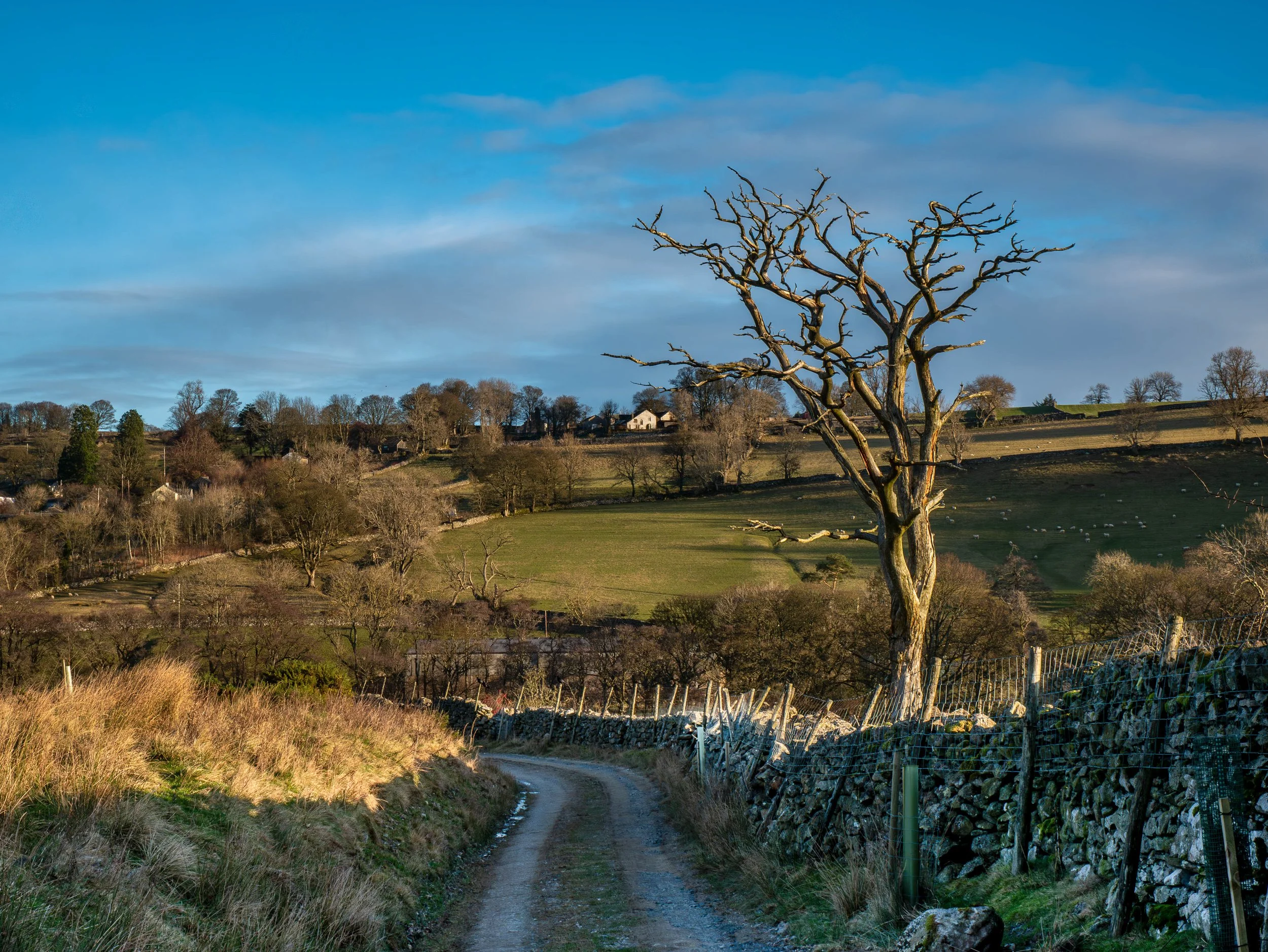
This image captures the quiet, rugged soul of the Lake District in Cumbria, likely during the late autumn or winter months. It moves away from the dramatic lakeside vistas and instead focuses on the "working" landscape—the fellside farms and the ancient boundaries that define the region.
Composition and Atmosphere
The photograph is anchored by a skeletal, leafless tree in the foreground. Its intricate, reaching branches create a sharp silhouette against the soft sky, acting as a natural frame for the rolling valley beyond.
The light appears to be from the "golden hour," casting long, dramatic shadows and highlighting the golden-brown hues of the dormant grasses. This low-angled sun gives a three-dimensional quality to the dry stone walls, which are a quintessential feature of the Cumbrian heritage.
Key Elements of the Cumbrian Landscape
Dry Stone Walls: These hand-built structures wind across the hills, marking out grazing land. They represent centuries of agricultural history and a deep connection to the local stone.
The Fellside Farm: Nestled on the ridge in the background, the stone buildings sit low against the landscape, designed to withstand the harsh Atlantic weather that often sweeps through the dales.
The Lane: The muddy, winding track in the foreground invites the viewer into the scene, suggesting a slow, quiet pace of life far removed from urban centers.
Pastoral Life: If you look closely at the green slopes in the mid-ground, you can see the white dots of sheep, likely the hardy Herdwick or Swaledale breeds that are synonymous with Lake District farming.
The Mood
There is a profound sense of stillness and resilience in this image. The bare tree and the muted colors of the valley suggest a landscape in hibernation, waiting for the spring. It evokes the poetry of William Wordsworth or the sketches of Alfred Wainwright, capturing a timeless version of England’s most famous National Park.
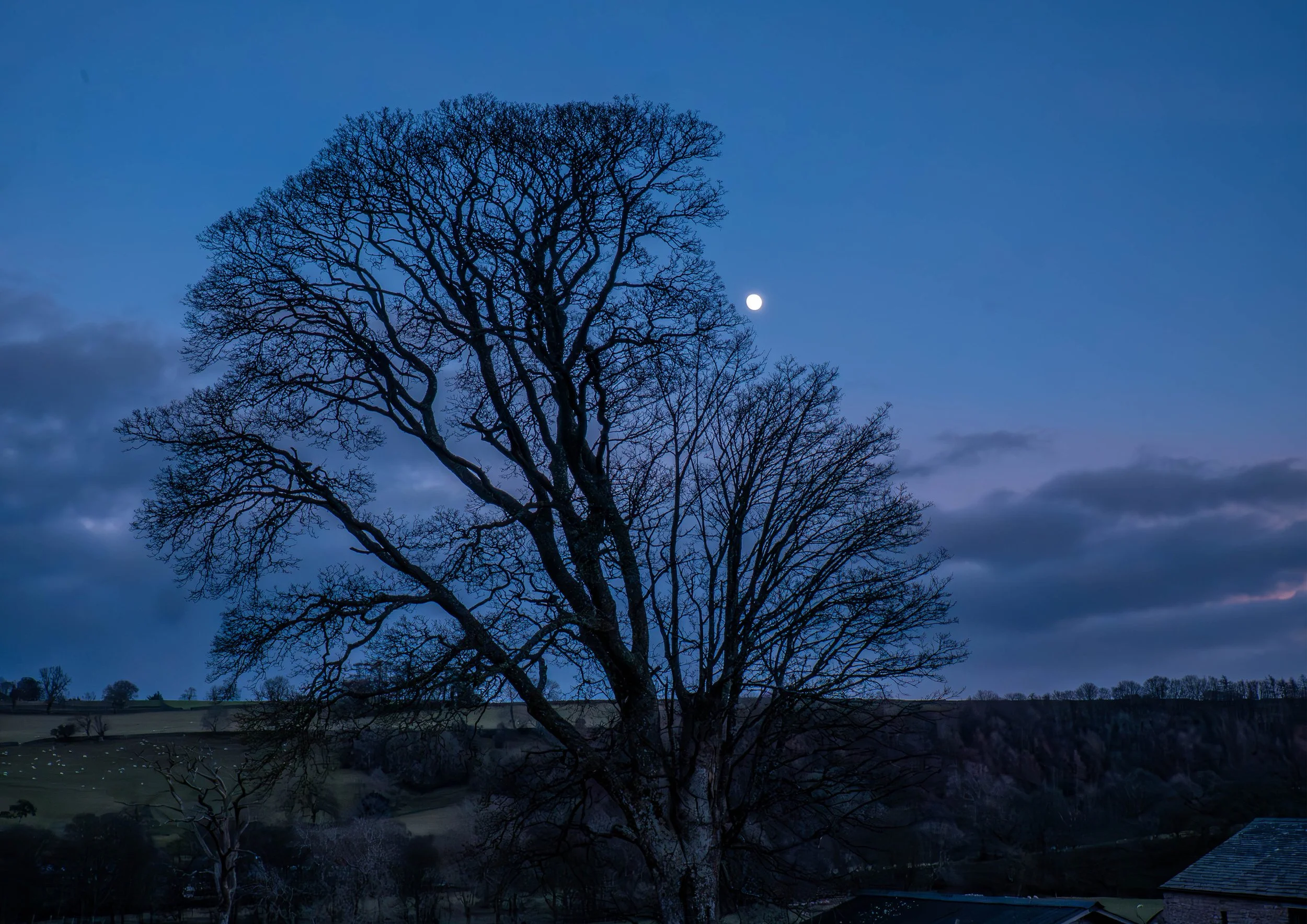
This image captures a quintessentially moody evening in the Lake District, likely taken during the "blue hour" when the sun has dipped just below the horizon, leaving the landscape washed in cool, indigo tones.
The composition relies on a beautiful contrast between the intricate, skeletal details of the dormant hardwood tree and the soft, sprawling fells of Cumbria in the background.
Visual Analysis
The Silhouette: The large, leafless tree acts as a powerful focal point. Its complex network of branches—characteristic of an ancient Oak or Ash—creates a "lace-like" effect against the sky. This is a common sight in the winter months across the Cumbrian valleys.
The Lunar Presence: The moon, bright and nearly full, provides a sharp point of light that balances the heavy weight of the tree on the left. It adds a sense of stillness and cosmic scale to the rural scene.
The Landscape: In the lower-left, you can see the rolling, stone-walled pastures typical of the region, dotted with what appear to be sheep—the lifeblood of the Lake District’s cultural heritage. The distant, dark wooded slopes on the right suggest a deep valley or "ghyll."
Atmosphere and Mood
There is a profound sense of solitude and "stille" (the Old Norse word for quiet, which still influences Cumbrian dialect). The photo evokes the feeling of a cold, crisp walk back to a stone cottage after a day on the fells.
The color palette is dominated by:
Deep Ultramarine: In the upper atmosphere.
Soft Violet and Slate: In the cloud breaks near the horizon.
Charcoal: In the silhouettes of the valley floor.
A Poet's Perspective
The Lake District has long inspired poets like Wordsworth and Coleridge. This image mirrors the "sublime" they often wrote about—the feeling of being small in the face of nature’s quiet, nocturnal beauty.
"The moon doth with delight / Look round her when the heavens are bare..." — William Wordsworth
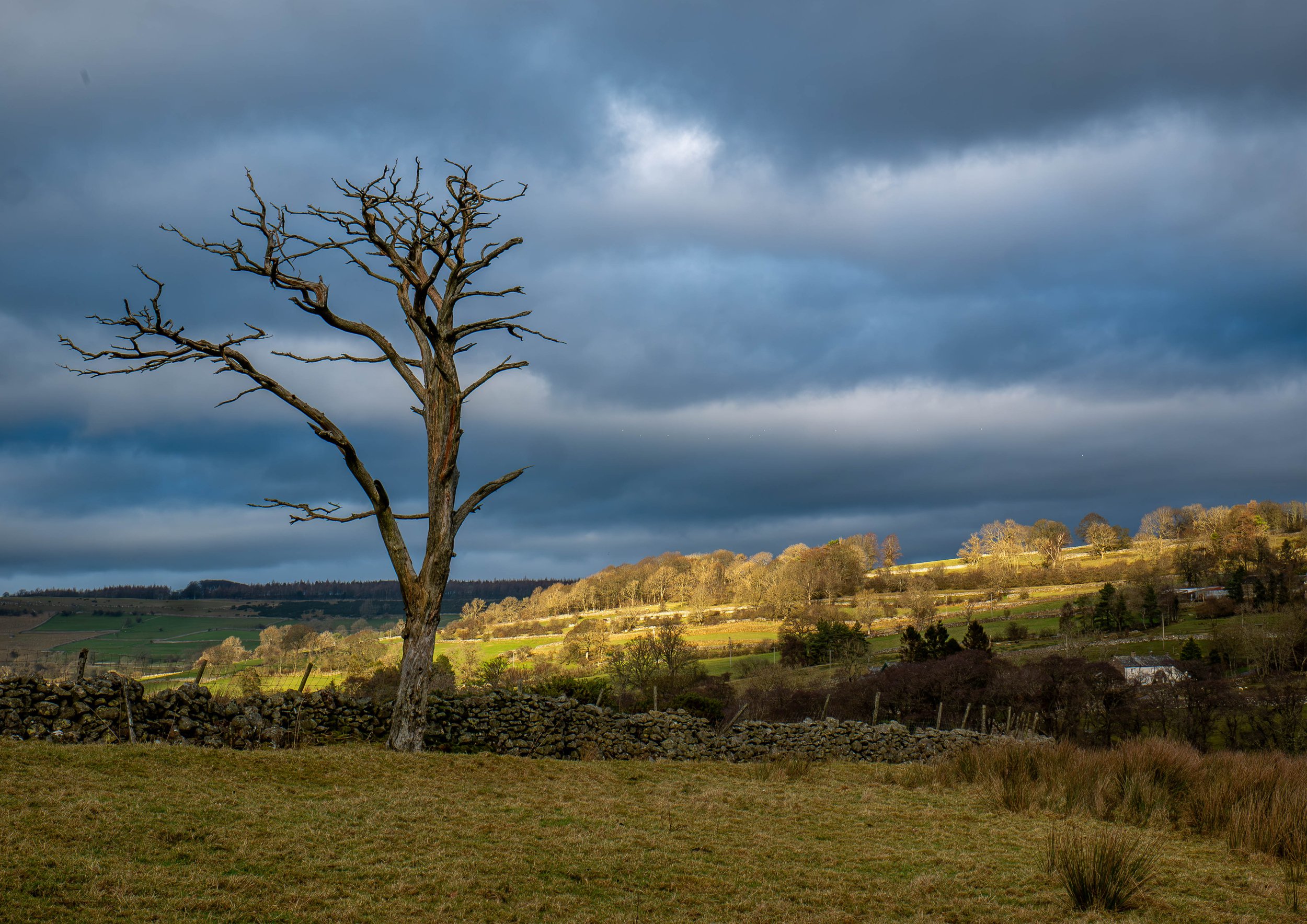
This image captures the raw, atmospheric beauty that defines the Lake District in Cumbria, particularly the transition between the rugged fells and the managed pastoral land.
Here is a reflection on the elements that make this photograph so characteristic of the Cumbrian landscape:
1. The Play of "Lake District Light"
The most striking feature is the chiaroscuro effect—the dramatic contrast between light and shadow. In Cumbria, weather moves rapidly over the mountains. The heavy, slate-gray clouds suggest a passing storm or "smirr" (fine rain), while a sudden break in the cloud cover illuminates the distant hillside in a warm, golden glow. This "spotlighting" is a hallmark of the region’s volatile climate.
2. The Skeleton of the Landscape
The lone, skeletal tree in the foreground serves as a powerful focal point. Stripped of its leaves, its jagged silhouette echoes the craggy peaks often found nearby. It stands as a testament to the harsh winds and the enduring nature of the Northern English countryside.
3. Human Heritage: Dry Stone Walls
Running across the mid-ground is a classic dry stone wall. These are the stitches that hold the Cumbrian landscape together. Built without mortar from local stone (likely slate or limestone depending on the specific valley), these walls have marked boundaries and corralled Herdwick sheep for centuries. Their presence reminds us that this is a "working" landscape, shaped by generations of hill farmers.
4. The Layered Perspective
The composition uses "layering" to create depth, a technique often used to capture the scale of the fells:
Foreground: Rough grazing grass and the stark tree.
Mid-ground: The textured dry stone wall and the sun-drenched "intake" land (fields reclaimed from the moor).
Background: The rising slopes of the fells, showing the transition from deciduous woodland to open pasture.
This photo feels like it could have been taken in the quiet back-slopes of Longsleddale or perhaps looking across the lower reaches of Eden Valley. It perfectly captures that "brooding" British autumnal or early spring mood where the land feels both ancient and alive.
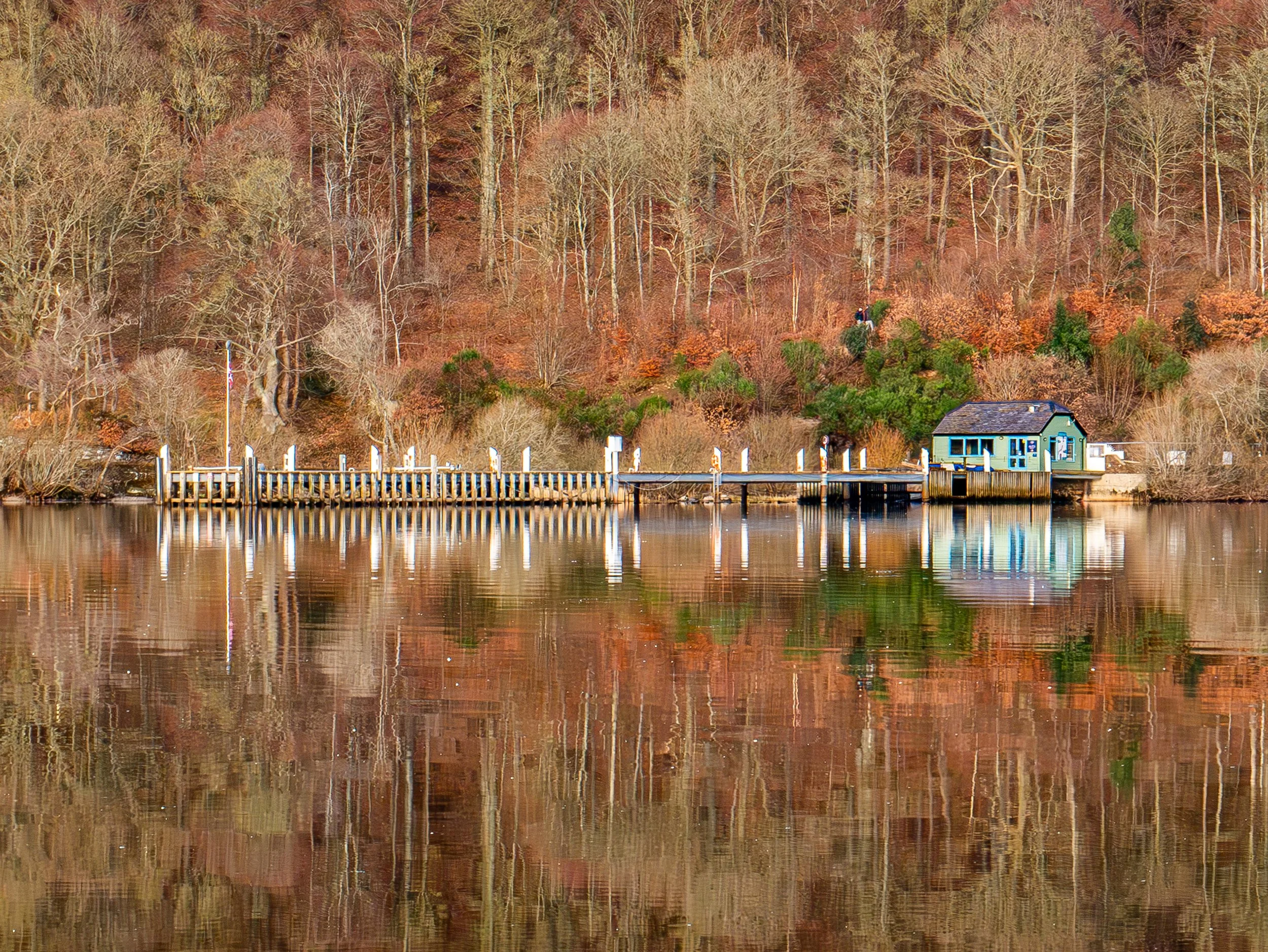
This image captures the quiet, contemplative beauty of the Lake District during the dormant season. It looks like a scene from Windermere or Coniston Water, where the busy summer crowds have been replaced by a glassy stillness.
A Study in Reflection
The composition is defined by its symmetry. Because the water is so calm, the lake acts as a perfect mirror, doubling the copper and rust tones of the hillside. This creates a rhythmic pattern where the vertical lines of the bare trees are elongated in the reflection, blurring the line between the land and the water.
Seasonal Character
While the Lake District is famous for its "Lakeside Green," this photo highlights the underrated warmth of winter and early spring:
The Palette: The hillside is a rich tapestry of ochre, sienna, and muted purples, likely from a mix of oak and beech trees that hold onto their warm-colored buds or dead leaves.
The Light: The soft, diffused light brings out the textures of the bark and the stone walls without harsh shadows, giving the scene a painterly quality.
The Human Element
The small, pale-green building and the wooden jetty provide a focal point. They represent the classic Cumbrian architecture—functional and integrated into the landscape. The jetty reaching out into the water adds a sense of invitation, suggesting a place where one might wait for a steamer or simply sit and watch the mist roll in.
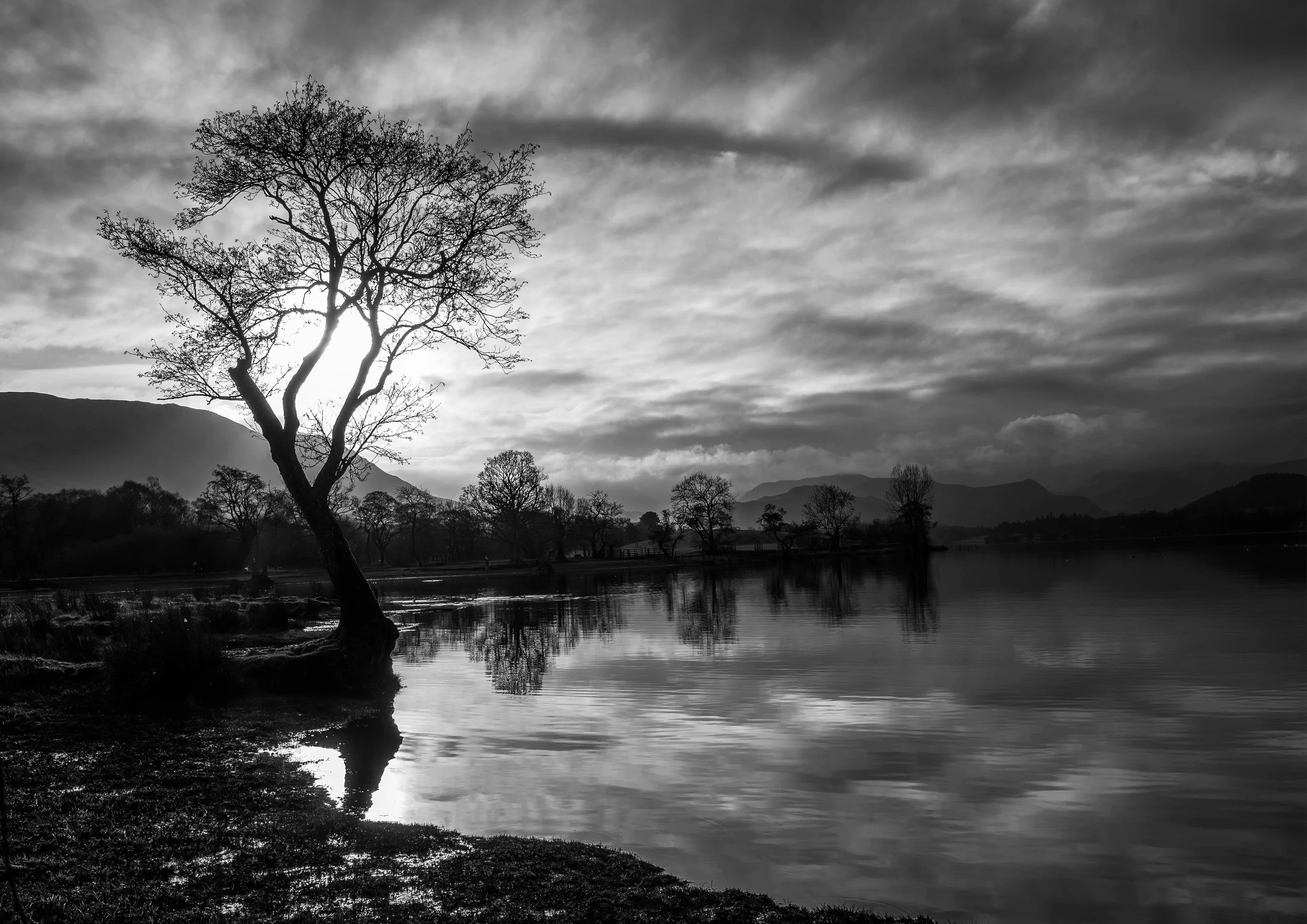
This image captures the quiet, atmospheric beauty that the Lake District is famous for—specifically, that "golden hour" light where the sun struggles to break through the characteristic Cumbrian mist.
The composition centers on a lone, weather-beaten tree on the shoreline of a lake (likely Derwentwater or Buttermere, given the surrounding fells). Here is a breakdown of why this photo resonates so strongly with the spirit of Cumbria.
The Atmosphere of the Lakes
The image perfectly illustrates the "mood" of the English North. It isn't just a sunny day; it’s a moment of transition.
The Light: The sun is positioned directly behind the silhouette of the tree, creating a backlit effect that softens the landscape. This diffused glow turns the sky into a canvas of silvery-grey and pale gold.
The Reflections: The stillness of the water creates a near-perfect mirror image. This doubling of the shoreline and the sky is a hallmark of the Lakes, providing a sense of deep tranquility and balance.
The Silhouette: By keeping the foreground and the tree in shadow, the photo emphasizes the organic shape of the branches. It tells a story of survival against the elements—wind, rain, and rising lake levels.
A Land of Giants
In the background, the silhouettes of the fells rise through the haze. These aren't just hills; they are the ancient foundations of the district. The way the light catches the distant slopes adds a sense of scale and depth, making the viewer feel small in comparison to the vastness of the landscape.
Creative Reflection
"I wandered lonely as a cloud / That floats on high o'er vales and hills..." — William Wordsworth
Looking at this photo, you can understand why poets like Wordsworth and Coleridge were so inspired by this region. There is a "melancholy beauty" here—a feeling of being completely alone with nature, yet feeling a profound connection to it.
Technical Observation
The photographer has used a wide-angle perspective, which allows the eye to travel from the textured, damp grass in the bottom left, across the expansive water, and up into the dramatic, cloud-heavy sky. The choice to underexpose the foreground slightly ensures that the viewer focuses on the play of light on the water's surface.
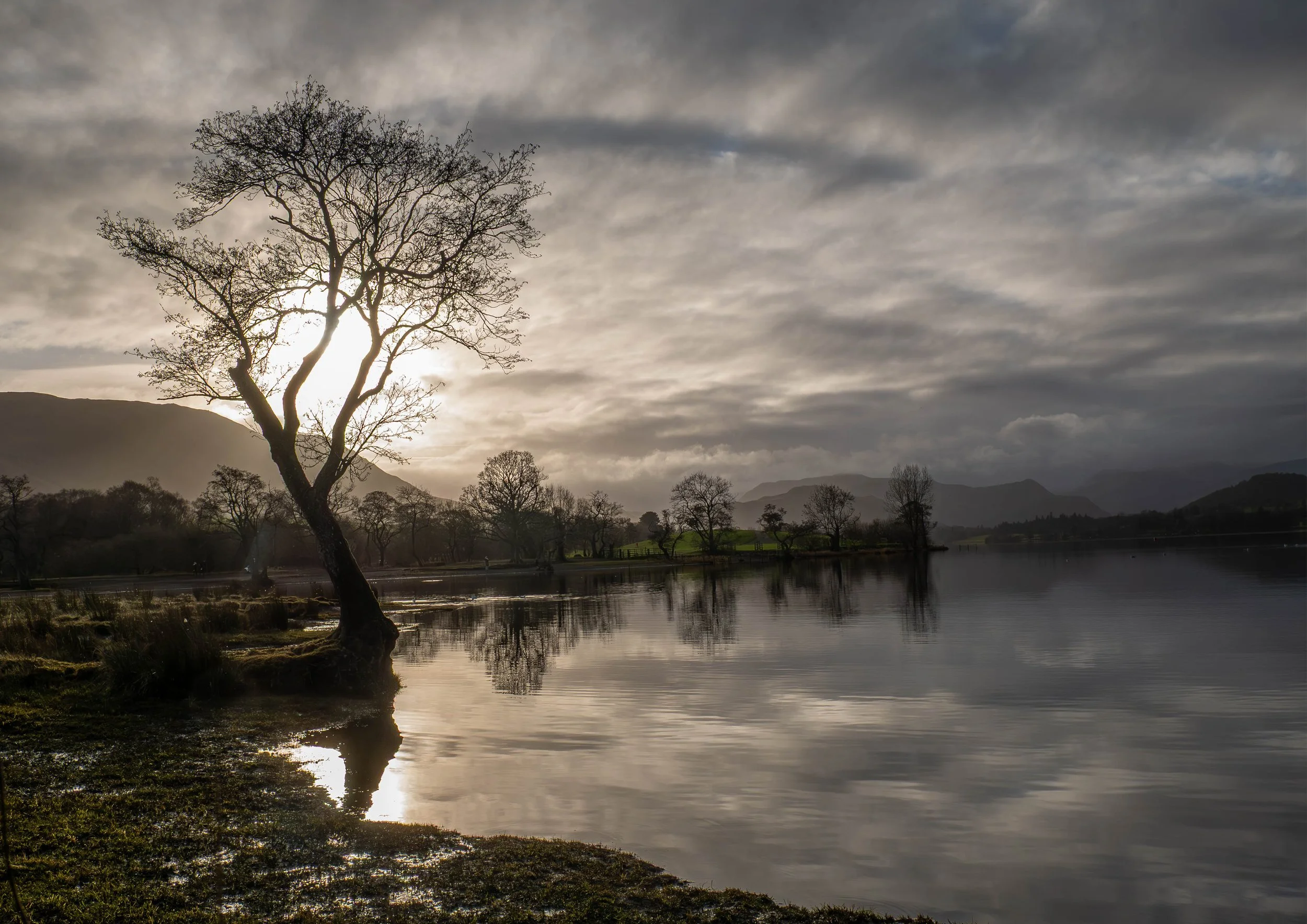
This image captures the quiet, atmospheric beauty that the Lake District is famous for—specifically, that "golden hour" light where the sun struggles to break through the characteristic Cumbrian mist.
The composition centers on a lone, weather-beaten tree on the shoreline of a lake (likely Derwentwater or Buttermere, given the surrounding fells). Here is a breakdown of why this photo resonates so strongly with the spirit of Cumbria.
The Atmosphere of the Lakes
The image perfectly illustrates the "mood" of the English North. It isn't just a sunny day; it’s a moment of transition.
The Light: The sun is positioned directly behind the silhouette of the tree, creating a backlit effect that softens the landscape. This diffused glow turns the sky into a canvas of silvery-grey and pale gold.
The Reflections: The stillness of the water creates a near-perfect mirror image. This doubling of the shoreline and the sky is a hallmark of the Lakes, providing a sense of deep tranquility and balance.
The Silhouette: By keeping the foreground and the tree in shadow, the photo emphasizes the organic shape of the branches. It tells a story of survival against the elements—wind, rain, and rising lake levels.
A Land of Giants
In the background, the silhouettes of the fells rise through the haze. These aren't just hills; they are the ancient foundations of the district. The way the light catches the distant slopes adds a sense of scale and depth, making the viewer feel small in comparison to the vastness of the landscape.
Creative Reflection
"I wandered lonely as a cloud / That floats on high o'er vales and hills..." — William Wordsworth
Looking at this photo, you can understand why poets like Wordsworth and Coleridge were so inspired by this region. There is a "melancholy beauty" here—a feeling of being completely alone with nature, yet feeling a profound connection to it.
Technical Observation
The photographer has used a wide-angle perspective, which allows the eye to travel from the textured, damp grass in the bottom left, across the expansive water, and up into the dramatic, cloud-heavy sky. The choice to underexpose the foreground slightly ensures that the viewer focuses on the play of light on the water's surface.
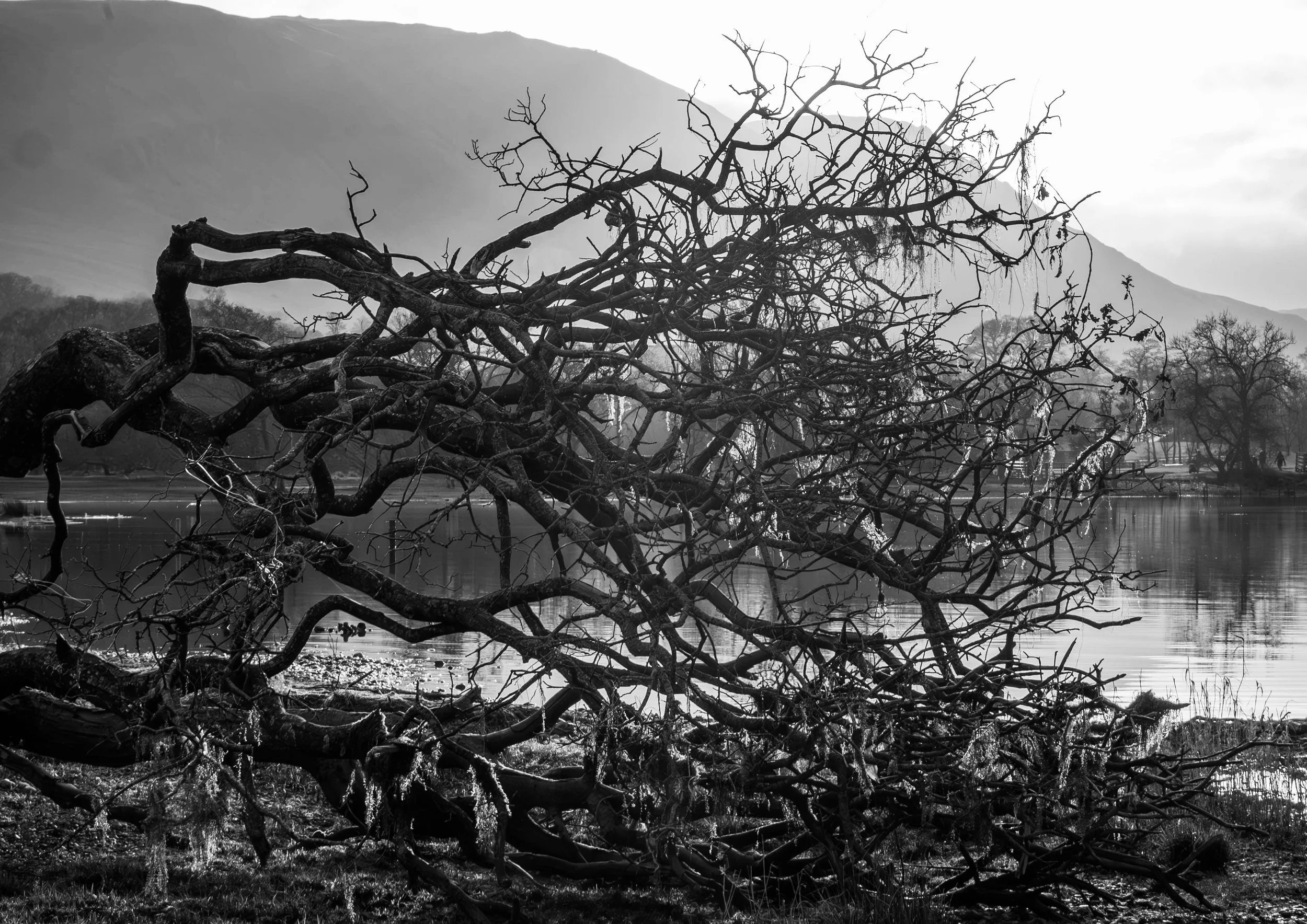
This image captures a beautifully moody, atmospheric moment at the edge of a lake in Cumbria, likely Ullswater or Derwentwater given the surrounding fells. It perfectly encapsulates the "wild" feel of the Lake District that has inspired poets and artists for centuries.
A Study in Contrast and Texture
The composition is dominated by the gnarled, fallen tree in the foreground. Its skeletal, moss-covered branches reach out across the shoreline like something from a gothic novel. This provides a rugged, tactile contrast to the glassy stillness of the lake water to the right.
Light and Atmosphere
The lighting is the true protagonist of this shot:
The Sun: Breaking through a thick layer of Cumbrian cloud, the sun creates a soft, diffused glow that photographers often call "silver light." It lacks the harshness of midday sun, instead casting a gentle haze over the distant mountains.
The Reflections: The far hills and the individual trees on the opposite bank are mirrored perfectly in the water, creating a sense of total stillness and silence.
The Palette: The colors are muted and earthy—deep moss greens, slate greys, and pale golds—which reflects the damp, fresh environment of the English Lakes.
The Spirit of Cumbria
There is a profound sense of quietude here. The fallen tree suggests the passage of time and the strength of the elements, while the soft light over the fells suggests a moment of peace after a storm. It’s a scene that feels both ancient and fleeting.
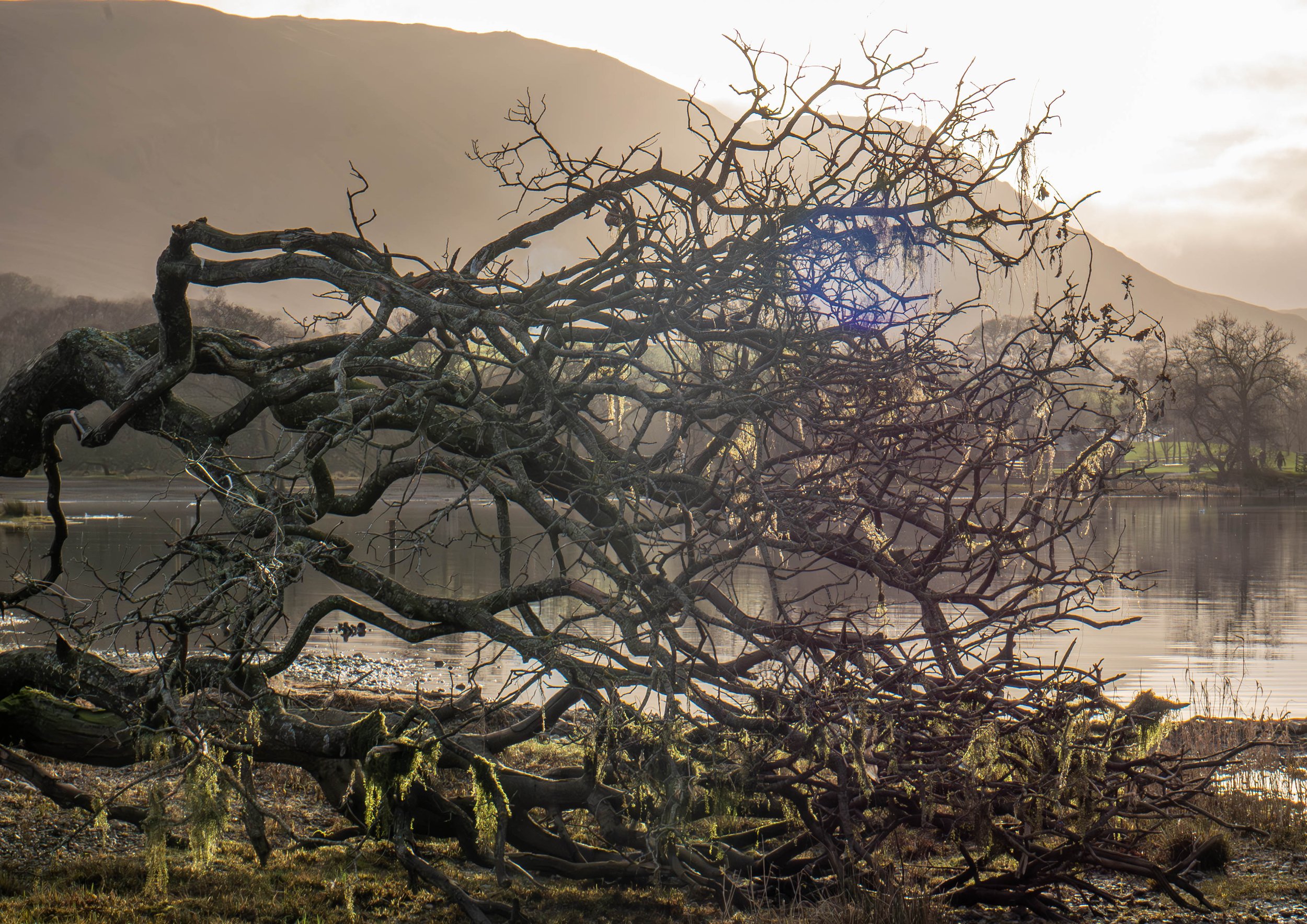
This image captures a beautifully moody, atmospheric moment at the edge of a lake in Cumbria, likely Ullswater or Derwentwater given the surrounding fells. It perfectly encapsulates the "wild" feel of the Lake District that has inspired poets and artists for centuries.
A Study in Contrast and Texture
The composition is dominated by the gnarled, fallen tree in the foreground. Its skeletal, moss-covered branches reach out across the shoreline like something from a gothic novel. This provides a rugged, tactile contrast to the glassy stillness of the lake water to the right.
Light and Atmosphere
The lighting is the true protagonist of this shot:
The Sun: Breaking through a thick layer of Cumbrian cloud, the sun creates a soft, diffused glow that photographers often call "silver light." It lacks the harshness of midday sun, instead casting a gentle haze over the distant mountains.
The Reflections: The far hills and the individual trees on the opposite bank are mirrored perfectly in the water, creating a sense of total stillness and silence.
The Palette: The colors are muted and earthy—deep moss greens, slate greys, and pale golds—which reflects the damp, fresh environment of the English Lakes.
The Spirit of Cumbria
There is a profound sense of quietude here. The fallen tree suggests the passage of time and the strength of the elements, while the soft light over the fells suggests a moment of peace after a storm. It’s a scene that feels both ancient and fleeting.
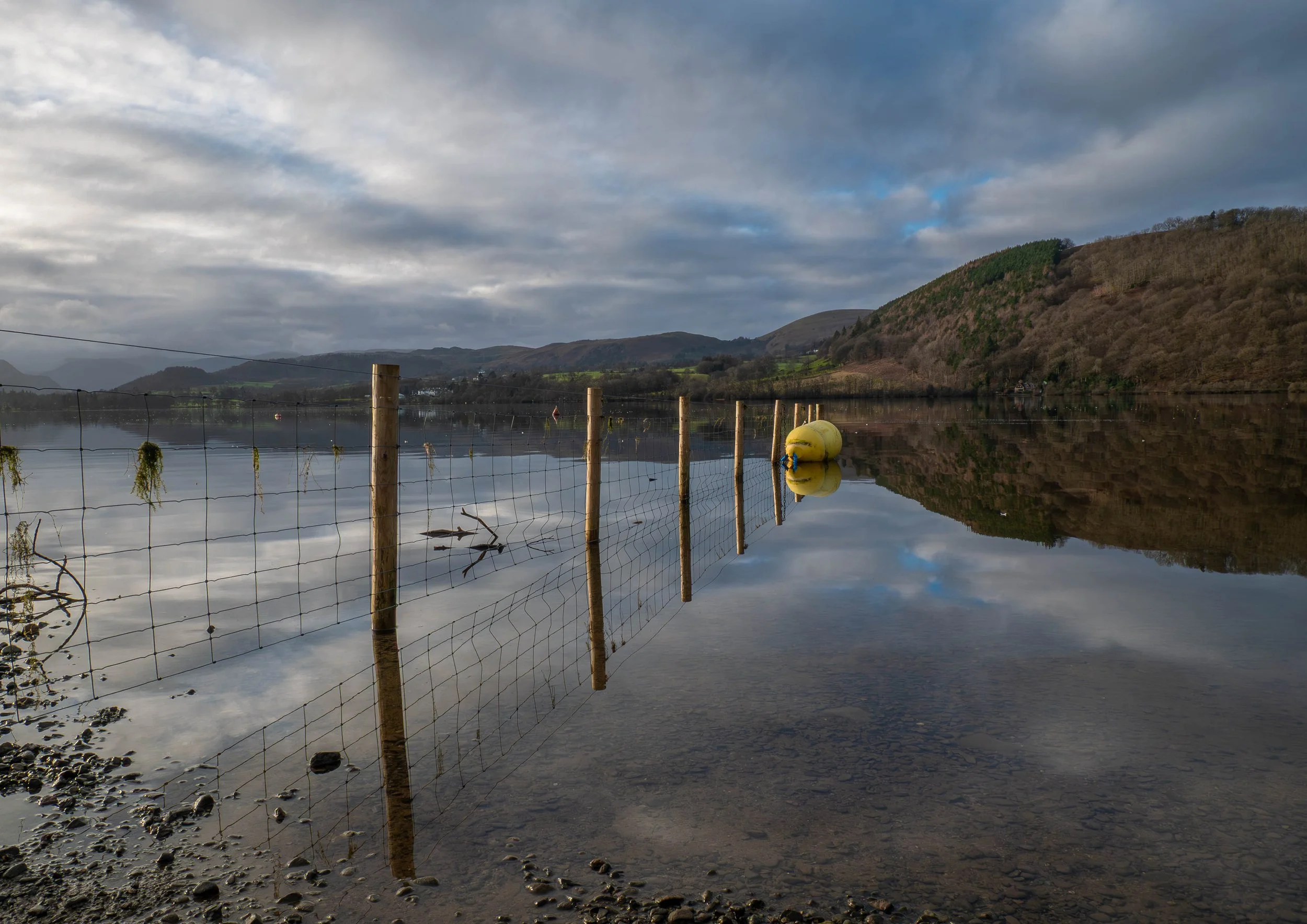
This image captures a hauntingly beautiful, quiet moment in the Lake District, Cumbria, likely following a period of heavy rainfall or seasonal flooding. The composition tells a story of the landscape’s shifting boundaries, where the "Lake" has momentarily reclaimed the "District."
The Stillness of High Water
The most striking element is the submerged fence line. These wire-and-post boundaries, usually found separating sheep pastures, now lead directly into the glassy depths of the water.
The Mirror Effect: Because the water is so incredibly still, the reflection of the clouds and the wooded fells is almost perfect. It creates a symmetrical world where the sky and the lake bed feel like a single entity.
The Yellow Buoy: The bright yellow buoy provides a sharp, artificial contrast to the muted greens, browns, and grays of the natural landscape. It serves as a visual anchor, drawing the eye toward the center of the frame.
Signs of the Surge: If you look closely at the fence wire on the left, you can see clumps of dried grass and debris snagged on the top strands. This indicates that the water level was recently even higher than it is now, leaving behind "tide marks" from the flood.
A Typical Cumbrian Atmosphere
The lighting is quintessential Lake District—soft, diffused, and slightly moody. The heavy cloud cover suggests the cool, damp air that defines the region’s rugged character.
The hills in the background (likely near a body of water like Ullswater or Derwentwater) show the transition of the seasons, with the russet tones of dormant bracken and the dark evergreens of managed forestry.
"In the Lake District, the weather isn't something you just observe; it's something that physically reshapes the land every single day."
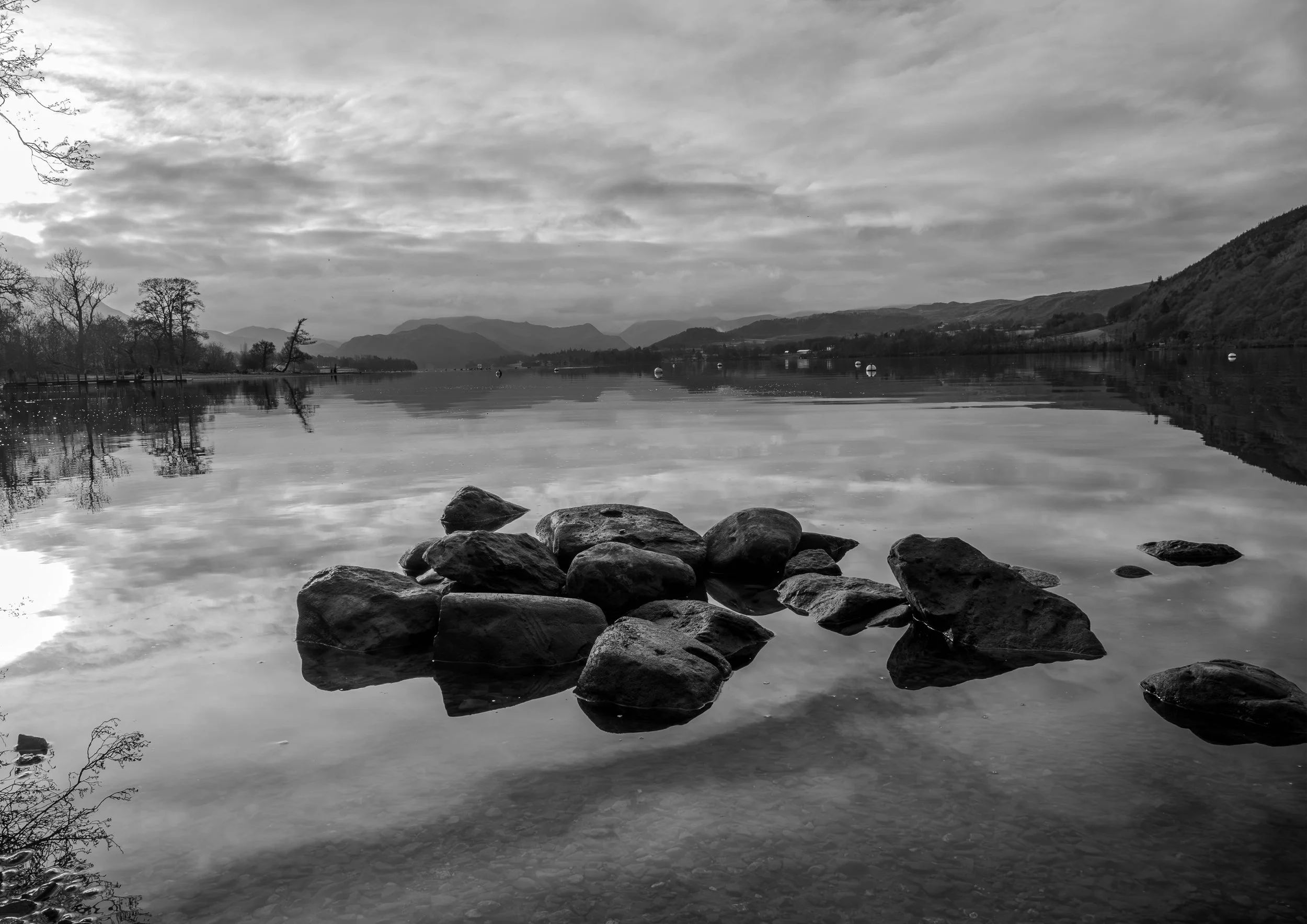
Black & White print.
This image captures the moody, ethereal essence of the Lake District, likely taken at Ullswater or Derwentwater during a quiet winter or early spring morning. The composition masterfully uses the dark, volcanic stones in the foreground to ground the viewer, creating a sense of being right there on the water's edge.
Atmosphere and Composition
The photograph is a study in tonality and stillness.
The Foreground: The cluster of dark, wet rocks provides a sharp textural contrast to the glass-like surface of the lake. Their deep shadows suggest the sun is still low or heavily filtered through the cloud layer.
The Midground: The lake acts as a near-perfect mirror. The subtle ripples around the rocks and the distant buoys are the only things breaking the surface, emphasizing the profound silence of the Cumbrian fells.
The Background: The silhouettes of the fells are layered in soft gradients of grey and blue. This "atmospheric perspective" gives the landscape a massive sense of scale, making the mountains feel both permanent and ghost-like behind the veil of mist.
Lighting and Mood
The lighting is quintessentially British—diffuse and silvered.
The Sky: The heavy, dramatic cloud cover creates a "softbox" effect, eliminating harsh shadows and bathing the entire scene in a monochromatic palette.
The Reflection: Notice how the brightest part of the sky is reflected on the far left. This creates a vertical "path" of light that guides the eye from the distant horizon back toward the foreground rocks.
The Spirit of Cumbria
This photo perfectly illustrates why the Lake District inspired the Romantic poets like Wordsworth and Coleridge. It captures that specific moment of sublime solitude where the water, land, and sky bleed into one another. There is a heavy, peaceful quality to the air that you can almost feel through the screen.
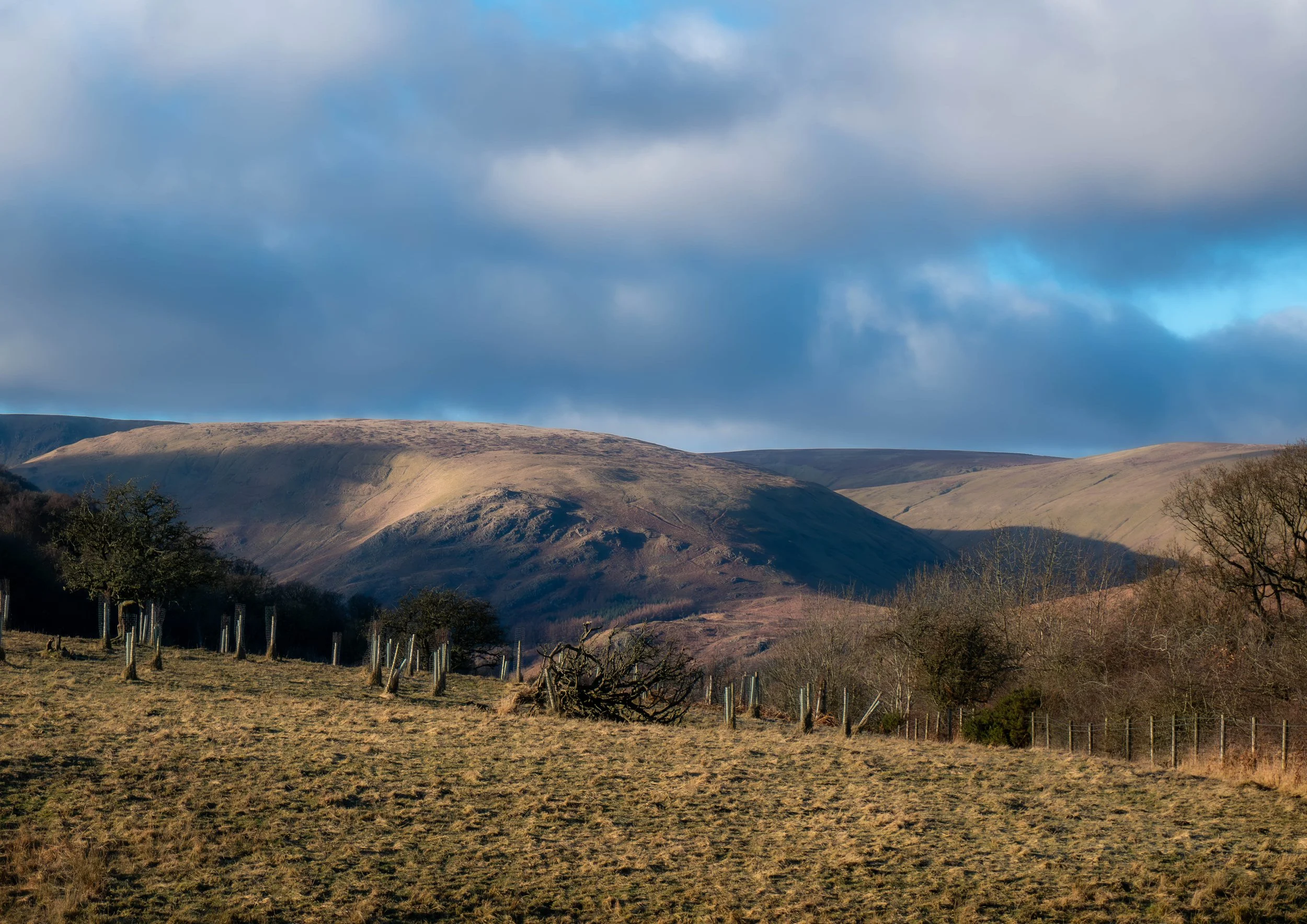
This image captures the quiet, rugged character of the Howgill Fells or the eastern fringes of the Lake District in Cumbria. It moves away from the dramatic, craggy peaks of the central Lakes and instead highlights the rolling, velvet-like textures that define this part of the county.
The photograph is a beautiful study of light, land management, and the transition of seasons.
The Play of Light and Shadow
The most striking element is the winter sun (indicated by the long, low-angled shadows). The light creates a spotlight effect on the central fell side, revealing the subtle undulations and scree-scarred slopes that might look flat under a midday sun. The deep shadows in the valleys provide a heavy, grounded contrast to the glowing ridge lines.
Land and Conservation
In the foreground, we see a story of landscape restoration:
Sapling Guards: The vertical plastic tubes indicate a significant tree-planting project. This is a common sight in Cumbria today as organizations work to restore native woodland and improve flood resilience.
The Fallen Tree: The gnarled, skeletal remains of an old hawthorn or oak in the center provide a stark contrast to the new life being protected around it.
The Fells: The hills are characterized by their "bald" appearance—mostly grass and bracken—which is the result of centuries of traditional sheep farming, a practice that defined the Lake District’s UNESCO World Heritage status.
Atmosphere and Palette
The color palette is classic Cumbrian winter:
Rust and Gold: The dormant bracken and dried grasses create a warm, earthy foreground.
Cool Blues: The heavy, brooding sky suggests the fast-moving weather the region is known for. The sliver of blue breaking through the clouds offers a sense of "changeable" weather, where a storm and bright sunshine often coexist.
A Quiet Moment
While many photos of Cumbria focus on the famous lakes like Windermere or Ullswater, this image captures the "quiet" Lake District. It feels like a view from a high pasture or a fell-side farm, far from the tourist crowds, where the only sound would be the wind and the distant bleat of a Herdwick sheep.
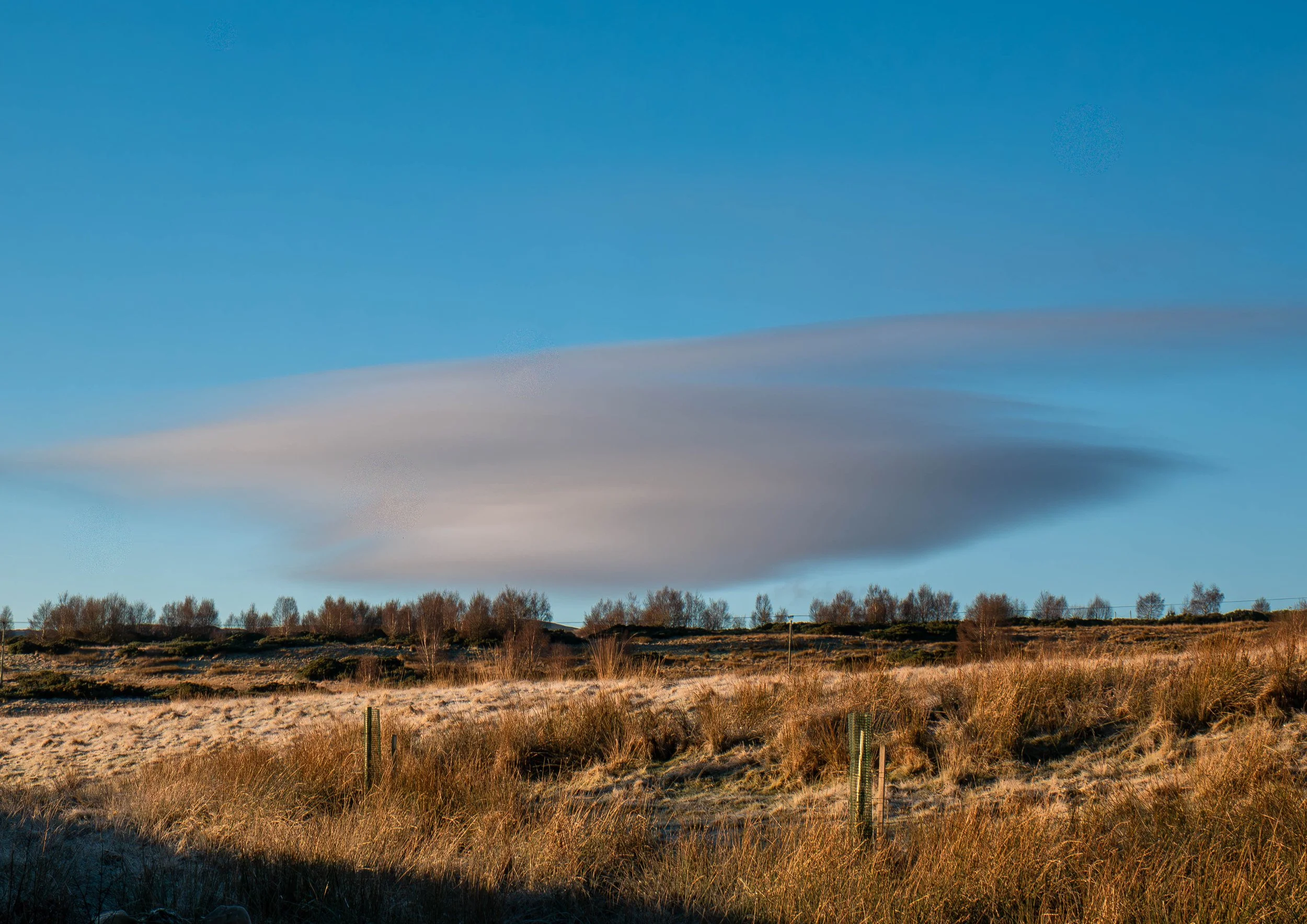
That is a striking photograph. What you’ve captured here is a classic Lenticular cloud (Altocumulus lenticularis), often nicknamed "UFO clouds" for their smooth, saucer-like shape.
While they look stationary, they are actually formed by a constant flow of moist air being pushed upward by mountains—in this case, likely the fells of the Lake District.
The Science Behind the Sight
The "Standing Wave": When strong winds blow across the rugged topography of Cumbria, they create "waves" in the atmosphere, much like water flowing over a submerged rock in a stream.
Condensation: As the air rises to the crest of the wave, it cools and moisture condenses into a cloud. As the air drops back down, it warms and the cloud evaporates.
The Result: The cloud appears to sit perfectly still over the landscape even though air is racing through it at high speeds.
Composition & Atmosphere
The photo beautifully captures the stark, wintry texture of the Lake District. The low-angled sunlight highlights the frost or dried bracken in the foreground, creating a warm, golden contrast against the deep blue of the sky. The row of leafless trees acts as a natural "pedestal" for the cloud, emphasizing its massive scale.
In a region known for its dramatic weather, lenticular clouds are a favorite for photographers in the Lakes because they signal high-altitude wind activity, often preceding a change in the weather.
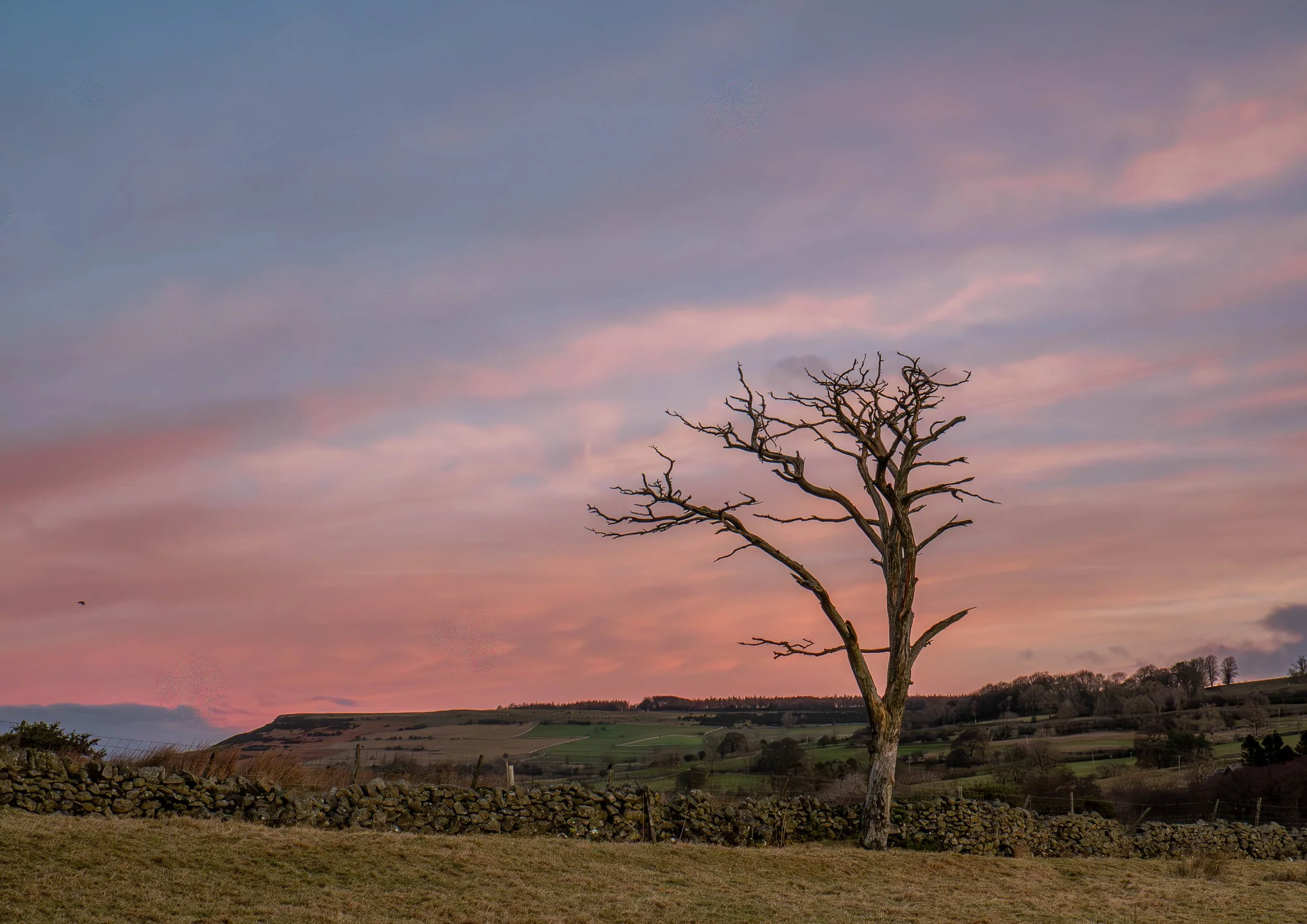
This image captures a beautifully melancholic side of the Lake District, focusing on the quiet, rural uplands rather than the famous lakes themselves. It evokes the feeling of a cold, crisp winter evening in Cumbria.
Visual Narrative
The composition is dominated by a lone, skeletal tree, its bare branches reaching into a soft "candy-floss" sky. This suggests a transition into late autumn or winter, where the landscape loses its lush greenery and takes on more muted, earthy tones.
The setting features classic Cumbrian elements:
The Dry Stone Wall: A quintessential marker of the Northern English landscape, slicing across the frame and separating the foreground pasture from the rolling hills beyond.
The Fellside: In the background, the rising slope (likely a "fell") shows the patchwork of fields and managed woodland typical of areas like the Eden Valley or the outskirts of Keswick.
The Alpenglow: The pink and lavender hues in the clouds suggest the sun has just dipped below the horizon, reflecting light back onto the cloud deck.
Mood and Atmosphere
There is a profound sense of solitude and stillness. Unlike the bustling tourist hubs of Windermere or Bowness, this photo represents the "hidden" Lake District—the working landscape of sheep farmers and quiet country lanes.
The contrast between the rugged, permanent stone wall and the fleeting, delicate colors of the sunset creates a poignant balance between the timelessness of the land and the transience of a single evening.
Creative Reflection
If this photo were a poem, it would speak of the "hush before the frost." The air looks thin and cold, and the silence of the fells is almost audible through the image. It is a reminder that the Lake District's beauty isn't just in its water, but in the stark, honest silhouettes of its high ground.
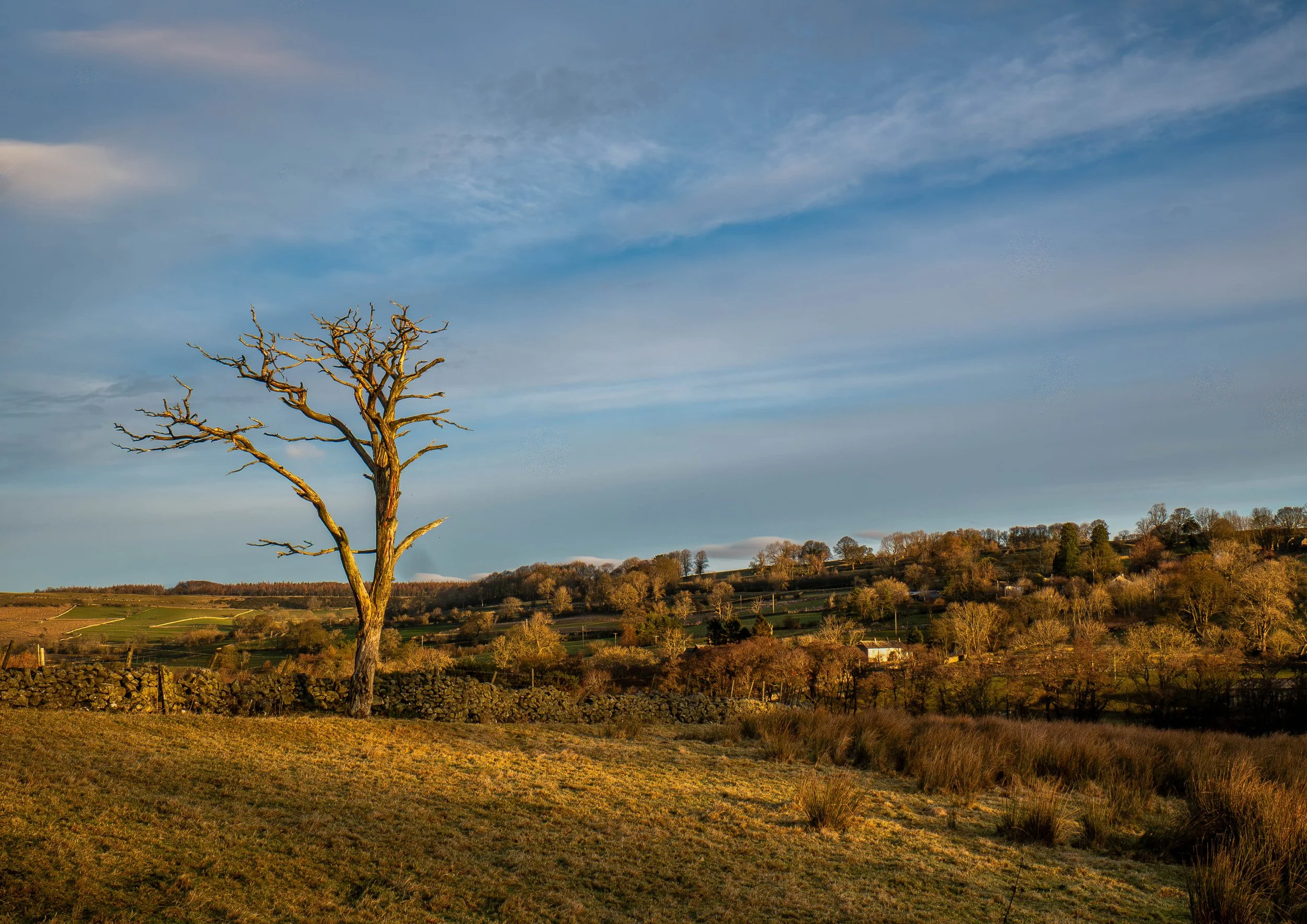
This image captures the quiet, rugged soul of the Lake District during the "golden hour." It beautifully portrays the transition between the lush vibrancy of summer and the stark, dramatic winters that define the Cumbrian landscape.
Visual Analysis
The photograph uses a classic composition that emphasizes the rural character of Northern England:
The Lone Sentinel: The skeletal, leafless tree acts as a powerful focal point. Stripped of its foliage, its jagged silhouette highlights the harsh weather conditions that sweep through the fells.
The Dry Stone Wall: Running across the mid-ground is a traditional dry stone wall, a quintessential feature of the Lake District. These walls represent centuries of Cumbrian farming heritage, built without mortar to divide the communal grazing lands.
Atmospheric Lighting: The low sun casts a warm, honey-colored glow across the foreground grasses, contrasting sharply with the cool, streaking blues and soft greys of the sky. This "side-lighting" creates deep textures in the rolling hills and the distant woodland.
The Essence of Cumbria
This scene looks like it could be found in the quieter valleys, perhaps near Wasdale or the outskirts of Windermere. It moves away from the "postcard" lake views and focuses instead on the living landscape:
The Fells: The gentle rise of the hills in the background shows the patchwork of woodland and pasture that has earned the region its UNESCO World Heritage status.
Solitude: There is a profound sense of stillness. The scattered farmhouses nestled in the trees suggest a life lived in rhythm with nature, far from the bustle of the more tourist-heavy hubs.
Resilience: The contrast between the fragile, bare branches of the tree and the solid, ancient stone wall speaks to the endurance required to live and work in this environment.
"The Lake District is a place where every season has its own unique voice. In this photo, we hear the whisper of a cold wind and the warmth of a setting sun."
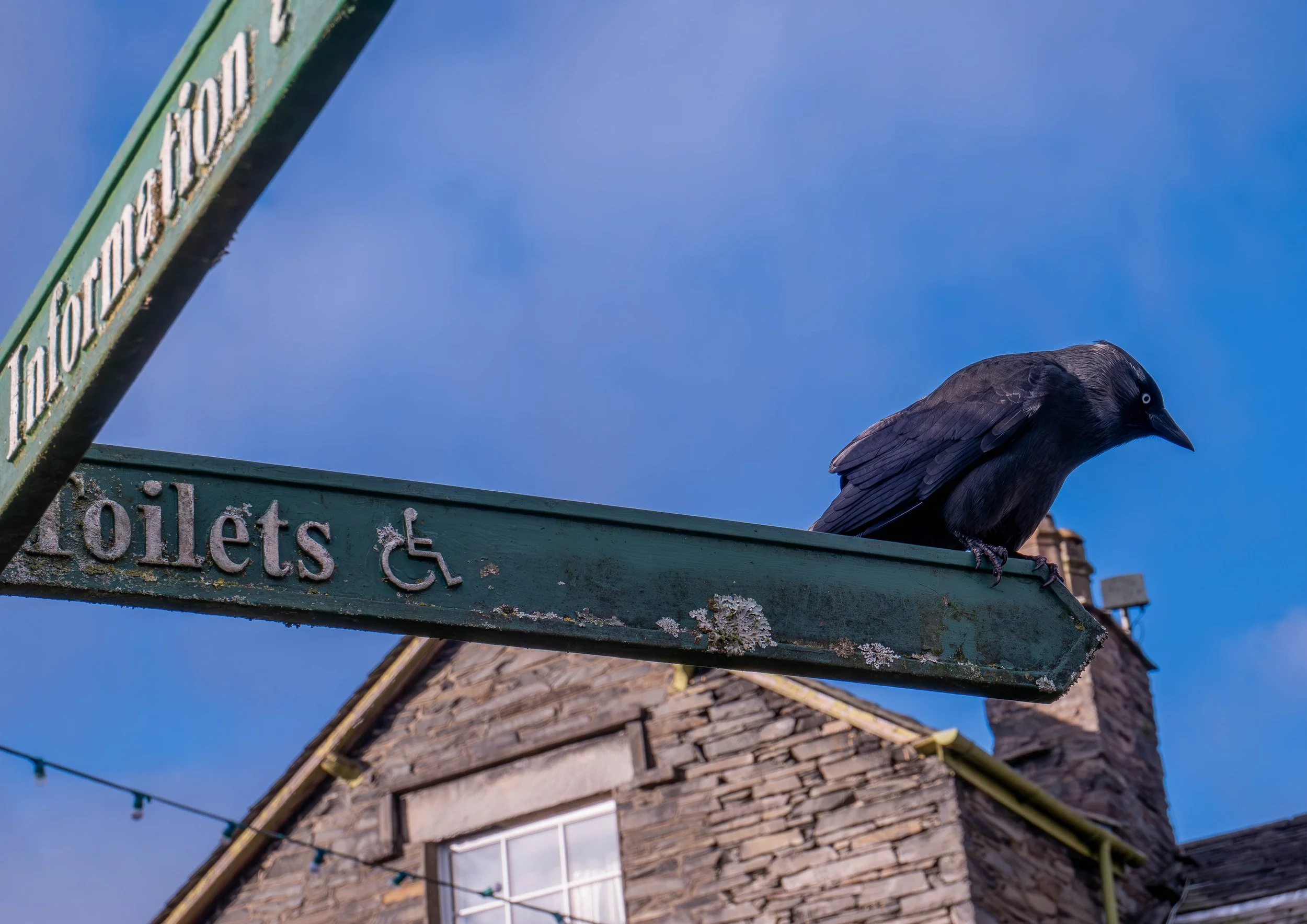
This striking photo captures a Western Jackdaw perched on a weathered signpost, perfectly blending the natural intelligence of the Lake District’s wildlife with the region's rustic, human-made landscape.
The composition highlights several elements that make the Lake District so evocative:
The Subject: The Clever Jackdaw
The bird is a Western Jackdaw (Coloeus monedula), easily identified by its silvery-grey nape and piercing pale white eye. Jackdaws are members of the crow family and are known for being incredibly social and opportunistic. Seeing one perched on a sign for "Toilets" or "Information" is quite fitting—they are the "know-it-alls" of the avian world, often found hanging around villages like Ambleside or Keswick, waiting for a stray crumb from a hiker's sandwich.
The Setting: Weathered Charm
The Signpost: The moss and lichen growing on the green wooden sign suggest the damp, humid climate of Cumbria. The mix of functional signage (including the accessibility symbol) and the encroaching nature is a common sight in National Park car parks and visitor centers.
The Architecture: In the background, we see a glimpse of traditional Lakeland slate construction. The jagged, grey stone building with its heavy lintels is quintessential to the Lake District aesthetic, grounding the image in its specific geographical location.
Mood and Atmosphere
The deep blue sky provides a crisp, high-contrast background that makes the bird's dark silhouette and the green of the sign pop. There is a sense of quiet, early-morning clarity here—the kind of light you get in the Lakes just after the mist has cleared, but before the crowds arrive.
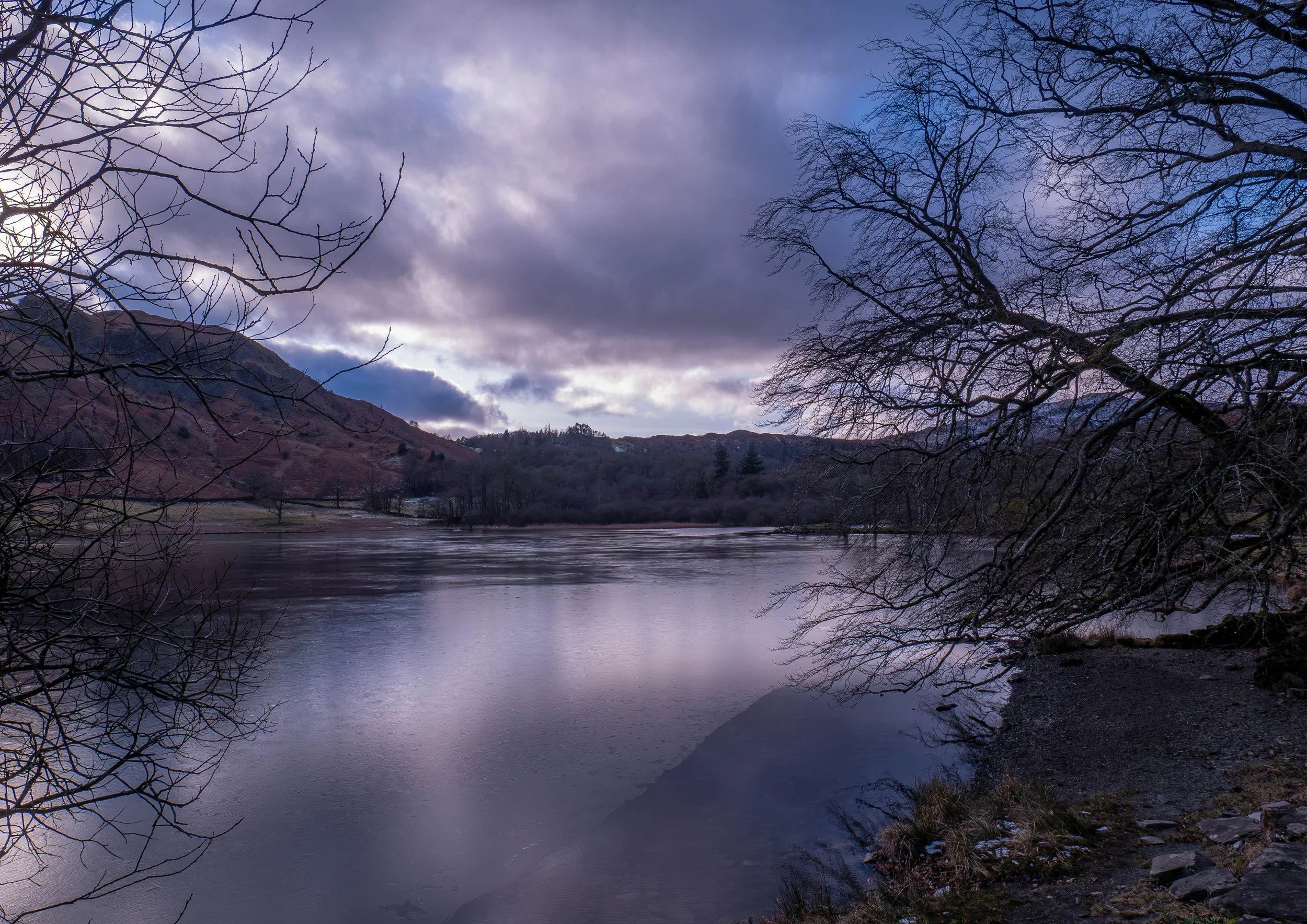
This image captures the quiet, brooding atmosphere of the Lake District during what appears to be the transition into winter. The scene likely depicts a smaller tarn or the edge of a major lake like Rydal Water or Grasmere, framed by the skeletal branches of deciduous trees.
The composition and lighting tell a specific story of the Cumbrian landscape:
The Atmosphere
The palette is dominated by cool purples, deep indigos, and muted greys, suggesting either the blue hour of dawn or a late winter afternoon. The heavy, low-hanging clouds are characteristic of the Lake District’s unpredictable weather, creating a sense of isolation and stillness. The way the light breaks through the center of the clouds casts a soft, metallic sheen across the water’s surface.
Texture and Detail
The Foreground: The intricate, leafless "fractal" patterns of the tree branches act as a natural frame. They add a layer of complexity and texture against the smoother surface of the water.
The Water: The lake surface looks almost viscous or partially frozen, reflecting the sky with a mirror-like quality that is slightly interrupted by the dark shoreline on the right.
The Fells: In the background, the rolling hills (fells) show the rust-colored hues of dead bracken, a staple of the Cumbrian autumn and winter landscape.
A Sense of Place
There is a profound silence in this photo. It captures the "Romantic" essence that inspired poets like Wordsworth and Coleridge—the idea of the sublime, where nature feels vast, ancient, and indifferent to human presence. The absence of people or buildings emphasizes the raw, geological beauty of Cumbria.
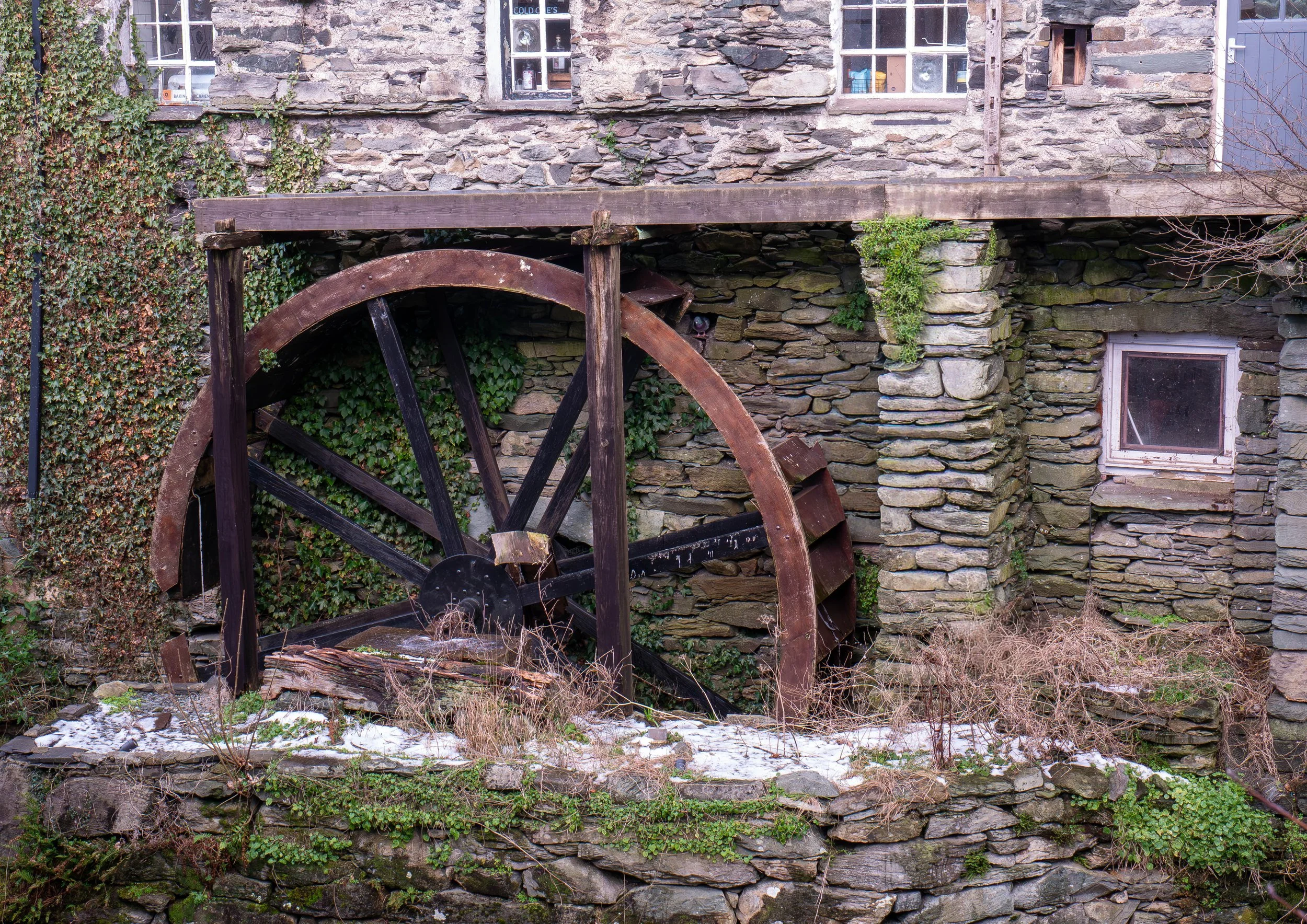
This image captures the quiet, enduring spirit of Cumbria’s industrial past. It shows an old, weathered waterwheel nestled against a traditional dry-stone wall, likely part of a former mill or farmstead in the Lake District.
The scene is a beautiful example of how nature and human engineering coexist over time. Here is a closer look at the elements that make this photo so characteristic of the region:
1. Traditional Stonework
The structure is built from Lakeland slate and fieldstone, stacked in the classic "dry stone" style common throughout the Lake District. You can see how the stones are carefully wedged to create a sturdy frame around the window and the wheel’s housing.
2. The Mechanics of the Past
The Overshot Design: This appears to be an overshot wheel, where water would have been channeled via a wooden trough (the "launder") onto the top of the wheel.
The Hub and Spokes: The heavy timber spokes and iron-reinforced hub suggest this was a serious workhorse, perhaps used for grinding corn, crushing minerals, or powering a small textile loom.
The Weathering: The deep rust on the outer rim and the moss-covered timber speak to the damp, misty climate of the fells.
3. Nature Reclaiming the Space
The ivy creeping across the stones and the dormant, wintry grass in the foreground give the image a peaceful, melancholic atmosphere. The patches of lingering snow or frost at the bottom suggest a cold winter morning, a time when the Lake District is at its most rugged and quiet.
Why this matters to the Lake District
The Lake District is a UNESCO World Heritage site not just for its natural beauty, but for its cultural landscape. Industrial relics like this waterwheel are reminders of the 18th and 19th centuries when the valleys were bustling with small-scale industry powered entirely by the region's abundant rainfall and steep streams (becks).
A Small Detail: If you look closely at the masonry just above the wheel, you can see a small pigeon perched in a nook—a tiny sign of life in a scene that feels frozen in time.
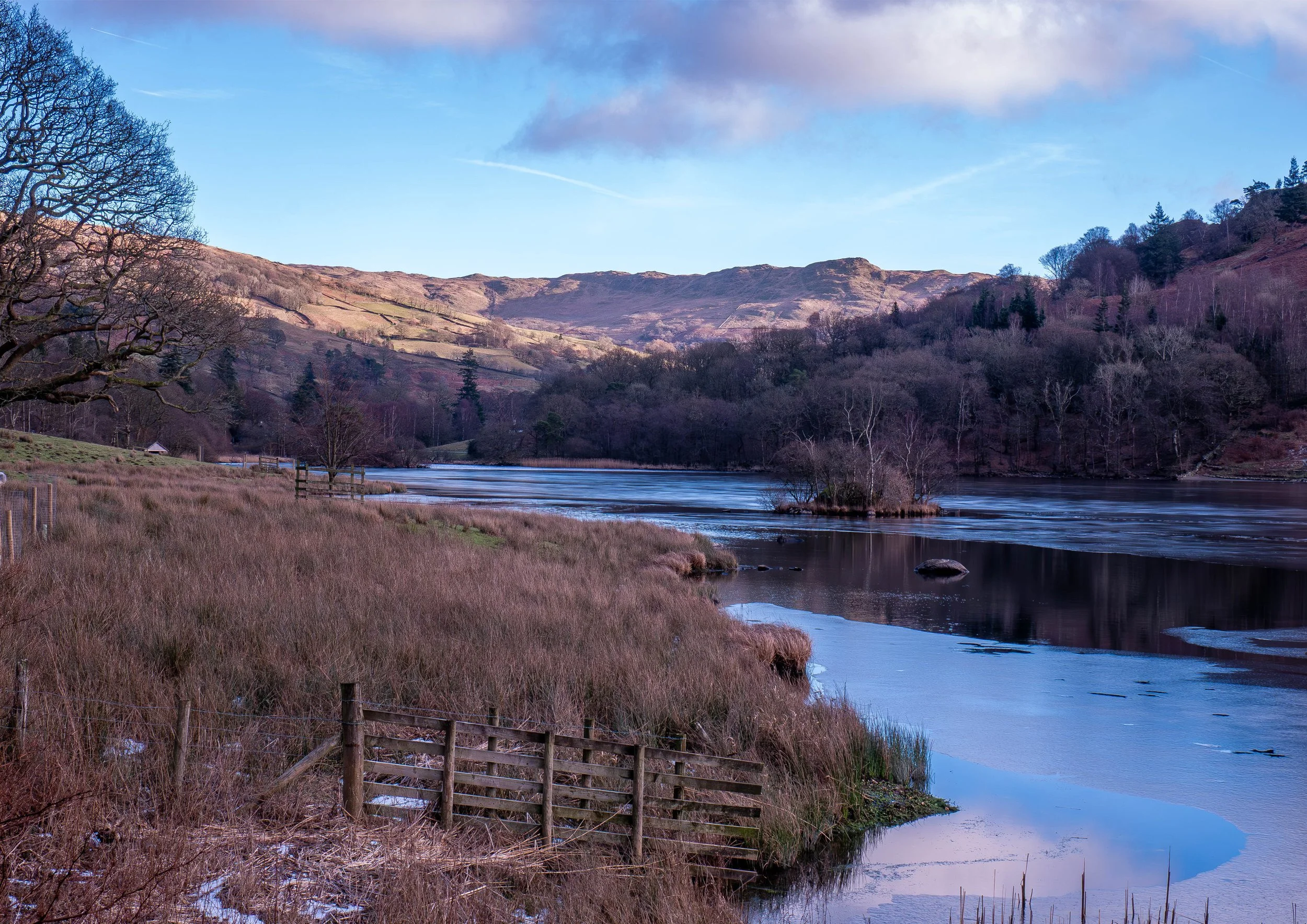
This image captures the quiet, late-afternoon soul of the Lake District, likely during the transition from autumn into winter. The scene, reminiscent of the areas surrounding Rydal Water or Grasmere, reflects the rugged yet tranquil character that has inspired poets and hikers for centuries.
The Composition and Light
The photo is defined by its cool, atmospheric palette. The low winter sun casts long shadows across the valley, illuminating the distant fell tops with a pale gold while leaving the foreground in deep, moody purples and browns.
The Foreground: The weathered wooden gate and wire fencing anchor the image in the reality of Cumbrian hill farming. The tall, dormant grasses and rushes show the "russet" tones typical of the fells in the colder months.
The Water: The lake is remarkably still, acting as a dark mirror for the surrounding woodland. The thin, icy texture on the water’s surface suggests a crisp, biting temperature—the kind of day where the air feels perfectly still.
The Fells: In the background, the characteristic craggy silhouettes of the Lake District mountains rise up. The patchwork of stone walls snaking up the hillside is a testament to the region’s UNESCO World Heritage status, marking centuries of agricultural tradition.
A Sense of Place
There is a profound sense of "stille" (the Old Norse word for quiet) in this shot. It avoids the bustling tourist energy of the summer months, instead offering a glimpse of the Lakes in their "honest" season. The bare silver birches and oaks lining the shore create a delicate, skeletal frame against the hills, highlighting the raw geology of the landscape.
"The Lake District is a place where the earth seems to breathe. In winter, that breath is visible, cold, and immensely peaceful."
Why This Image Works
The photographer has successfully captured the layered depth of a Cumbrian valley. From the rustic textures of the wooden fence to the glassy surface of the lake and the sun-drenched peaks, the eye is led on a journey through the terrain. It evokes the feeling of a rewarding walk coming to an end as the light begins to fail.
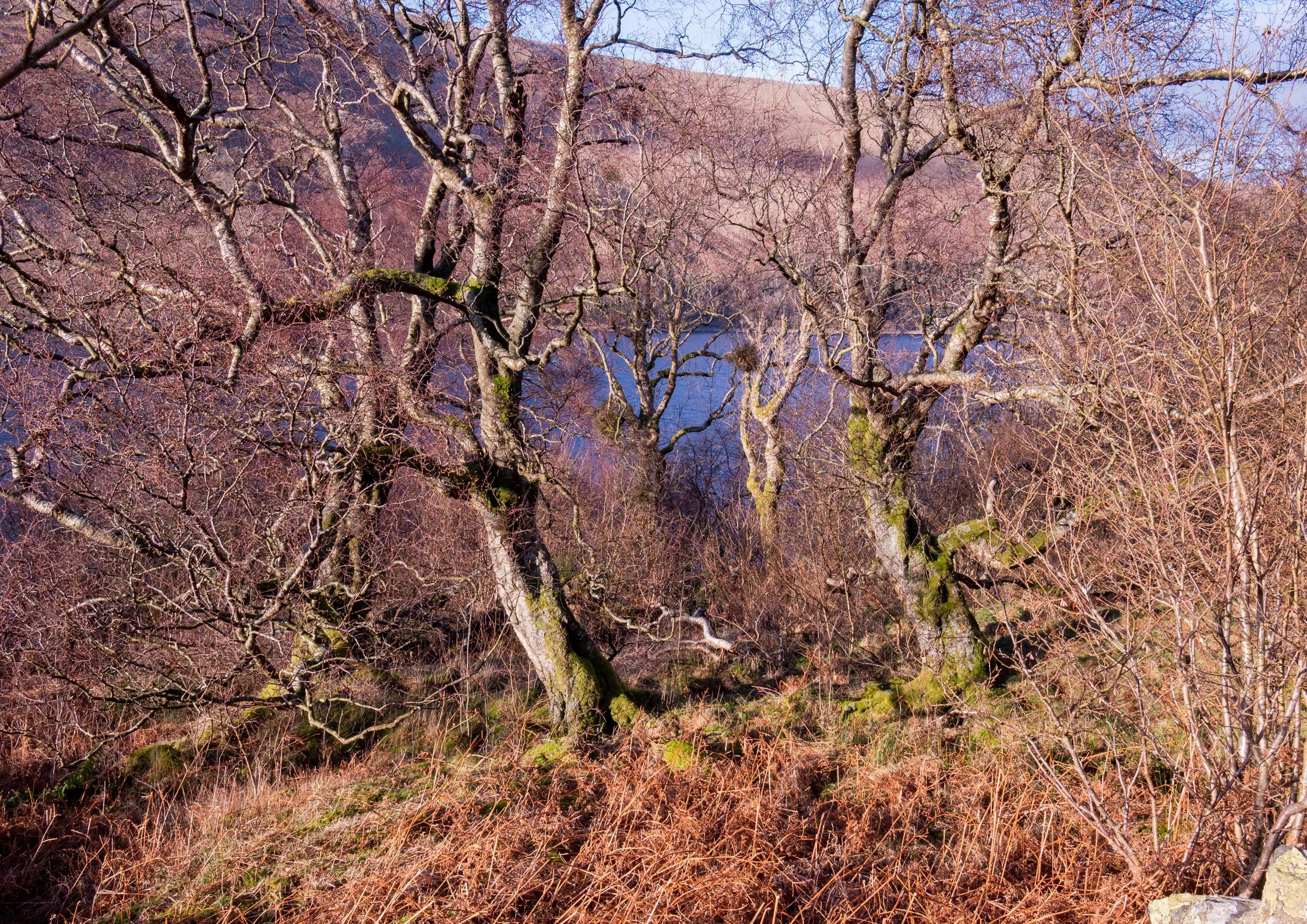
This image captures the rugged, skeletal beauty of a Cumbrian winter. The scene appears to be overlooking one of the Lake District’s famous waters—likely somewhere like Ullswater or Buttermere, where ancient oak and birch woodlands cling to the steep fellsides.
Here is a reflection on the elements that make this shot quintessentially "Lakeland."
The "Atlantic Oakwood" Aesthetic
The twisted, moss-covered trunks suggest these are part of Britain’s temperate rainforests. The high humidity of the Lake District allows bryophytes (mosses and liverworts) to flourish, coating the bark in a vibrant green that contrasts sharply with the copper tones of the dormant bracken on the forest floor.
A Study in Texture and Light
The Foreground: The dense, interlacing branches of the birch and oak create a natural "lace" over the landscape. Without leaves to block the view, the structural complexity of the trees takes center stage.
The Palette: There is a beautiful "warm-meets-cold" color profile here. The low winter sun brings out the russet and ochre of the dead ferns, while the deep, cold blue of the lake peeks through the center, providing a focal point of stillness.
The Fells: In the background, the soft, hazy browns of the rising fells provide a sense of scale, reminding the viewer that these woods are nestled in a high-altitude, mountainous environment.
The Atmosphere
There is a profound sense of quietude in this photo. It captures the "off-season" in Cumbria—the time when the crowds have thinned, the air is crisp, and the landscape feels raw and ancient. The way the trees lean suggests years of prevailing winds coming off the water, shaping their growth into these gnarled, resilient forms.
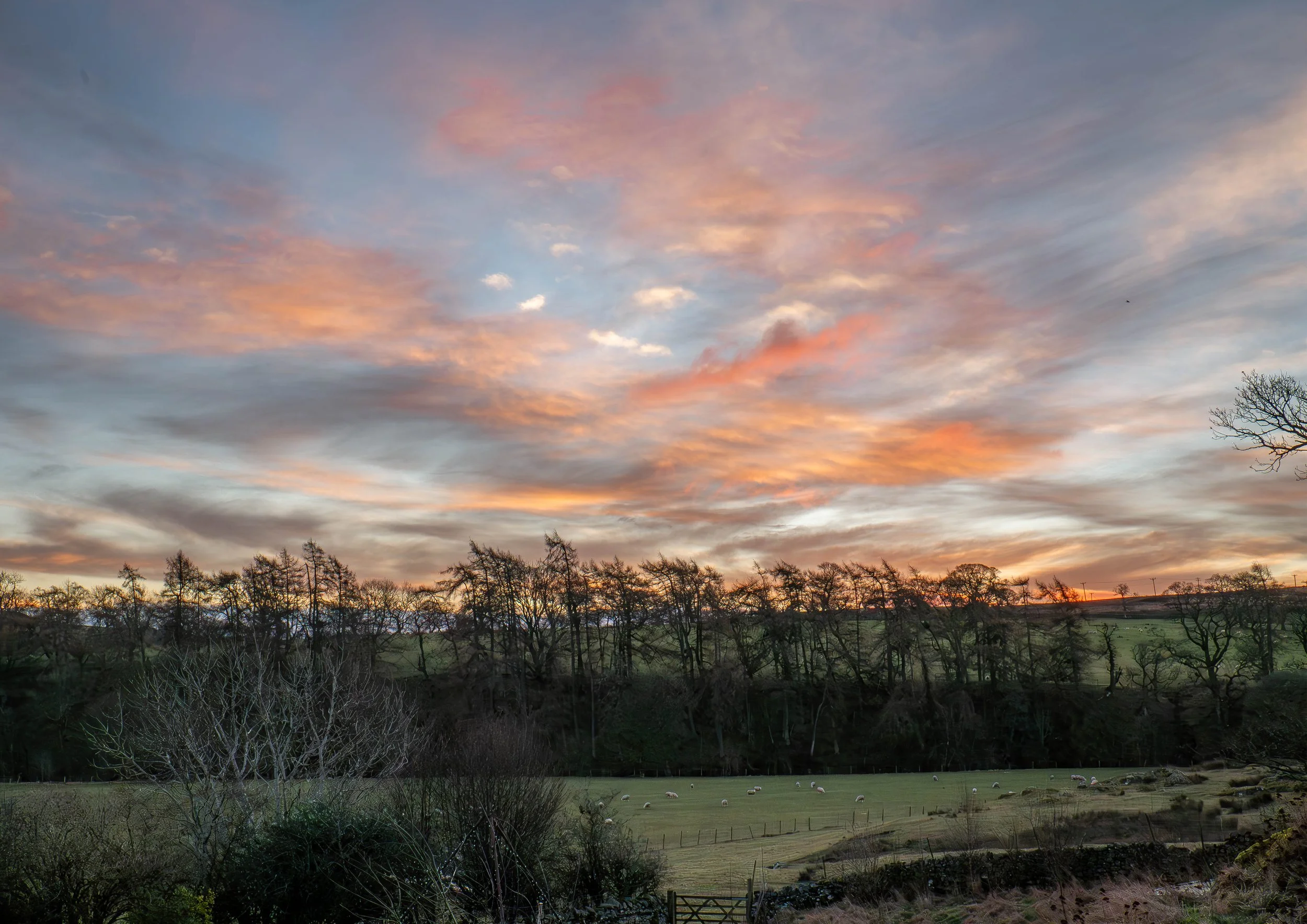
This image captures that quiet, transitionary magic that the Lake District is so well known for. While many photos focus on the dramatic peaks of the fells, this scene highlights the pastoral beauty of the Cumbrian valleys and the expansive "big sky" moments found in the Eden Valley or the fringes of the National Park.
Atmosphere and Light
The defining feature of this photograph is the crepuscular light. The soft, feathered cirrus clouds act as a canvas for the setting sun, scattering light into shades of apricot, rose, and pale violet.
The Sky: The long, wispy streaks suggest a high-altitude wind, typical of the changing weather patterns in Northern England.
The Silhouette: The line of deciduous trees—likely larch or oak—provides a stark, dark contrast to the glowing horizon. Their bare branches indicate a scene captured in late autumn or winter, when the Lakeland air is crisp and clear.
The Cumbrian Landscape
The lower third of the image grounds the ethereal sky in the reality of Lake District life:
Pastoral Life: You can see a scattering of sheep grazing in the field below. These are likely Herdwicks or Swaledales, the hardy breeds that have shaped this landscape for centuries.
Tiered Perspective: The composition moves from the tangled brush in the foreground to the structured treeline, eventually opening up to the rolling hills in the far distance.
Color Palette: The cool, muted greens of the winter grass provide a perfect anchor for the warm, fiery tones above.
"The Lake District is a place where the earth and sky seem to have a constant, glowing conversation."
Photography Reflection
The wide-angle perspective chosen here captures the scale of the Cumbrian horizon. It isn't just a picture of a sunset; it’s a picture of the stillness that settles over the fells once the hikers have headed home and the day begins to fade.
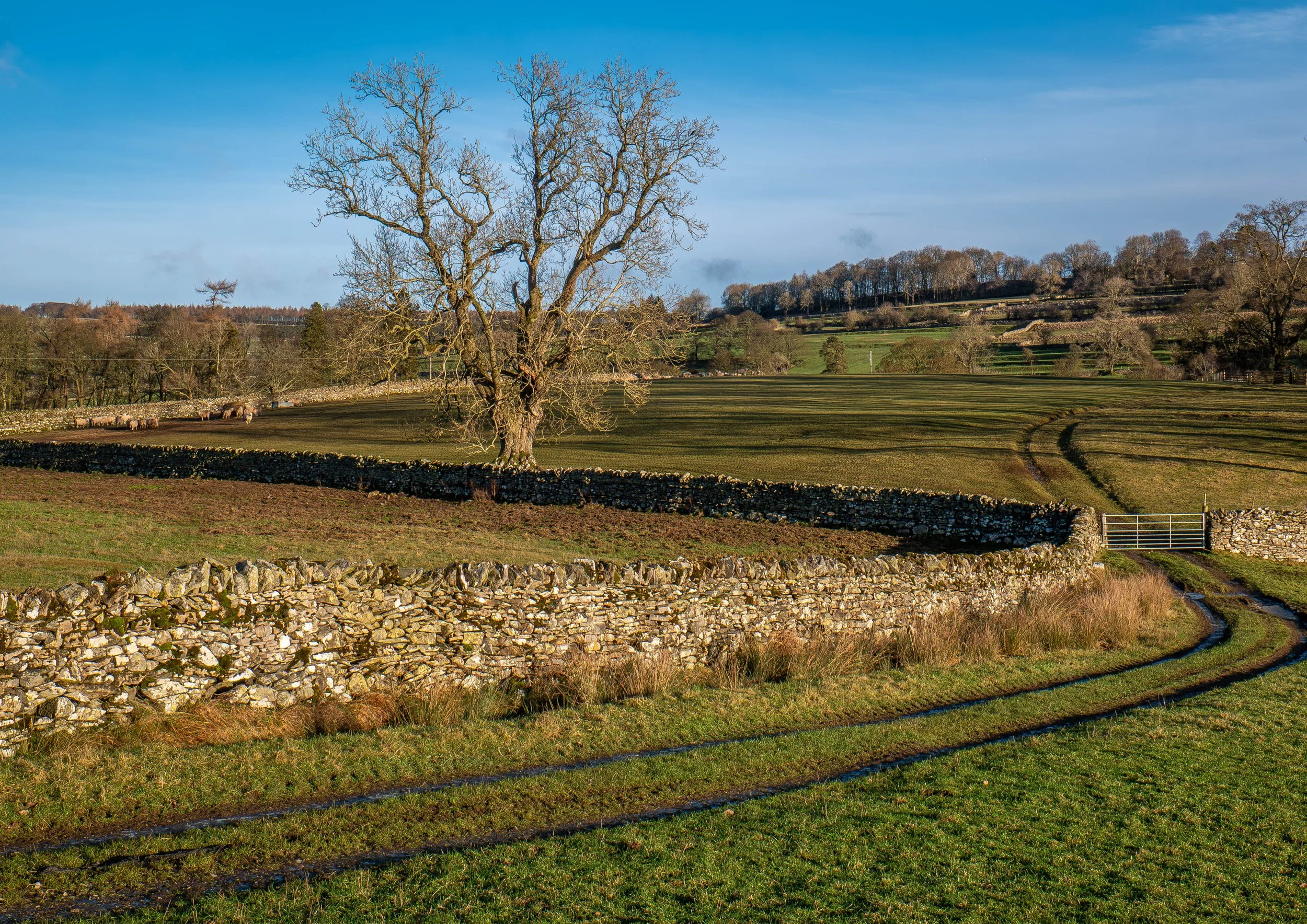
This image captures the quiet, rugged charm of the Lake District in Cumbria, likely during the late autumn or winter months. It beautifully illustrates the agricultural heritage and geological character that earned this region its UNESCO World Heritage status.
The Landscape Elements
Dry Stone Walls: The primary focal point is the intricate network of dry stone walls. These are a signature of the Cumbrian landscape, built without mortar using local limestone or slate. They follow the natural contours of the undulating fells, serving both as livestock boundaries and as a testament to centuries of hill farming.
The Bare Oak: A solitary, leafless deciduous tree (likely an oak) dominates the mid-ground. Its skeletal form suggests the "dormant" season, allowing the low-angled sun to cast long, dramatic shadows across the pasture.
The "S-Curve" Track: The muddy tire tracks leading toward the metal gate create a classic leading line in photography. It draws the eye into the composition, suggesting the daily rhythm of farm life and the movement of tractors or stock through the fields.
Atmosphere and Light
The lighting is characteristic of a "Golden Hour" in Northern England. The sun is low in the sky, illuminating the texture of the stones and the dampness of the grass with a warm, amber glow. This contrast between the bright highlights on the wall and the deep shadows in the field creates a sense of depth and tranquility.
Agricultural Heritage
In the far left of the frame, you can spot a small huddle of sheep near the wall. Sheep farming, particularly of the hardy Herdwick breed, is the lifeblood of the Lake District. The patchwork of fields, divided by stone and gate, shows how the land has been managed for generations.
A Sense of Place: This isn't just a scenic view; it's a "working" landscape. The mud in the tracks and the ruggedness of the walls remind us that while the Lake District is a place of beauty for visitors, it is a demanding environment for those who care for it.
No results found
No results match your search. Try removing a few filters.