
 Image 1 of 1
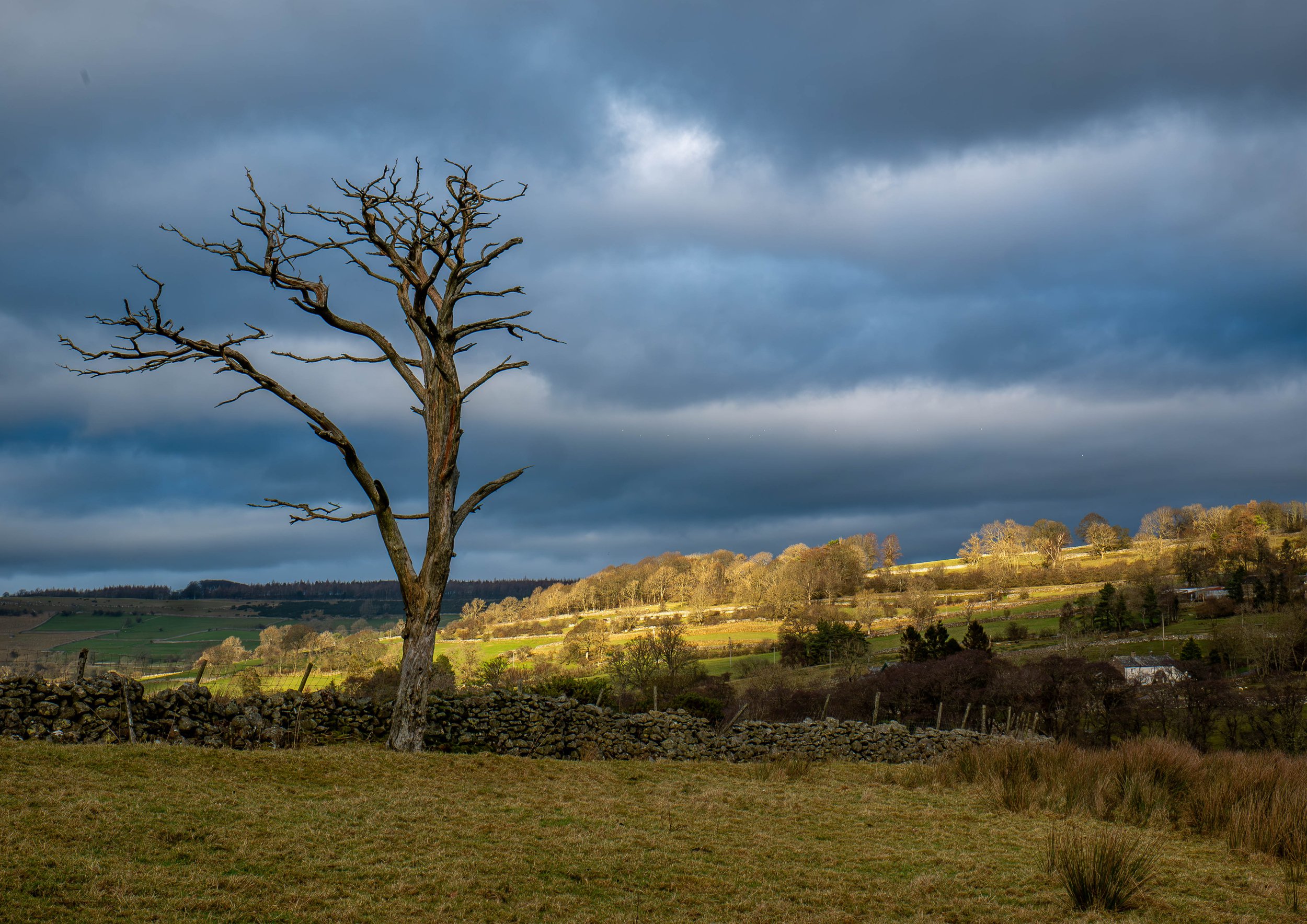
This image captures the raw, atmospheric beauty that defines the Lake District in Cumbria, particularly the transition between the rugged fells and the managed pastoral land.
Here is a reflection on the elements that make this photograph so characteristic of the Cumbrian landscape:
The most striking feature is the chiaroscuro effect—the dramatic contrast between light and shadow. In Cumbria, weather moves rapidly over the mountains. The heavy, slate-gray clouds suggest a passing storm or "smirr" (fine rain), while a sudden break in the cloud cover illuminates the distant hillside in a warm, golden glow. This "spotlighting" is a hallmark of the region’s volatile climate.
The lone, skeletal tree in the foreground serves as a powerful focal point. Stripped of its leaves, its jagged silhouette echoes the craggy peaks often found nearby. It stands as a testament to the harsh winds and the enduring nature of the Northern English countryside.
Running across the mid-ground is a classic dry stone wall. These are the stitches that hold the Cumbrian landscape together. Built without mortar from local stone (likely slate or limestone depending on the specific valley), these walls have marked boundaries and corralled Herdwick sheep for centuries. Their presence reminds us that this is a "working" landscape, shaped by generations of hill farmers.
The composition uses "layering" to create depth, a technique often used to capture the scale of the fells:
Foreground: Rough grazing grass and the stark tree.
Mid-ground: The textured dry stone wall and the sun-drenched "intake" land (fields reclaimed from the moor).
Background: The rising slopes of the fells, showing the transition from deciduous woodland to open pasture.
This photo feels like it could have been taken in the quiet back-slopes of Longsleddale or perhaps looking across the lower reaches of Eden Valley. It perfectly captures that "brooding" British autumnal or early spring mood where the land feels both ancient and alive.
This image captures the raw, atmospheric beauty that defines the Lake District in Cumbria, particularly the transition between the rugged fells and the managed pastoral land.
Here is a reflection on the elements that make this photograph so characteristic of the Cumbrian landscape:
The most striking feature is the chiaroscuro effect—the dramatic contrast between light and shadow. In Cumbria, weather moves rapidly over the mountains. The heavy, slate-gray clouds suggest a passing storm or "smirr" (fine rain), while a sudden break in the cloud cover illuminates the distant hillside in a warm, golden glow. This "spotlighting" is a hallmark of the region’s volatile climate.
The lone, skeletal tree in the foreground serves as a powerful focal point. Stripped of its leaves, its jagged silhouette echoes the craggy peaks often found nearby. It stands as a testament to the harsh winds and the enduring nature of the Northern English countryside.
Running across the mid-ground is a classic dry stone wall. These are the stitches that hold the Cumbrian landscape together. Built without mortar from local stone (likely slate or limestone depending on the specific valley), these walls have marked boundaries and corralled Herdwick sheep for centuries. Their presence reminds us that this is a "working" landscape, shaped by generations of hill farmers.
The composition uses "layering" to create depth, a technique often used to capture the scale of the fells:
Foreground: Rough grazing grass and the stark tree.
Mid-ground: The textured dry stone wall and the sun-drenched "intake" land (fields reclaimed from the moor).
Background: The rising slopes of the fells, showing the transition from deciduous woodland to open pasture.
This photo feels like it could have been taken in the quiet back-slopes of Longsleddale or perhaps looking across the lower reaches of Eden Valley. It perfectly captures that "brooding" British autumnal or early spring mood where the land feels both ancient and alive.