
Portraits
Portraits
Filters
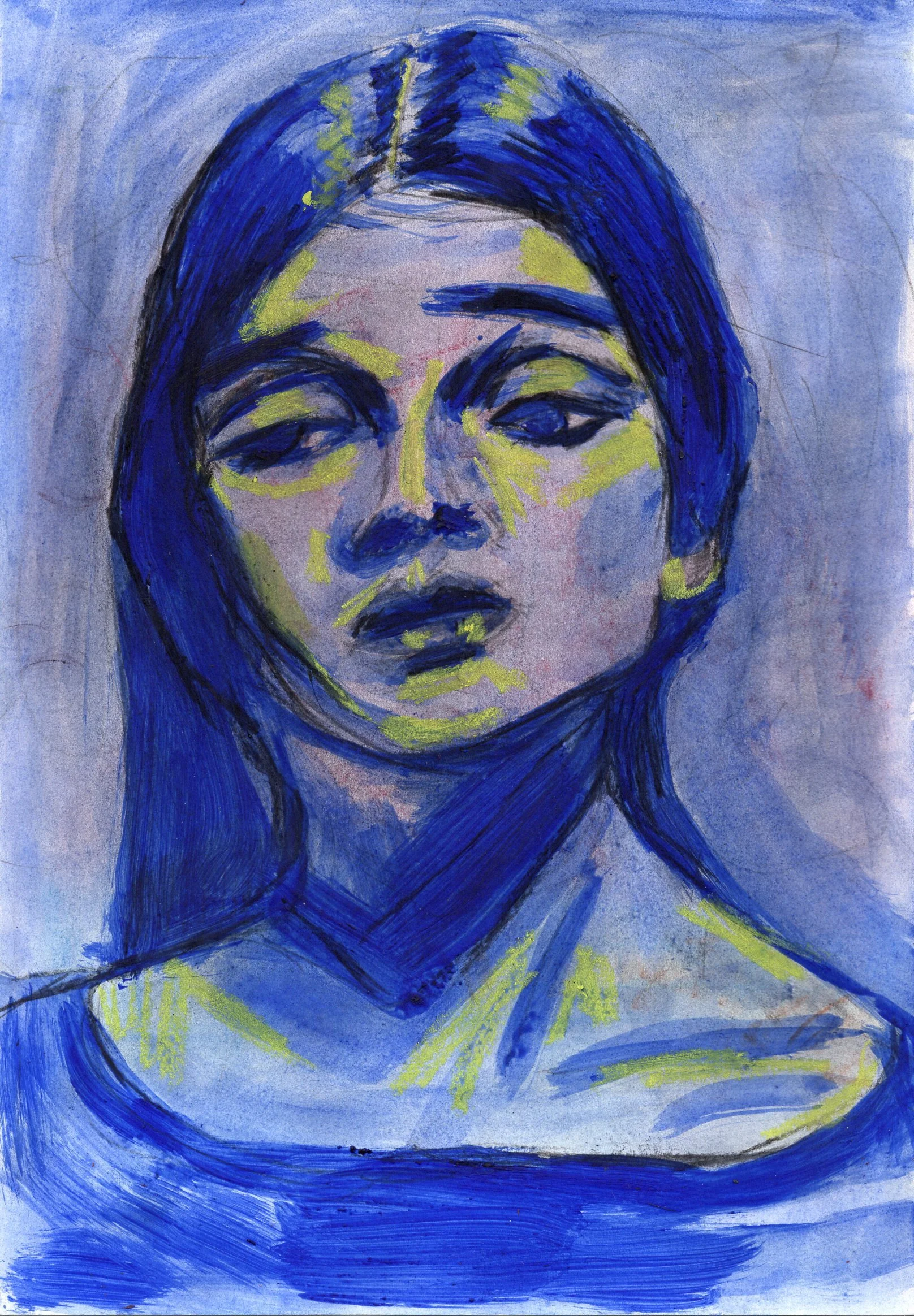
A4 picture in a 30×40 cm white mount (Frame NOT included).
This portrait radiates an emotional tension that feels both intimate and distant. The artist uses an expressive, almost turbulent palette dominated by deep blues, giving the figure a sense of quiet melancholy or introspective stillness. Splashes of yellow-green break through the blue, highlighting the contours of the face and adding a sense of flickering light like illumination from an unseen, shifting source. These contrasting colors create a visual vibration that makes the face feel alive, even unsettled.
The subject’s expression is ambiguous. Her half-closed eyes and slightly parted lips suggest a moment of thought, vulnerability, or exhaustion. She appears present but unreachable, as if lost in an internal landscape more vivid than the physical space around her. The brushwork reinforces this sense: rough, layered strokes form a textured surface where emotion is carried as much by the medium as by the figure.
Her elongated neck and the simplified lines of her clothing give the portrait a calm, sculptural quality, balancing the intensity of the color. The background, washed in pale blues and muted tones, sets her apart from her environment, emphasizing her isolation and atmosphere of introspection.
Overall, the portrait feels like a study in mood—an exploration of how color and gesture can evoke inner states. It is not merely a likeness of a person but a visual expression of emotional depth, fragility, and quiet strength.
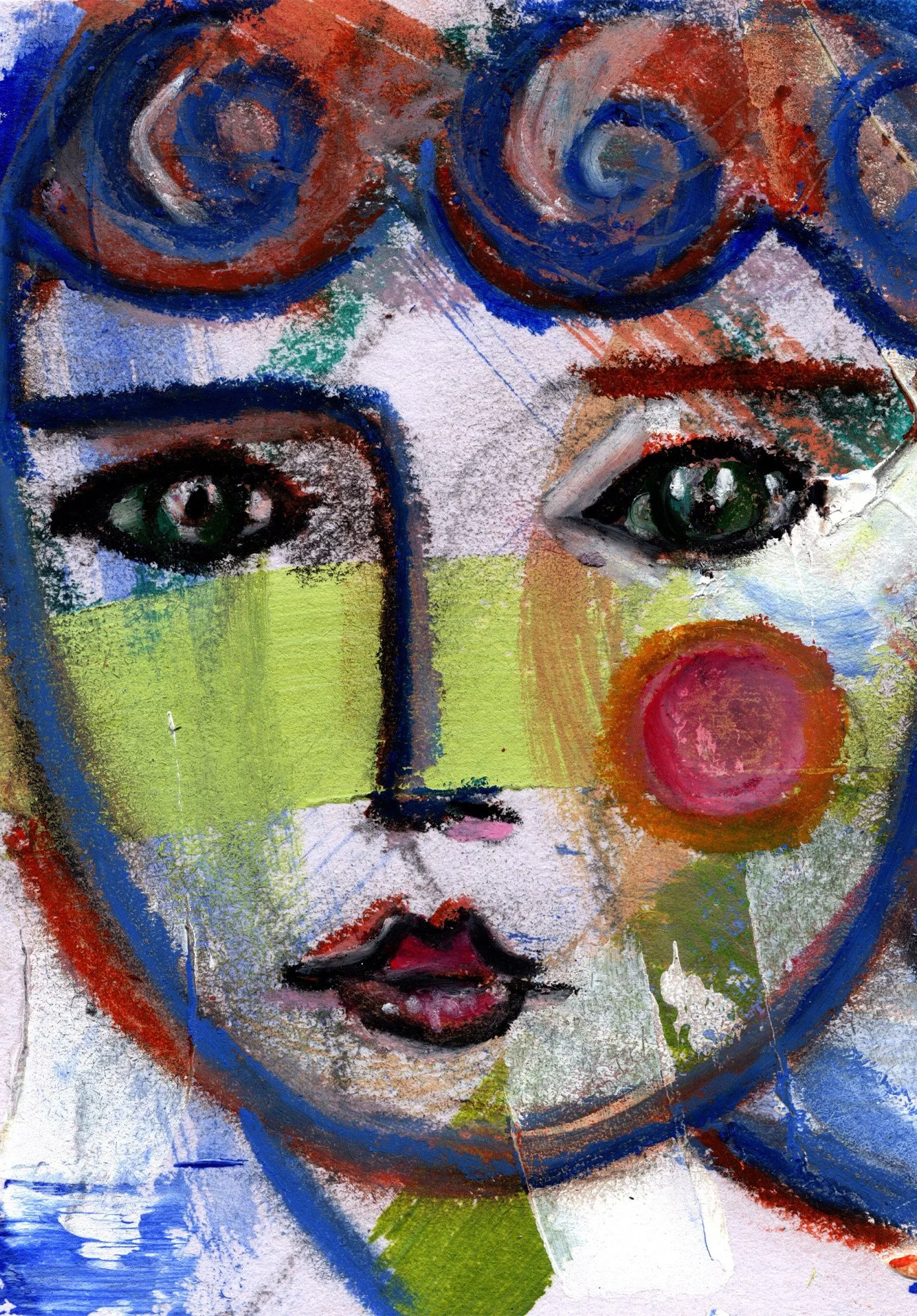
This painting presents a stylized, abstract portrait rendered with bold strokes and expressive color blocking. The face is simplified into strong, confident lines particularly the deep blue contour that frames the cheeks and jaw, and the thick vertical and horizontal strokes that define the nose and eye line.
What stands out immediately is the artist’s use of color to shape mood and personality. A broad swath of lime green cuts across the center of the face, creating a sense of calm or introspection, while the vivid red circle on the right cheek introduces warmth and emotion, almost like a symbolic blush or a sun-like mark of vitality. The lips, painted in layered shades of pink and crimson, suggest sensitivity or contemplation.
Above the eyes, swirling red-blue forms evoke hair, clouds, or thought spirals adding movement and a dreamlike quality. The eyes themselves are striking: green, reflective, and rendered with unexpected realism compared to the rest of the composition. They act as a focal point, grounding an otherwise free, layered, and textured surface.
The brushwork is energetic and layered; you can see the underlying textures of previous strokes, scratches, and smudges, giving the piece a raw and emotional tactility. The overall composition blends childlike simplicity with sophisticated abstraction, resulting in a portrait that feels both vulnerable and vibrantly alive.
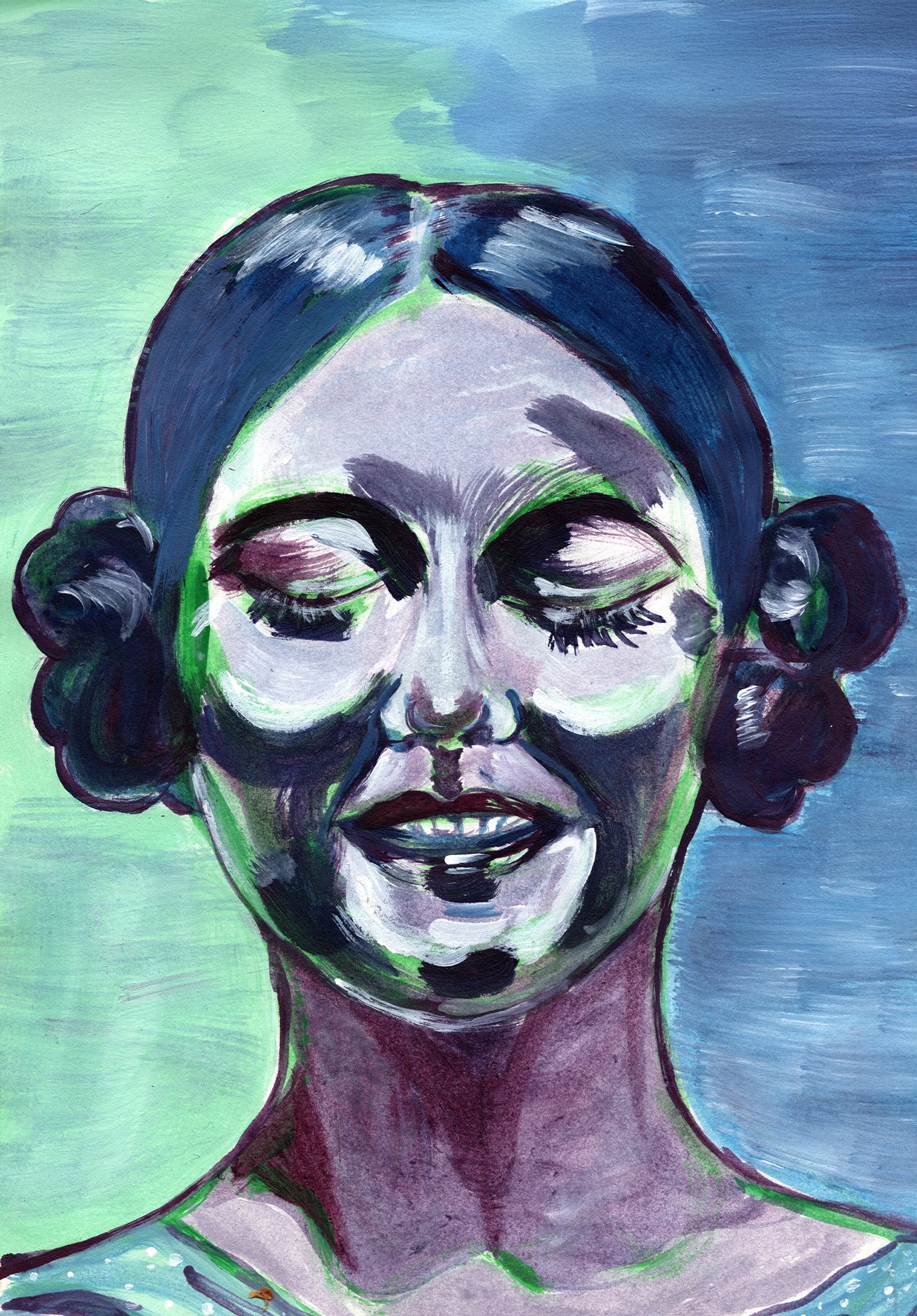
A4 picture in a 30×40 cm white mount (Frame NOT included).
This is a striking and emotionally expressive painting, rendered primarily in cool, vibrant colors like blues, greens, and deep purples. It appears to be a framed portrait, possibly done in acrylics or gouache, given the visible texture and broad, expressive brushstrokes. The skin tones are represented by stark contrasts of deep purple/maroon, brilliant neon green, and pale lavender/grey. This high contrast creates a dramatic, almost theatrical lighting effect, emphasizing the bone structure of the cheeks, nose, and brow. The hair is a dark, inky blue/purple, styled in two prominent buns or coils on either side of the head. The background is an abstract blend of horizontal brushstrokes, transitioning from a mint/aqua green at the bottom to a deep, stormy blue at the top. The closed eyes and wide, slightly unsettling smile suggest a complex, inward-focused emotion perhaps intense joy, relief, or a kind of ecstatic, trance-like state. The green highlights around the eyes give the impression of deep shadows or dramatic makeup.
The painting utilizes Expressionistic elements, prioritizing the emotional impact and the artist's subjective experience over realistic depiction. The aggressive, non-naturalistic use of color transforms a simple portrait into a study of internal feeling. The neon green highlights against the deep purple shadows create an arresting, almost spectral quality, making the subject feel both vulnerable and intensely alive.
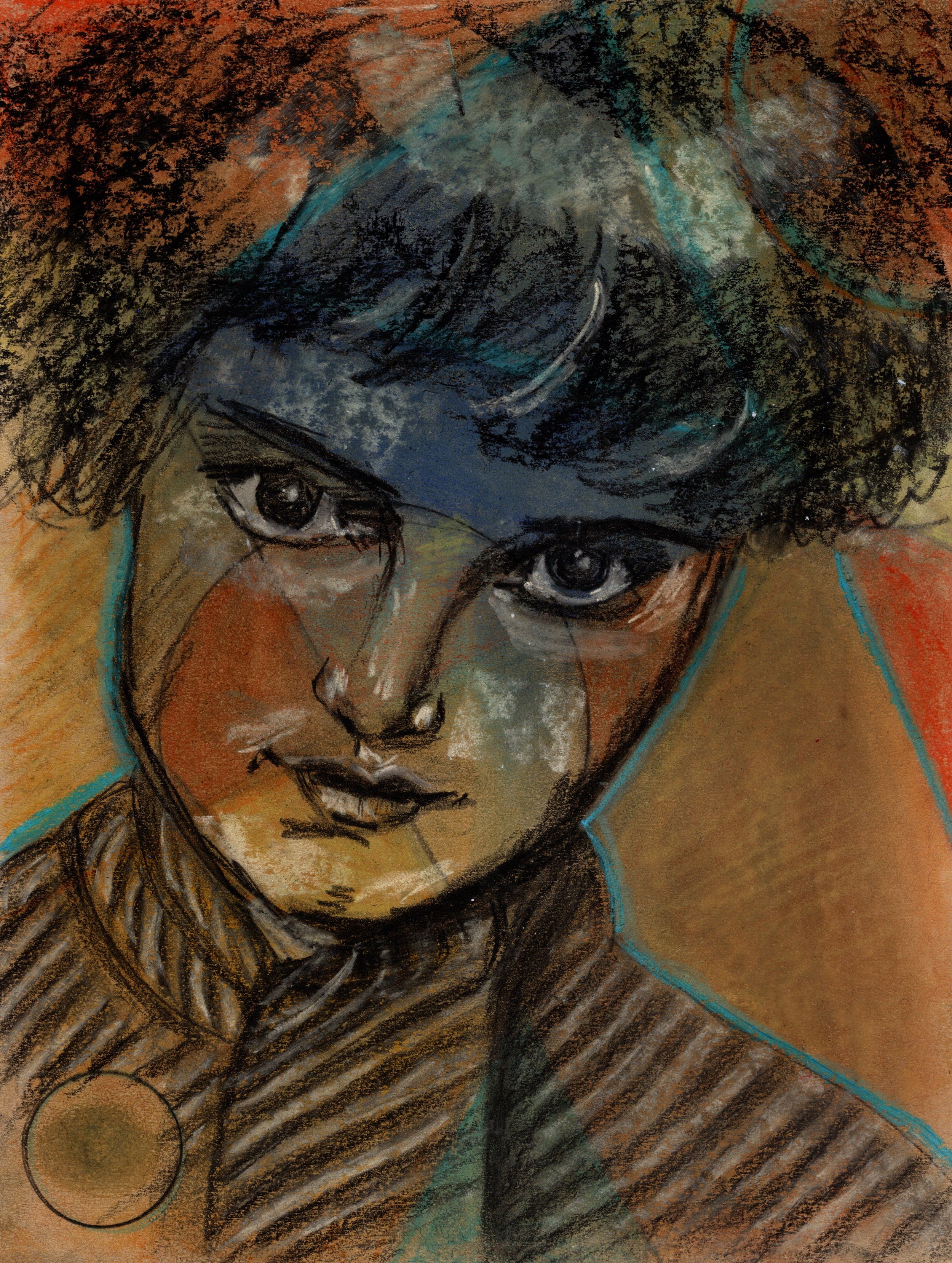
A4 picture in a 30×40 cm white mount (Frame NOT included).
This image is a portrait executed in a mixed media style, likely incorporating pastel, charcoal, or crayon due to the visible texture and layering of colors.
Subject: The central focus is a person, likely a young individual, depicted in a close-up, slightly tilted view. The gaze is direct and intense, looking straight out at the viewer.
Style: The style is expressionistic and abstract. It is not a literal, photographic rendering; instead, it uses bold, gestural marks and non-naturalistic colors to convey mood and character.
Color Palette: The dominant colors are earthy browns and oranges, which provide a warm background, contrasted sharply with cool blues and teal used on the hair and face. This juxtaposition of warm and cool tones adds depth and dynamism.
Technique:
The face is fragmented by fields of color, such as the blue patch on the forehead, suggesting an internal or emotional landscape rather than just external appearance.
The clothing (a jacket or collar) is indicated by distinct, dark, diagonal stripes, adding a pattern element that contrasts with the softer textures of the hair and background.
A bold, aqua-blue outline defines parts of the figure, separating it from the background and acting as a strong graphic element.
Composition: The figure fills much of the canvas space, creating an intimate yet powerful connection with the viewer. The overall presentation is a framed print, with a wide white mat and a black frame, which modernizes and formalizes the artwork.
The portrait evokes a sense of melancholy, introspection, or deep emotion due to the serious expression and the striking use of color and shadow. The way the colors overlay and interact suggests layers of identity or feeling.
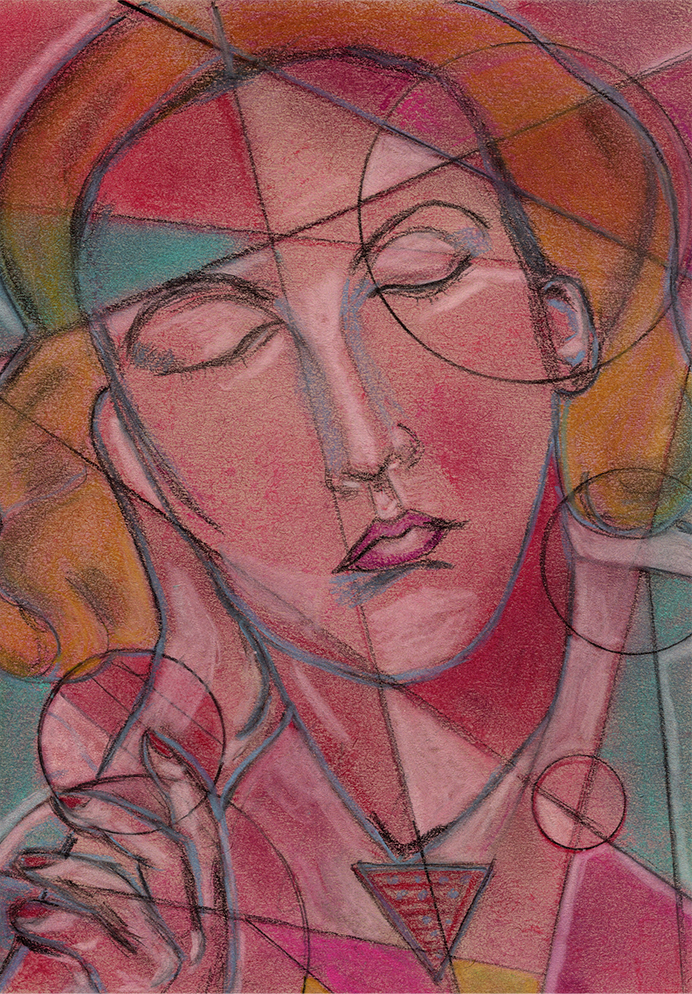
A4 picture in a 30×40 cm white mount (Frame NOT included).
This painting is a striking portrait that appears to blend elements of Cubism and Fauvism with a contemporary or stylized approach.
Style and Technique
Geometric Abstraction: The face and figure are heavily broken down into geometric shapes (triangles, rectangles, circles, and linear segments) reminiscent of Cubism. This fragmentation is used to structure the composition rather than purely to depict multiple perspectives.
Contour Lines: Prominent blue/cyan lines outline the facial features and geometric divisions. These strong contours define the structure and add a sense of graphic precision to the softer color fields.
Color Palette: The dominant colors are warm pinks, reds, and flesh tones, providing a passionate or introspective mood. These are contrasted with cooler cyan and teal accents in the background and dividing lines, creating a vibrant tension. The hair is rendered in warm ochres and oranges.
Texture: The visible brushwork and shading suggest the medium could be pastel, chalk, or a mixed media on a textured surface, giving the piece a palpable, slightly grainy quality.
Subject and Mood
The Subject: The painting depicts the head and shoulders of a woman. Her eyes are closed, suggesting a state of meditation, contemplation, or rest.
Pose and Gesture: Her head is slightly tilted, and a hand, also geometrically rendered, is resting near her cheek or ear. This gesture enhances the sense of introspection and quiet intensity.
Mood: The combination of closed eyes, the strong, angular structure, and the warm, intense colors creates a mood that is both vibrant and deeply personal. It feels like a moment captured in time, viewed through a complex geometric lens.
Key Takeaways
The work successfully marries a deeply human, emotional subject (a moment of quiet contemplation) with a rigorous, geometric, and abstracted style. The bold use of color and the strong linear structure make it a visually arresting piece.
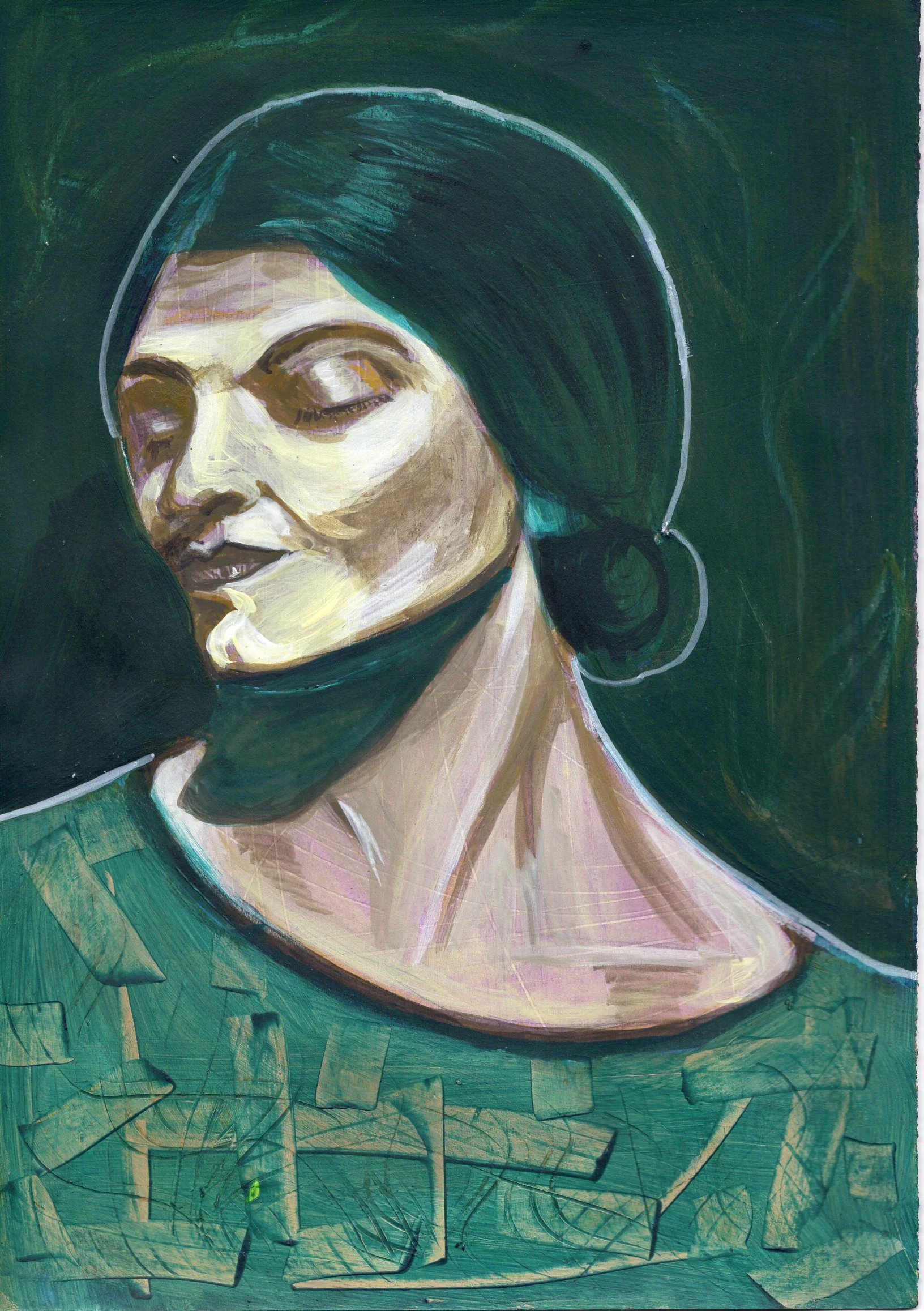
A4 picture in a 30×40 cm white mount (Frame NOT included).
The work is a bust-length portrait of a woman, framed in a dark color and set against a dark, richly textured background.
Subject and Expression: The woman is depicted with her eyes closed or cast downwards, giving her expression a sense of introspection, peace, or melancholy. Her head is tilted slightly. Her hair is dark, pulled back into a neat bun at the nape of her neck.
Color Palette: The dominant colors are deep, muted greens and dark tones, giving the piece an intense, somber, or contemplative atmosphere. The skin is rendered with pale tones, perhaps highlights of yellow, pink, and white, which stand out sharply against the dark surroundings.
Texture and Style: The most unique element is the texture, especially on the garment. The woman's top is a bright, deep green, covered in an array of geometric, angular shapes, painted in the same color but creating a dynamic, almost fragmented surface. The background also appears to have a subtle, brushy texture that keeps the dark space from feeling flat. The brushstrokes are visible and bold, suggesting an expressive, possibly Expressionist or post-impressionist approach.
Light and Shadow: Strong, dramatic shadows are cast, particularly under her chin and along the sides of her face, enhancing the three-dimensional form and adding to the dramatic mood. The lighting source appears to be focused from the upper front, illuminating the prominent features of her face and neck.
The overall effect is a portrait that feels both modern and deeply personal, focusing more on an internal state than a straightforward physical likeness.
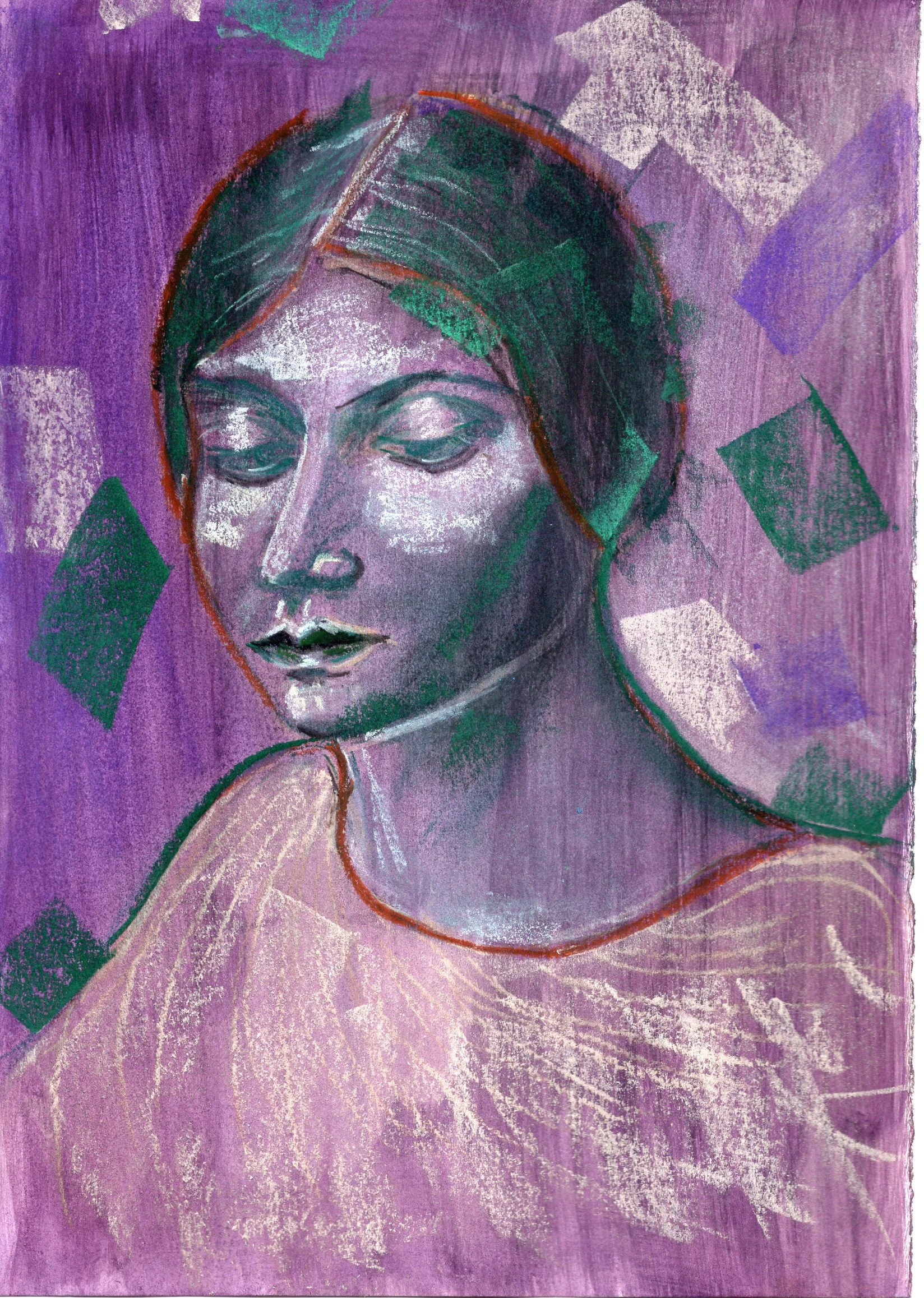
A4 picture in a 30×40 cm white mount (Frame NOT included).
This is a striking, expressive portrait executed in what appears to be a mixed media style, likely combining painting (such as acrylics or gouache) with dry media (like oil pastel or chalk).
Key Visual Elements
Subject: The central subject is a female figure depicted in a head-and-shoulders format. Her head is bowed slightly, and her eyes are closed, suggesting introspection, meditation, or quiet contemplation.
Color Palette: The dominant colors are rich, deep purples and lilacs, contrasted with cool, dark greens/teals and bright, chalky whites/silvers. The use of these cool, saturated tones creates a mysterious and somewhat somber mood.
Technique and Texture:
The background is heavily textured and active, with visible brushstrokes and layering of color.
There are distinct, angular, diamond-like shapes in the background rendered in green/teal and white, which introduce a geometric, abstract element and provide a dynamic contrast to the organic form of the figure.
The figure's face and clothing utilize a lot of white or light-colored dry media, creating a luminous, almost ghostly or ethereal effect against the darker background.
There is a visible use of thin, dark outlines (possibly in a reddish-brown or dark green) around the face, neckline, and shoulders, which defines the form.
Interpretation and Mood
Mood: The closed eyes, subtle pose, and dominant cool colors evoke a feeling of calmness, introspection, and melancholy. The figure seems detached from the viewer, fully absorbed in an internal state.
Style: The style leans toward Expressionism, focusing on conveying emotion and subjective experience rather than pure objective reality. The rough texture and non-naturalistic color choices enhance this expressive quality. The geometric elements could also suggest an influence of early 20th-century movements like Cubism or Futurism, simplifying and angularizing the space.
Overall, the piece is a captivating study of an internal emotional landscape, using strong color and texture to draw the viewer into the figure's quiet world.
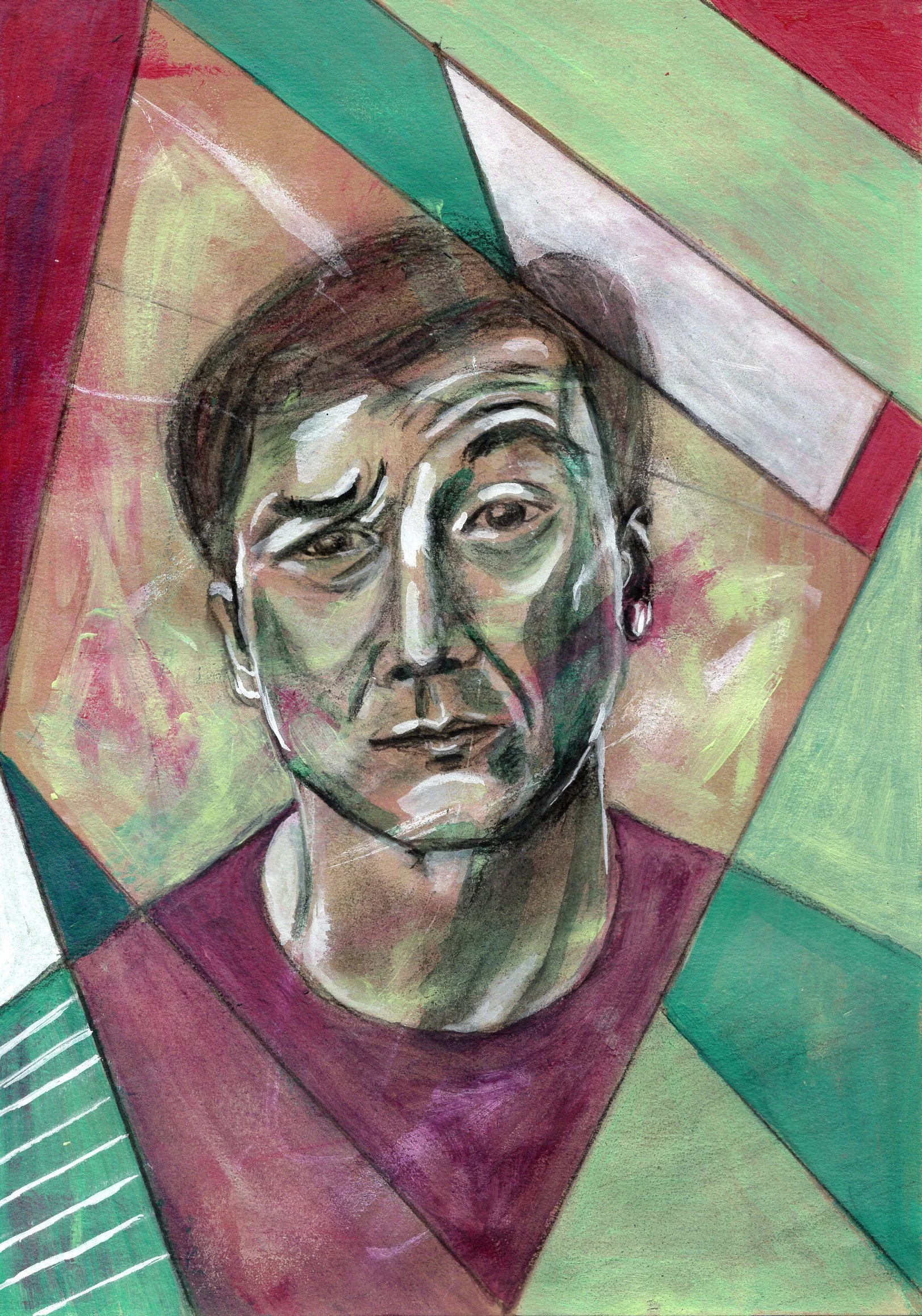
A4 picture in a 30×40 cm white mount (Frame NOT included).
This is a striking, framed portrait that appears to be a mixed-media work, likely featuring paint and drawing materials, by an artist named R.G. Osbaldeston, whose copyright is visible in the lower left.
Subject and Expression
Subject: The central focus is the head and shoulders of an adult male.
Expression: The man has a somber, perhaps melancholic or weary expression. His brow is furrowed, and his eyes look directly out, conveying a sense of intensity or inner turmoil.
Style: The portrait itself is rendered with a realistic yet expressive approach. The colors used on his skin are highly stylized, featuring green, yellow, and red undertones, giving the face a dramatic, almost sickly or spectral cast, moving it away from pure naturalism.
Composition and Background
Background: The figure is set against an abstract and highly geometric background.
Geometry and Color: The background is constructed from sharp, angular planes and shapes in contrasting and complementary colors, primarily shades of green (teal/emerald) and red/maroon, interspersed with sections of pale yellow/lime green. This hard-edged, segmented quality gives the piece a fractured, Cubist-like energy.
Framing: The composition is contained within a white border and a simple, thick black frame, which effectively isolates and highlights the vibrant, complex inner image.
Dynamic Elements: The geometric shapes seem to interact with the figure. One white, triangular shape appears to float above the man's head, perhaps symbolizing a thought, a weight, or a disruptive element in his inner world.
Overall Impression
The painting is a powerful blend of expressive portraiture and abstract composition. The rigid, dynamic geometry of the background contrasts sharply with the soft, troubled humanity of the face, suggesting the subject is perhaps struggling or existing within a complex, fractured, or difficult environment. The stylized, unnatural colors enhance the emotional depth and drama of the piece.
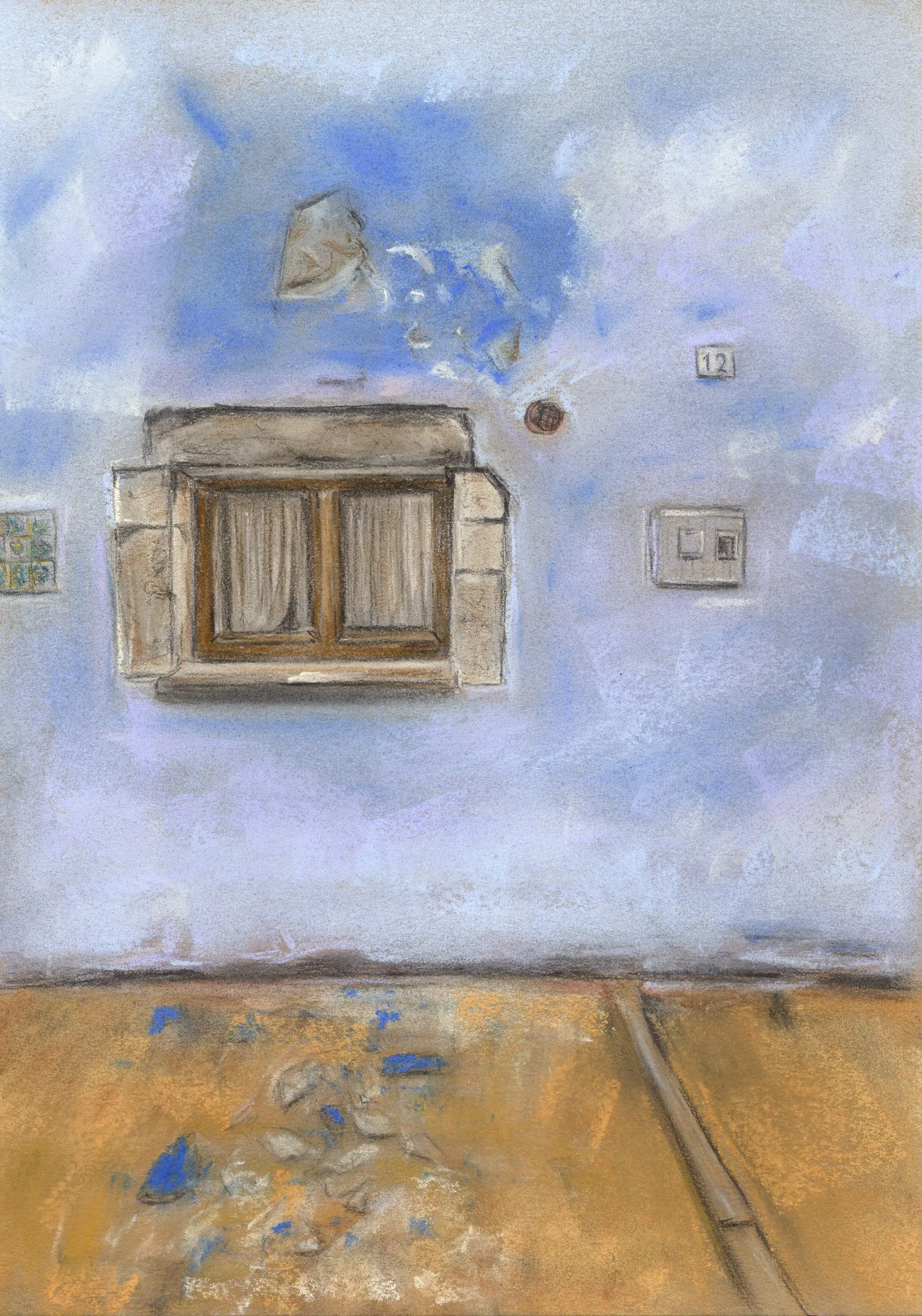
A4 picture in a 30×40 cm white mount (Frame NOT included).
This painting appears to be an urban or architectural study, likely rendered in soft pastel, oil pastel, or perhaps a dry medium like chalk or charcoal, given its texture and somewhat hazy quality. The composition is divided strongly into two horizontal areas, creating a sense of tension and balance.
The Upper Section (Sky/Wall):
The dominant color is a muted, textured blue, suggesting a weathered exterior wall. This blue is heavily mixed with white and a hint of lilac or grey, giving it an ethereal, aged, or distressed appearance.
There is visible evidence of decay: patches where the blue surface seems to have flaked away, revealing lighter, possibly raw wall material beneath.
A small, centrally placed, stone-framed window is the focal point. The window is covered by sheer, light-colored curtains, obscuring the interior and lending a sense of privacy or mystery. The stone frame adds a sense of permanence and historical architecture to the decaying wall.
Small, square details—a simple house number ("12") and a couple of faint, square shapes—suggest the wall belongs to a structure, anchoring the piece in reality.
The Lower Section (Ground):
This area is painted in a stark ochre or deep yellow-brown, representing the ground, pavement, or a dusty floor.
In sharp contrast to the solid color, there are significant patches of vibrant blue debris scattered on the ground, mirroring the color of the wall above. This suggests that pieces of the wall's paint or plaster have fallen and are accumulating below.
A faint, straight line or series of lines running diagonally across the ground suggests a path, a drain, or a simple crack, adding a dimension of perspective and depth.
Style: The technique leans toward an expressive or impressionistic style. The lines are not sharp and photographic; instead, the focus is on capturing the feeling and texture of the aged wall and ground. The use of color layering and visible strokes creates a tangible sense of weathering and time.
Mood: The painting evokes a mood of quiet melancholia, isolation, or the passage of time. The decay in the wall juxtaposed with the sturdy window suggests endurance amidst ruin. The curtained window suggests a hidden life within, contrasting with the exposed, weathered exterior.
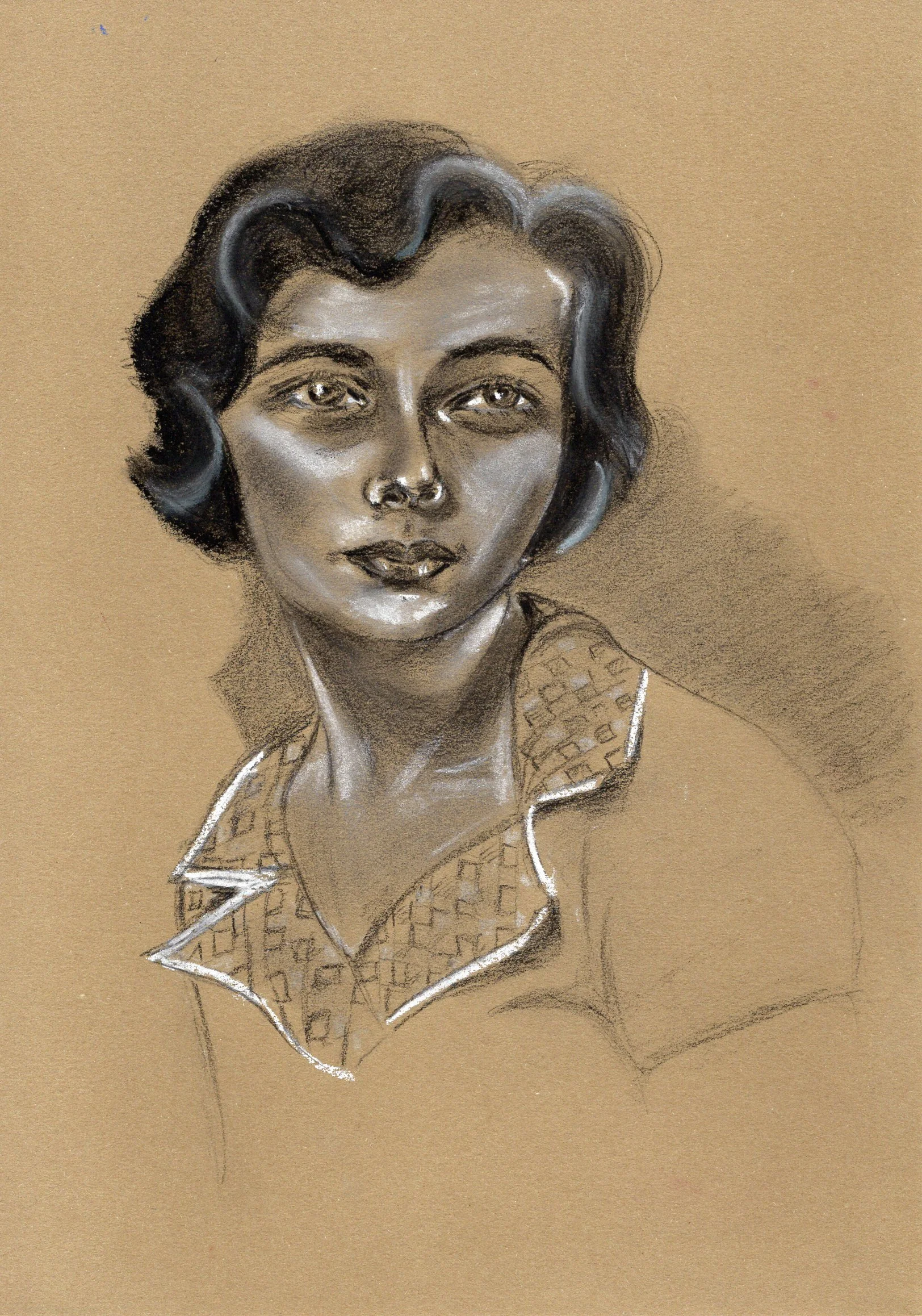
A4 picture in a 30×40 cm white mount (Frame NOT included).
This is a compelling portrait, likely a study of a woman's head and shoulders.
Medium and Style: The artist has used dry media, such as charcoal and white chalk or pencil, on brown or tan toned paper. This technique allows the artist to effectively build up dark tones (shadows and hair) and bright highlights (on the face and hair) while letting the middle tone of the paper serve as the base color for the skin and clothing. The technique gives the drawing a striking, high-contrast, and almost monochromatic appearance.
Subject: The subject is a woman with short, dark, styled hair (possibly finger waves or a similar 1930s-1940s style) and an intense, direct gaze. Her expression is serious or contemplative. She is wearing a collared blouse with a distinct geometric or patterned print, edged with piping.
Composition: The figure is centrally positioned, occupying the majority of the drawing area. The background is simple, with some soft shading to the subject's right, grounding the figure and suggesting ambient light. The drawing itself is framed with a wide white mat inside a black frame, which enhances its display quality.
Artistic Credit: A copyright or artist's signature is visible at the bottom of the white border: "© R.G. Osbaldeston".
The artwork demonstrates strong skill in capturing likeness and modeling form through the effective use of light and shadow.
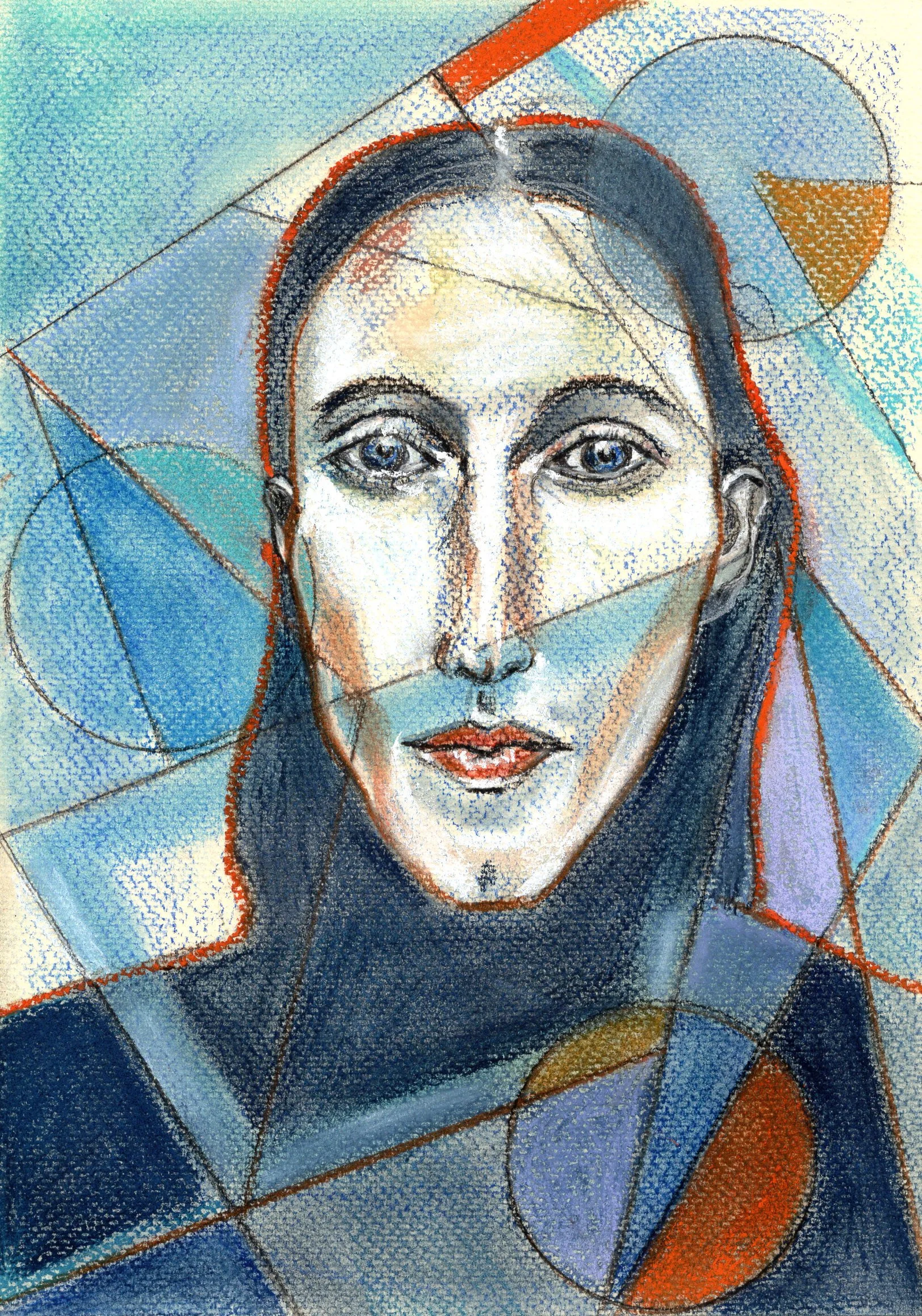
A4 picture in a 30×40 cm white mount (Frame NOT included).
This is a compelling portrait that combines elements of figuration with Cubist-inspired abstraction and a vibrant color palette, likely executed in pastel or colored pencil given the textured, dry appearance.
Subject: The central figure is a woman with striking, intense eyes and a neutral expression. Her features are rendered with a degree of naturalism, focusing the viewer's attention on her face. Her long, dark hair frames her face and blends into the dark turtleneck or garment she is wearing.
Composition & Style: The background and parts of the foreground are composed of geometric shapes—lines, triangles, and circles—that intersect and overlap. This use of geometry fragments the space, a characteristic technique of Cubism.
The background is not a realistic setting but an abstract plane of interlocking shapes, creating a dynamic energy around the static figure.
Color Palette: The dominant colors are cool, primarily shades of blue and teal, suggesting a sense of calm, introspection, or perhaps coolness of mood. These blues are sharply contrasted by accents of warm reddish-orange (seen in the arcs and triangles in the upper right and lower right), which adds tension and visual excitement to the composition.
Technique: The texture suggests a medium like pastel or crayon/pencil on a slightly textured paper, allowing the colors to be layered and blended while retaining a grainy, painterly quality. The fine lines used for the geometric framework provide structure against the softer shading of the face and background.
Overall Mood: The painting evokes a feeling of introspection and psychological depth. The figure seems to be looking directly out at the viewer, yet the abstract elements surrounding her hint at a complex internal landscape or a fragmented reality.
While not strictly Cubist (as the figure's face is not fully deconstructed), the work clearly draws on Post-Cubist or Analytical styles, where the subject is recognizable, but the surrounding space is broken down into geometric forms. This fusion of a realistic portrait with an abstract environment is a powerful way to express both the external appearance and internal complexity of the subject.
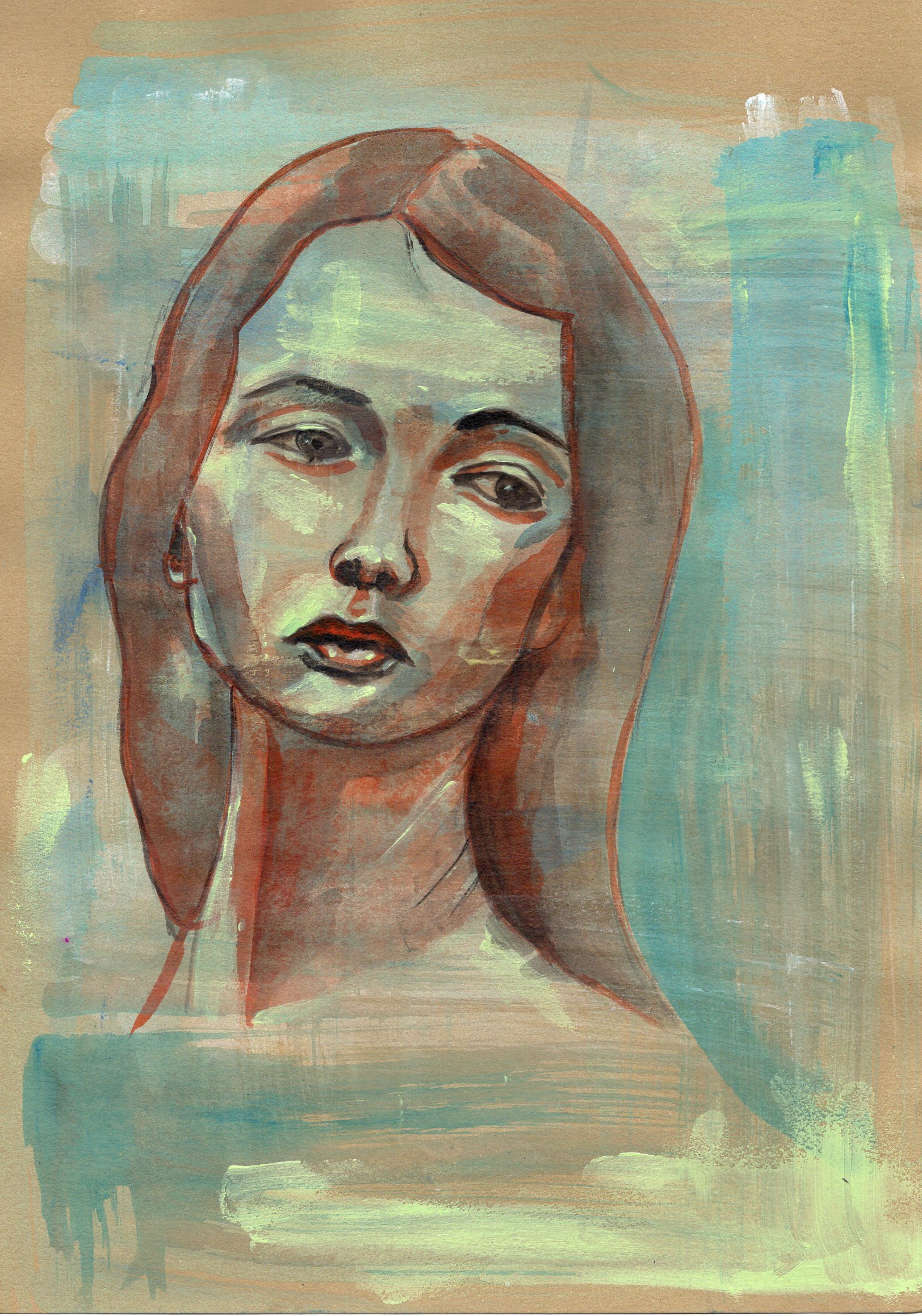
A4 picture in a 30×40 cm white mount (Frame NOT included).
This piece appears to be a contemporary portrait executed in a style that is both expressive and somewhat abstract.
Key Features
Subject: The central subject is the face and upper torso of a young woman with long, reddish-brown hair. She gazes directly, or slightly downward, with an expression that seems contemplative, melancholic, or perhaps detached.
Medium: The texture and brushstrokes suggest that the painting is done in acrylics or gouache, possibly on a surface like paper or cardboard, indicated by the visible natural tone of the material showing through (often called "support" or "ground").
Style: It employs a blend of figurative and expressive techniques. The figure is clearly recognizable, but the use of color is not strictly realistic, and the background is rendered with gestural, abstract brushstrokes.
Color and Technique
Palette: The palette is dominated by earth tones (the background support), soft reds and oranges used for the skin and hair, and cool teals, blues, and pale yellows/greens in the background.
Contour and Line: The artist uses lines sparingly, often relying on blocks of color to define form. A faint reddish outline seems to define the jawline and shoulders. The features of the face—especially the eyes and mouth—are depicted with a greater degree of detail and intensity.
Background: The background is highly textured and abstract, with visible, layered strokes of light blue, teal, and a pale yellow-green. This energetic, cool-toned backdrop contrasts with the warmer tones of the figure, helping her stand out.
Framing and Presentation
The artwork is presented within a thick black frame and a wide white mat, which professionally isolates the artwork from its surroundings.
Interpretation
The contrast between the defined, slightly melancholy face and the loose, layered, atmospheric background creates a sense of emotional depth. The figure seems caught in a moment of introspection, with the surrounding colors perhaps representing her inner or outer emotional state.
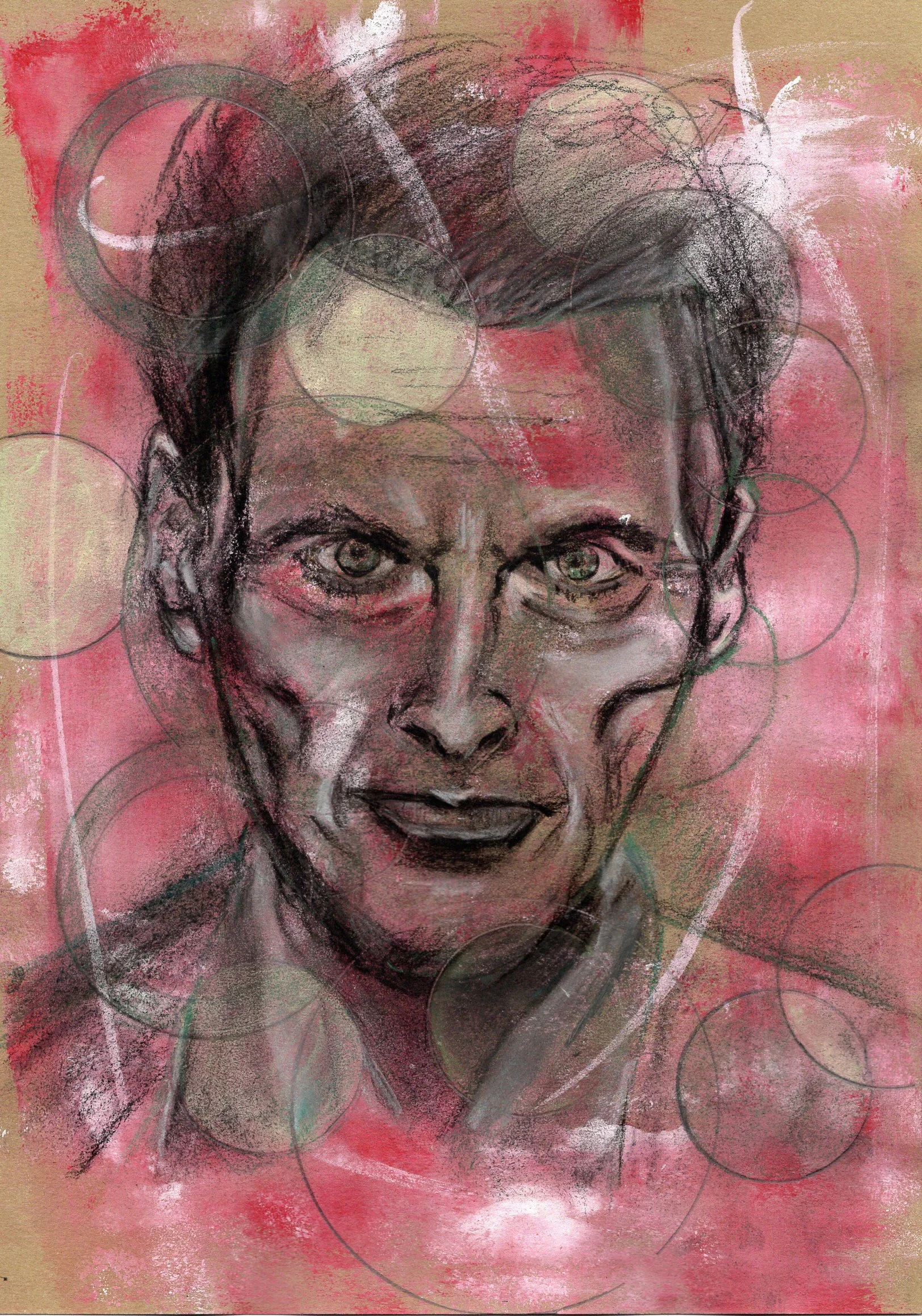
A4 picture in a 30×40 cm white mount (Frame NOT included).
This appears to be a mixed-media portrait characterized by intense expression and dynamic technique.
Subject and Expression: The subject is a male figure, rendered with a strong, almost gaunt facial structure. The eyes are particularly intense, engaging the viewer directly with a slightly unsettling yet captivating gaze. The expression is ambiguous—it could be a slight smile, a grimace, or simply a look of deep contemplation.
Technique and Media: The figure is primarily rendered in monochrome (likely charcoal, pencil, or black chalk), giving it a foundational sense of realism and shadow. This detail is contrasted sharply with a very abstract and colorful background.
Background: The backdrop is dominated by shades of red and pink, applied in a loose, painterly fashion, suggesting an emotional or energetic atmosphere. The visible tan/kraft paper base also adds texture and warmth.
Geometric Elements: The most distinctive feature is the overlay of large, pale, and incomplete circular or ring-like shapes that intersect both the background and the subject's head. These circles introduce a technical, almost mechanical or scientific counterpoint to the raw emotion of the portrait, perhaps suggesting a halo, thoughts, or an attempt to quantify the subject's energy.
Style and Mood: The overall style blends traditional portraiture with abstract expressionism. The mood is powerful, dramatic, and introspective. The contrast between the detailed face and the energetic chaos of the background creates tension and depth.
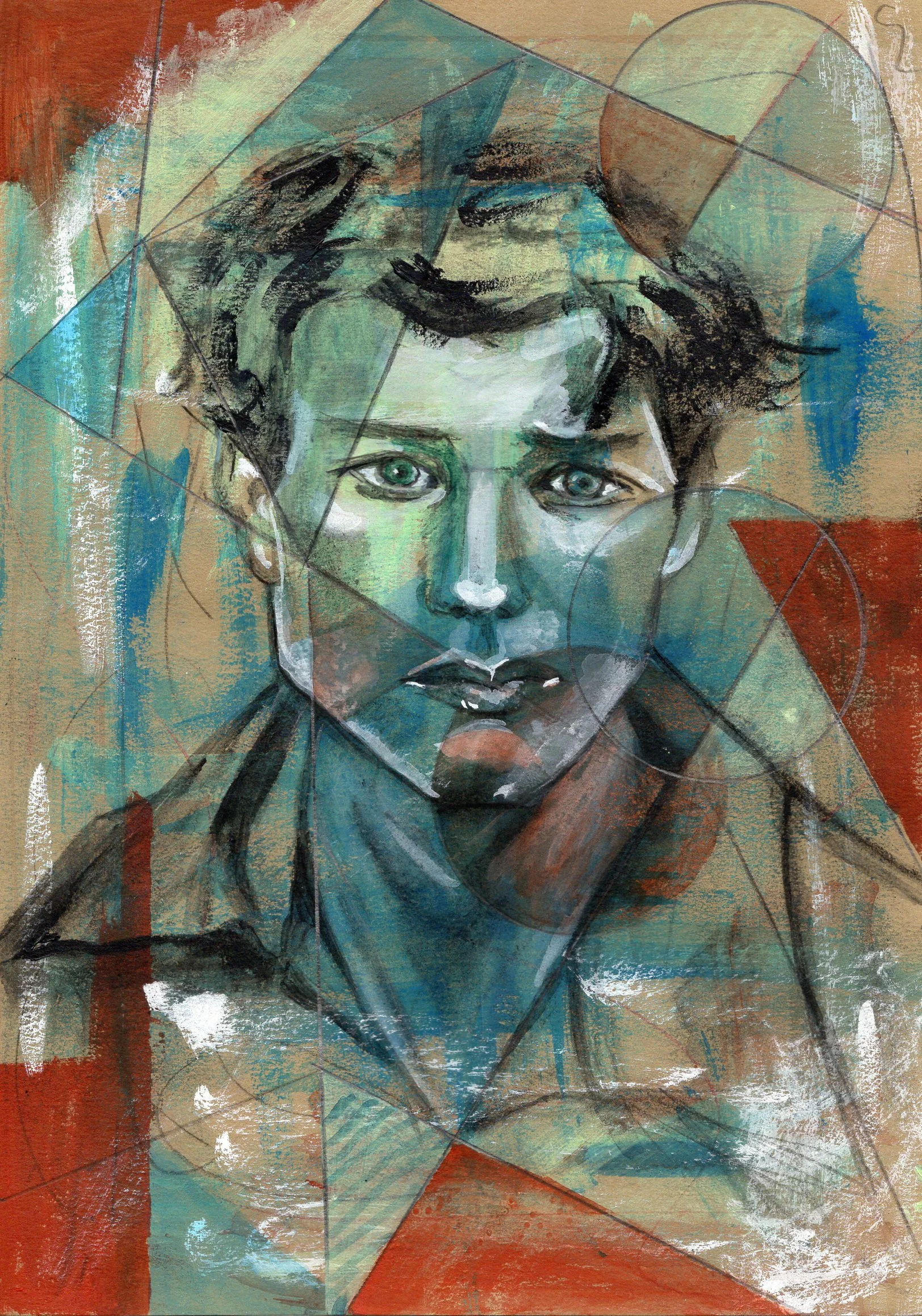
A4 picture in a 30×40 cm white mount (Frame NOT included).
That is a striking and complex piece of art. Based on the image, here is a write-up about the painting:
Analysis of the Portrait
This artwork is a compelling portrait that blends elements of figuration with abstraction, creating a sense of tension and psychological depth.
Style and Technique
The painting appears to be a mixed-media work, possibly combining techniques like acrylic, oil pastel, and charcoal on a surface that resembles board or wood (suggested by the visible brown, textured background tones).
Cubist Influence: The most prominent stylistic feature is the use of geometric planes, particularly the overlapping triangles and partial circles rendered in sharp lines and blocky colors (teal, turquoise, and rust red). This fragmentation of the face and background strongly echoes the principles of Cubism, particularly in the way it presents multiple viewpoints or a deconstructed reality.
Color Palette: The palette is dominated by cool blues and teals in the central face, contrasted sharply with warm, earthy tones of rust red and beige in the background and surrounding areas. This contrast creates a powerful visual dynamic, pulling the viewer's focus to the cool-hued subject.
Brushwork: The application of paint is expressive and somewhat rough, particularly in the textured, scratched, and layered areas of color. This adds to the feeling of raw energy and immediacy.
Subject and Mood
The subject is a young man with dark, tousled hair and an intense, direct gaze.
Expression: His expression is ambiguous—serious, perhaps slightly melancholic, or intensely focused. The use of light and shadow, particularly the green-blue wash over his face, gives him a slightly ethereal or haunting quality.
Composition: The figure is positioned centrally, facing forward, which establishes a strong connection with the viewer. The geometric elements do not entirely obscure the figure but rather overlay and penetrate it, suggesting a fracturing of identity or the complex layers of personality.
Psychological Depth: The contrast between the finely rendered features (the eyes and lips) and the surrounding chaotic geometry suggests an internal conflict or a commentary on the fragmentation of the modern psyche.
In summary, the painting is a powerful, expressionistic portrait by R.G. Osbaldeston that uses geometric abstraction and a cool/warm color contrast to explore the psychological complexity of the subject.
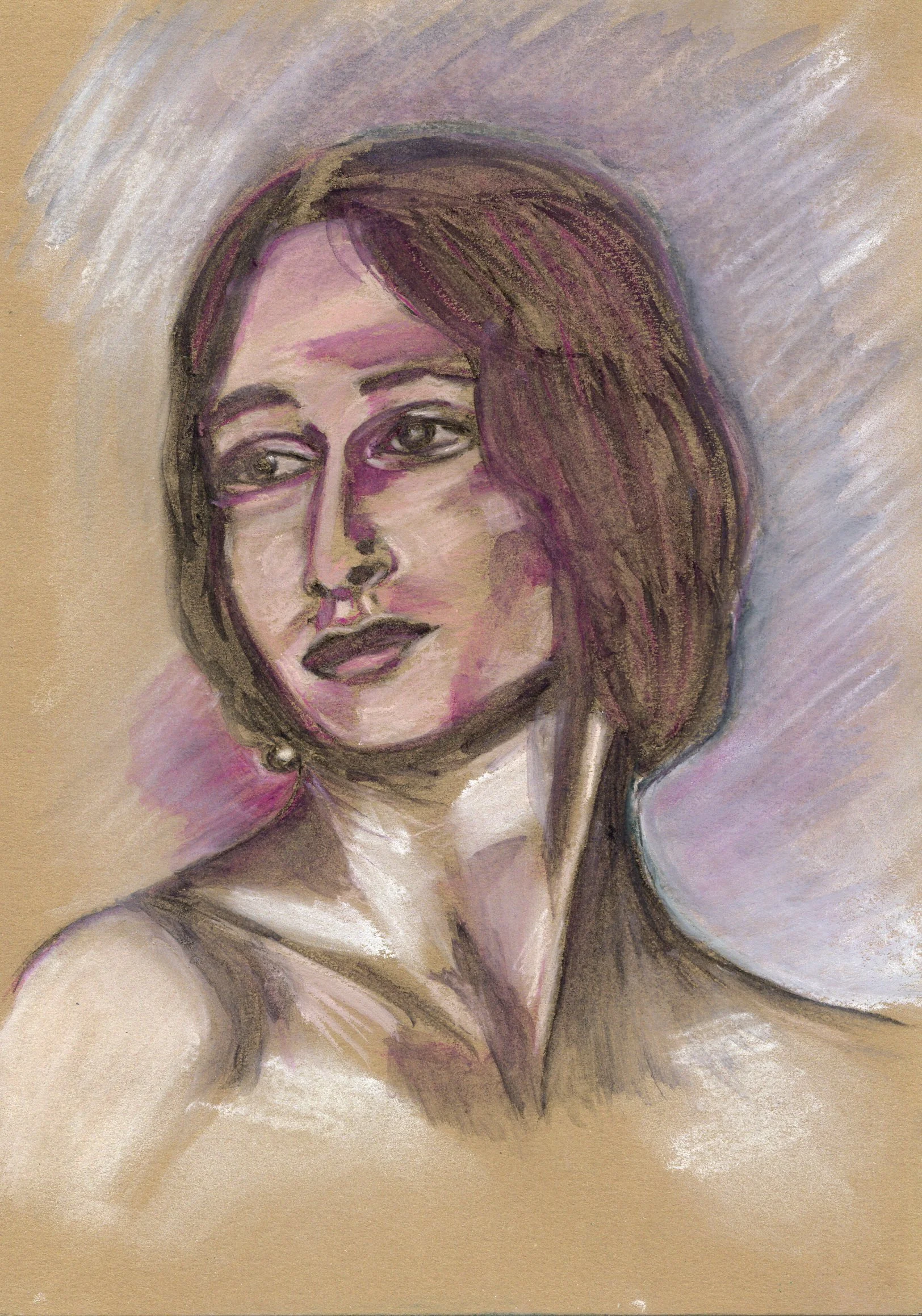
A4 picture in a 30×40 cm white mount (Frame NOT included).
That is a compelling portrait! Here is an analysis of the framed artwork:
Analysis of the Framed Portrait
This piece appears to be a mixed-media portrait or a pastel/chalk drawing on a toned, light brown or tan paper. It is presented within a simple, modern black frame, giving the artwork a clean, gallery-like presentation.
Key Artistic Elements
Medium and Texture: The use of pastels or chalk gives the piece a soft, slightly rough texture. The color is applied with visible strokes, especially in the background and hair, suggesting a spontaneous or expressive technique. The visible texture of the paper contributes to the overall warmth of the image.
Color Palette: The palette is dominated by earth tones (the paper itself and brown/aubergine for the hair) and cool, subtle undertones (mauve, lilac, and pale blue/grey) used for shading the face, neck, and background. This contrast between the warm paper and the cool shading creates an intriguing, somewhat moody atmosphere.
Subject and Expression: The subject is a woman with short, dark hair. Her gaze is directed off to the side, giving her expression a sense of thoughtfulness, distance, or melancholy. The artist has used color to define the planes of her face, with noticeable pink and purple highlights/shadows around the eye sockets and cheekbones.
Composition and Form: The portrait is a bust-length composition, focusing heavily on the head and bare shoulders. The lines defining her neck and shoulders are soft and impressionistic, blending into the paper. The background is loosely worked with broad strokes of white and cool colors, suggesting an aura or light source rather than a defined setting.
Potential Interpretation
The piece has an expressive quality, prioritizing emotion and color over strict photorealistic detail. It evokes a feeling of quiet introspection. The strong contrast in lighting and the use of unconventional colors for shading suggest a focus on the subject's inner life or a particular emotional state.
The style could be categorized as expressive realism or having impressionistic qualities due to the loose brushwork and focus on light and color effect.
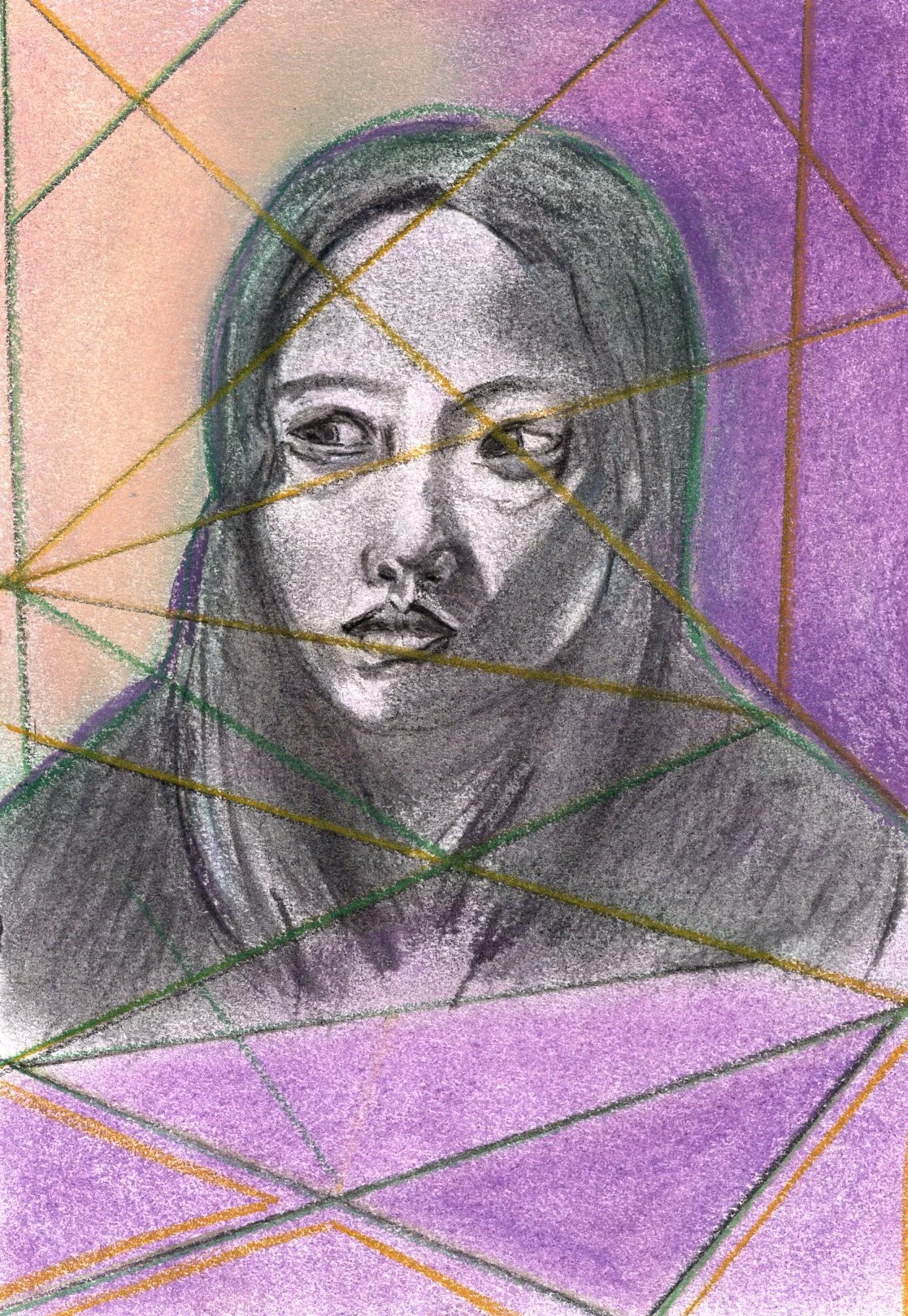
A4 picture in a 30×40 cm white mount (Frame NOT included).
Analysis of the Framed Artwork
This is an intriguing piece of framed artwork that combines portraiture with abstract geometric elements, creating a sense of tension and psychological depth.
Description and Style
Subject: The central subject is the bust of a woman depicted in a somewhat realistic, yet stylized manner. She has long, dark hair and her gaze is directed slightly off-center, contributing to an introspective or perhaps anxious mood.
Media and Technique: The artwork appears to be a mixed-media drawing or sketch, likely using colored pencils, charcoal, or pastels. The texture is visible, suggesting a hand-drawn quality. The use of soft blending for the figure contrasts with the sharp, straight lines overlaying the composition.
Color Palette: The palette is dominated by cool, moody tones like deep purples, lavender, and shades of grey/black for the figure. This is contrasted with a subtle, warmer peach or orange hue on the left side, which acts as a soft light source.
Geometric Overlay: The most distinctive feature is the web of thin, intersecting lines—predominantly gold, lime green, and copper—that are drawn over the portrait. These lines form abstract triangles and geometric shapes, seeming to cut across the figure's face and body.
Interpretation and Mood
Psychological Depth: The contrast between the figure's pensive expression and the confining geometric lines suggests themes of constraint, fragmentation, or inner conflict. The lines could symbolize the weight of external pressures, confusing thoughts, or a sense of being trapped within a structure or expectation.
Composition: The woman is illuminated from the left, casting deep shadows on the right side of her face, which enhances the dramatic and somber mood. The prominent purple background reinforces a feeling of mystery or melancholy.
Title/Artist Note: The copyright at the bottom, "© R.G. Osbaldeston," identifies the artist.
Summary
The artwork is a powerful study that moves beyond simple portraiture. By overlaying the emotional realism of the woman's expression with a cage-like grid of vibrant, angular lines, the artist creates a visually arresting metaphor for the internal and external structures that shape or constrain the human experience.
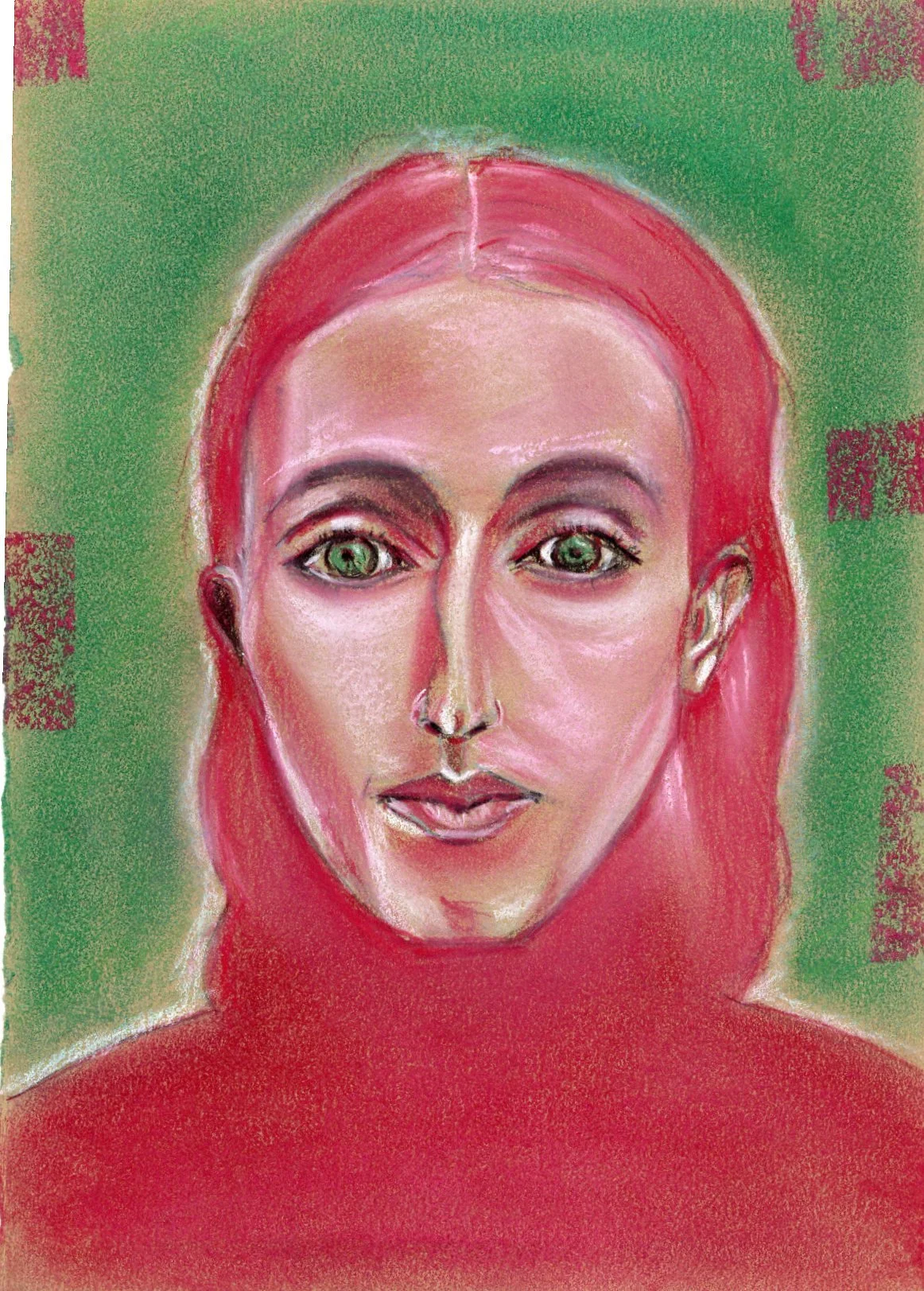
A4 picture in a 30×40 cm white mount (Frame NOT included).
Analysis of the Portrait
The image appears to be a drawing or painting, likely executed in colored pencil or pastel, framed and matted for presentation.
Subject and Style
Subject: The central figure is a young person, possibly a woman, with long, flowing red hair. The subject is looking directly at the viewer with an intense, steady gaze.
Facial Features: The face is rendered with an almost ethereal or elongated quality, reminiscent of certain early 20th-century movements like Expressionism or even elements of Byzantine iconography (due to the stark front-facing pose and flattened background). The eyes are prominent and light-colored, perhaps green, and hold a significant focal point.
Expression: The expression is generally neutral, though the direct eye contact creates a sense of vulnerability, introspection, or profound connection.
Attire: The figure is wearing clothing that appears to be a high-neck or turtleneck garment in a deep, saturated red, which blends with the color of the hair.
Color and Composition
Color Palette: The palette is dominated by two highly contrasting and symbolically rich colors: Saturated Green and Deep Red.
Red: Used for the hair and clothing, it is a warm, vibrant color that often symbolizes passion, intensity, or life force.
Green: Used for the background, it provides a cool, flat, and almost unnatural counterpoint to the figure. In combination with the subject's intensity, the green could evoke themes of the sacred, the natural, or the unsettling.
Background: The background is a solid block of green with faint, rectangular, reddish/brown geometric shapes or marks near the edges. This geometric element adds a layer of abstraction and pattern, keeping the focus squarely on the figure.
Lighting and Form: The face is highlighted to create a sense of three-dimensionality, with a clear light source illuminating the forehead and one side of the face, adding a subtle touch of realism to the otherwise stylised figure.
Attribution
A copyright notice is visible at the bottom of the mat: © R.G. Osbaldeston. This suggests the artist's name is R.G. Osbaldeston.
Summary and Interpretation
This portrait is characterized by its bold use of color, direct composition, and stylised rendering. It is an emotionally charged piece where the figure's intense gaze and the dramatic contrast between the crimson hair/garment and the emerald green background create a memorable visual impact. It successfully blends traditional portraiture with a modernist approach to color and form, making the subject feel both timeless and contemporary.
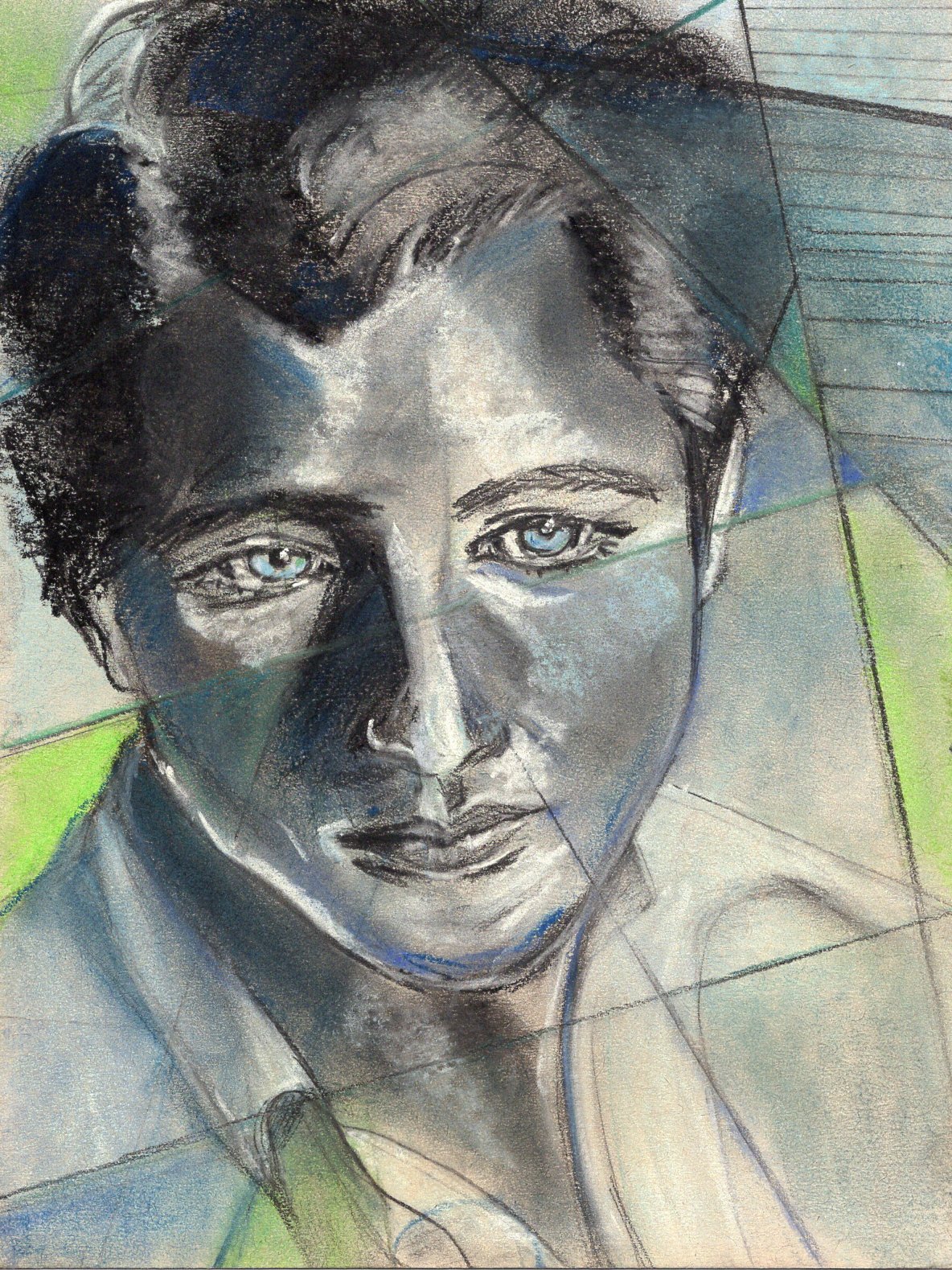
A4 picture in a 30×40 cm white mount (Frame NOT included).
This image displays a framed portrait painting, which appears to be a mixed-media piece, potentially using pastel, charcoal, or pencil with touches of color, possibly watercolor or light acrylics.
Key Visual Characteristics:
Subject: The painting is a close-up portrait of a young man. His expression is intense and direct, with a slight look of melancholy or contemplation.
Color Palette: The primary tones are monochromatic—shades of black, grey, and white are used to define the face and hair, giving it a high-contrast, almost photographic quality. This contrasts sharply with the background.
Use of Color: Strikingly, the man's eyes are a bright, piercing blue, which draws immediate focus. The background and some underlayers of the shirt feature patches of light vibrant green and pale blue, introducing a modern, abstract element.
Style and Technique: The style is expressionistic and dynamic.
The use of angular, overlapping lines (in black and light blue) gives the composition a fractured or cubist-like feel, suggesting movement or multiple perspectives.
The rendering of the face itself is highly detailed and volumetric, especially around the eyes and nose, but the edges of the figure blend into the abstract background elements.
Composition: The subject is centered and fills the majority of the inner frame, creating a sense of immediacy. The overall artwork is presented within a simple, thick black frame and a white mat.
Interpretation:
The combination of the traditional, moody portraiture with the abstract, geometric lines and vibrant background color creates a tension between the internal emotional state of the subject and the external, fragmented world. The piercing blue eyes serve as the anchor of the emotional intensity, pulling the viewer into the subject's gaze despite the surrounding visual complexity.
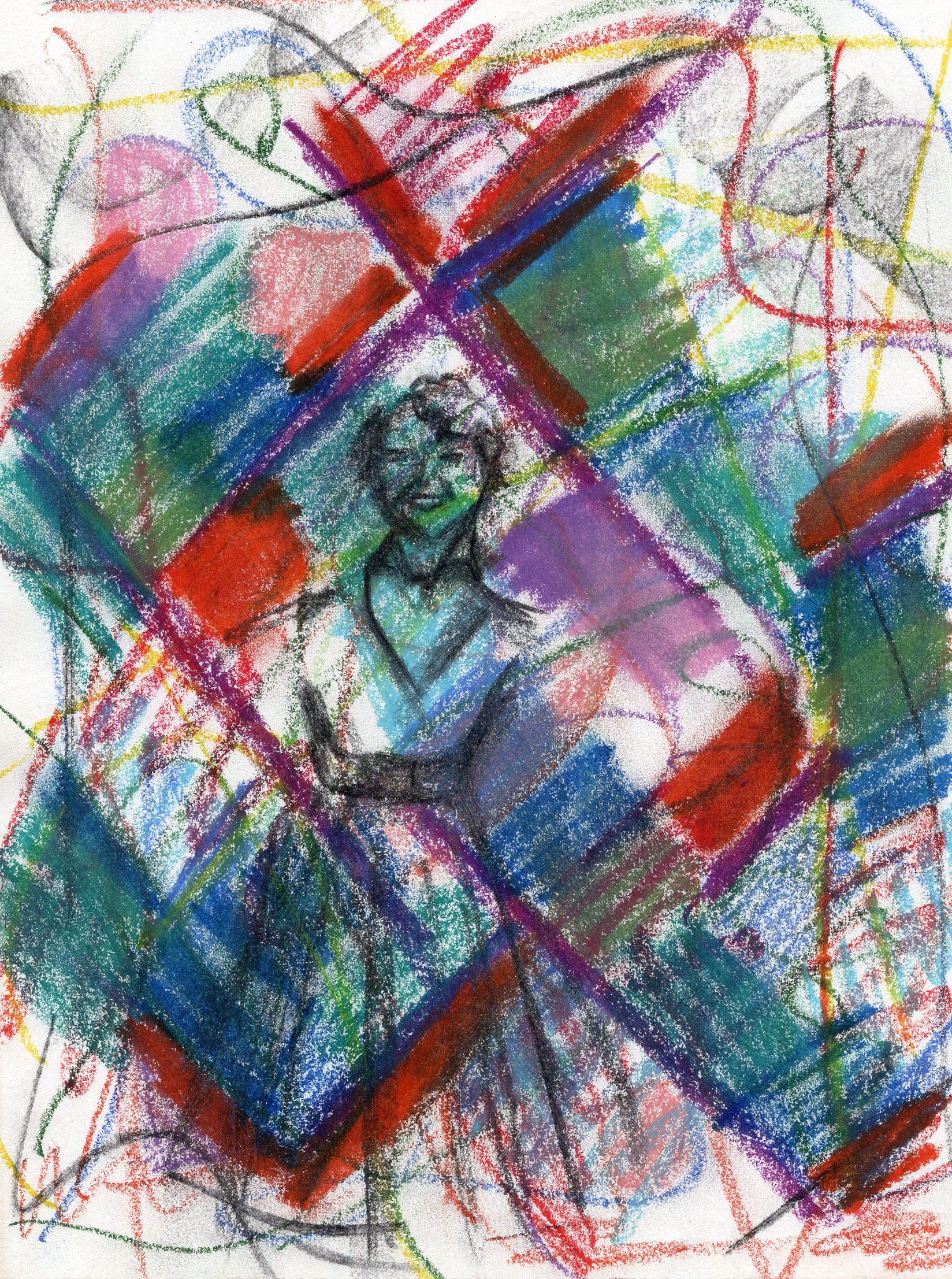
A4 picture in a 30×40 cm white mount (Frame NOT included).
This is an intriguing piece of mixed-media art that combines figurative elements with strong abstract and expressive qualities.
Analysis of the Artwork
The piece is a dynamic convergence of abstraction and a subtly rendered figure. It uses intense color and energetic line work to create a sense of movement and depth.
Subject and Composition
The Figure: Centered within the chaos of color is a lightly sketched, almost ghostly figure, possibly a woman, depicted from the waist up. She has a gentle expression and appears to be wearing a light garment, possibly a jacket or kimono-style top, with her arms resting in front of her. The lines defining her are faint and dark, standing in soft contrast to the vibrant background.
The Background: The figure is enveloped by an extremely busy, multi-layered abstract composition. This background dominates the canvas and can be broken down into two main types of marks:
Geometric Shapes: A strong, diagonal grid or lattice pattern is prominent, primarily outlined in deep red. These bold, angular lines create a sense of structure and tension, forming large, diamond-like or crisscrossing shapes.
Expressive Scribbling: Beneath and surrounding the geometric grid are layers of highly energetic, almost frenetic scribble and hatching marks in various colors. These lines are loose, chaotic, and give the impression of rapid, spontaneous movement.
Use of Color
The color palette is rich and deliberate, contributing significantly to the artwork's emotional intensity:
Vibrant and Saturated: The primary colors used are highly saturated red, blue, green, and yellow, with some accents of purple/magenta.
Color Blocks and Hatching: Large areas within the geometric grid are filled with dense, hatched strokes of contrasting colors, particularly blocks of teal/dark green and deep blue, often adjacent to the striking red lines.
Contrast and Light: The white of the paper is allowed to show through, acting as a light source. The dark, thin lines of the figure's outline contrast with the thick, vibrant color blocks that surround her, making her appear to emerge from the abstract field.
Technique and Interpretation
Media: The texture suggests this was executed using oil pastels or wax crayons on paper, allowing for thick, saturated color application and visible, layered strokes. The immediacy of the mark-making implies a fast, direct, and emotional process.
Theme: The piece seems to explore the relationship between the individual and the surrounding environment or internal state. The calm, centered, and faintly rendered figure is almost imprisoned or protected by the loud, dramatic, and chaotic abstraction. It could be interpreted as a representation of:
Inner Conflict: A quiet core of self surrounded by a whirlwind of thoughts, emotions, or external pressures.
Energy and Stasis: A still point (the figure) within a highly kinetic, energized universe (the background).
Style: The style aligns with Expressive Figuration or Abstract Expressionism where the emotionality of the lines and colors is as important as the subject matter itself.
In summary, it is a powerful piece that successfully merges the defined structure of a geometric abstract with the spontaneous energy of expressive drawing, creating a vivid portrait where the environment is arguably more central than the person it frames.
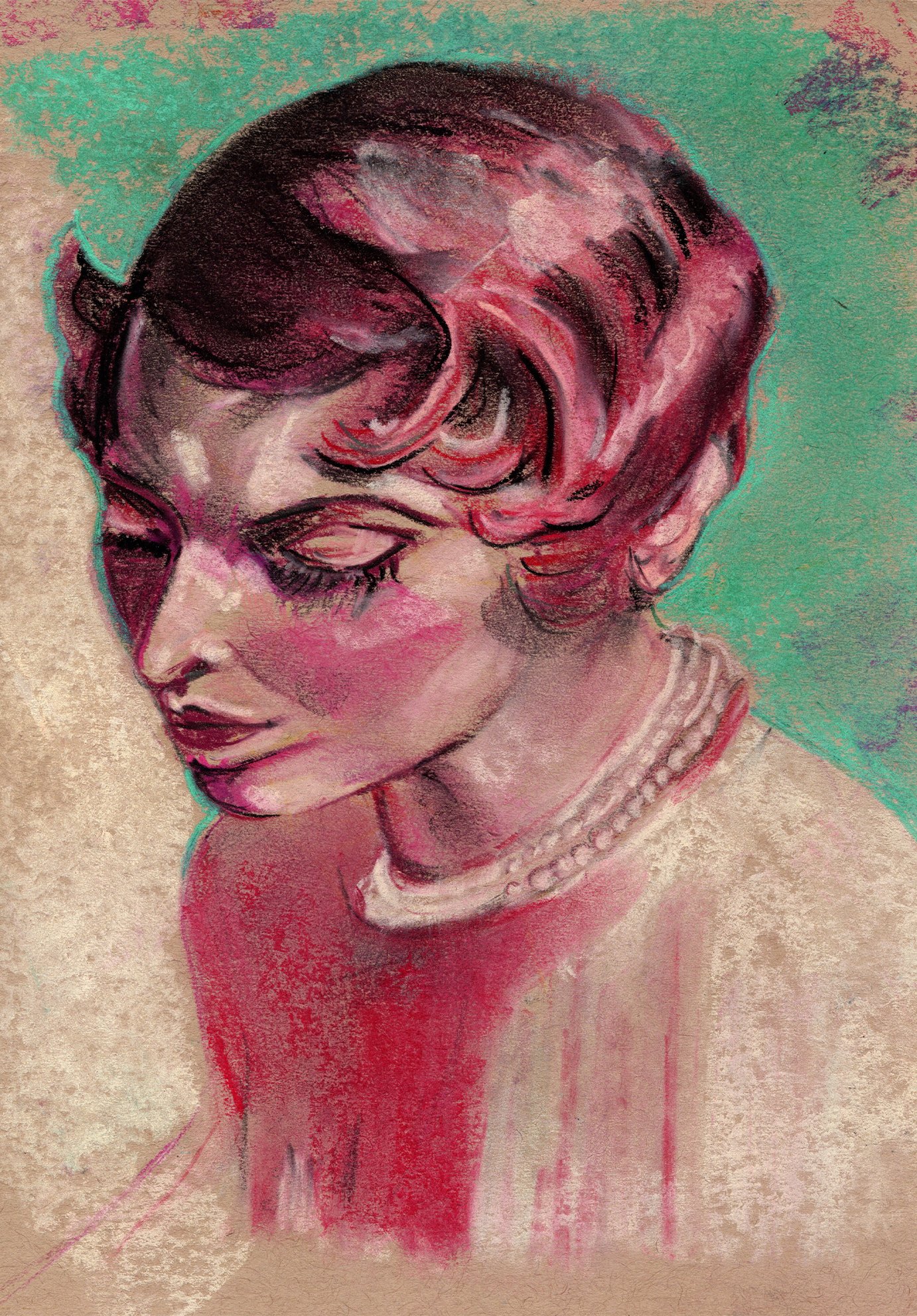
This is a visually striking portrait executed in a vibrant and expressive style, likely using pastels or colored pencils on a textured paper, given the distinct grain visible in the background and beneath the color application.
Subject and Style
The portrait depicts a woman shown in three-quarter profile, with her gaze lowered, suggesting a contemplative or melancholic mood.
Period Influence: Her short, coiffed hair with defined waves (a finger wave style) and the string of pearls around her neck strongly suggest the fashion of the 1920s or 1930s (the Jazz Age/Flapper Era).
Expression: Her eyes are closed or heavily lowered, and her expression is generally pensive or serene, drawing the viewer's attention to the expressive use of color on her face.
Artistic Style: The work is not strictly realistic; it leans toward Expressionism or a heightened form of figuration. The colors are deliberately non-naturalistic and applied with bold, visible strokes, prioritizing emotional impact over strict anatomical accuracy.
Color and Technique
The use of color is the most dramatic element of this piece.
Palette: The palette is dominated by rich, saturated colors, specifically magenta, crimson, and deep burgundy for the face and hair, contrasting sharply with the vivid turquoise/teal and muted beige/ochre of the background.
Technique: The artist utilizes scumbling and layering techniques, especially in the background, where the teal color appears heavily textured and partially covers a lighter, rougher surface. The portrait itself features strokes that follow the contours of the face, using the deep reds to define shadows and structure.
Effect: The warm, intense reds on the subject create a sense of vitality and emotional heat, making her appear luminous and almost feverish against the cool, contrasting turquoise background.
Overall Impression
The combination of the subject's vintage fashion and her introspective pose with the modern, aggressive use of color creates a work that is both nostalgic and intensely contemporary. It captures a fleeting moment of deep feeling, presenting the woman not just as an individual, but as a vessel for vivid emotional experience.

A4 picture in a 30×40 cm white mount (Frame NOT included).
That is a striking framed portrait, likely created using pastels or a similar dry media like chalk or crayon on a brown or tan paper.
Artistic Style and Technique
Medium: The textured strokes and layered color fields strongly suggest the use of soft pastels or oil pastels. The background shows areas of scherzo (cross-hatching) and blending, especially around the figure's head.
Surface: The natural tone of the paper (brown/tan/kraft color) acts as a middle ground and is integrated into the portrait, particularly visible in the collar and face highlights.
Color Palette: The palette is intense and expressive, primarily using a contrast between:
Warm Tones: Deep reds and reddish-browns in the hair and skin shadows.
Cool Tones: Rich blues and light, almost luminous whites/light blues in the background accents.
Composition: It's a tight, focused bust portrait. The figure's head is centered, drawing the viewer immediately to her gaze.
The Subject and Mood
Figure: The subject appears to be a woman or young woman with dark, short hair styled with soft waves and bangs. Her expression is intense, with large, soulful eyes and a small, defined mouth.
Clothing: She wears a high-necked, ruffled or pleated collar that evokes a vintage, perhaps early 20th-century or historical (e.g., Victorian/Edwardian) aesthetic, contrasting with the more modern, expressionistic background.
Atmosphere: The use of strong, dramatic shadows and highlights (especially the white/light blue marks that seem to 'slash' the background) creates a sense of drama and introspection. The intensity of her gaze gives the portrait a strong, perhaps even melancholic, emotional depth.
Overall Impression
The portrait blends the careful, detailed rendering of the subject's face with a looser, more abstract, and energetic background. The contrast between the detailed figure and the expressive, almost fragmented background is highly effective, giving the piece a feeling of both intimacy and stylized drama.
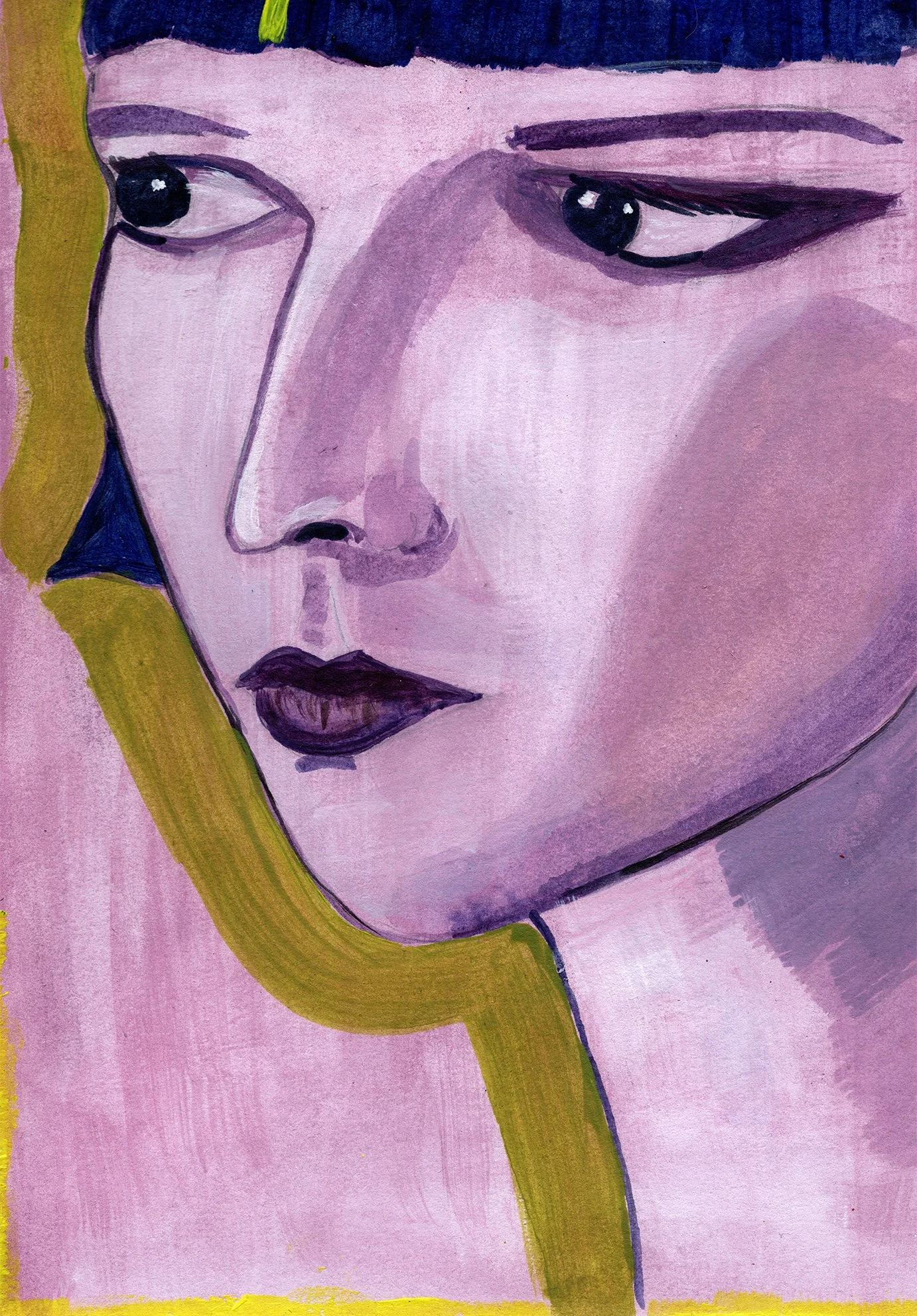
A4 picture in a 30×40 cm white mount (Frame NOT included).
This painting features a striking, stylized portrait of a woman's face in profile, likely a work done in a Modernist or Art Deco-inspired style.
Visual Analysis
Subject: A woman's head and neck are depicted, viewed in a three-quarter profile. Her expression appears introspective, perhaps slightly melancholic, or intensely focused.
Style: The style is highly graphic and angular. Features like the long, sharp nose, defined jawline, and precise, heavy eyeliner (suggestive of an Egyptian or flapper aesthetic) are characteristic of the 1920s or an artistic interpretation of that era. It evokes the clean lines and geometric simplification often found in Art Deco portraiture.
Color Palette: The palette is bold and deliberately contrasting:
The dominant skin tone is rendered in cool purples, mauves, and pinks, creating a sense of shadow and drama.
The background is primarily a soft pink/magenta wash.
A strong, mustard yellow/olive green is used as an accent, running along the left side of the face and creating a powerful, stylized border or shape. This contrast adds dynamic tension to the composition.
Her hair is a dark, severe blue-black, and her lips are painted a deep plum or burgundy.
Technique: The texture suggests it might be painted with gouache, acrylic, or watercolor, given the relatively flat, matte areas of color and visible brushstrokes.
Potential Interpretations
Mood and Emotion: The use of cool colors like purple often suggests mystery, sophistication, or depth of emotion. The downward glance and closed, dark lips contribute to a serious or contemplative mood.
Influence: The work is heavily reminiscent of the Art Deco movement's fascination with geometric form, exoticism (like Egyptian revival), and the "New Woman" of the 1920s a figure who was often portrayed as independent and severe.
Overall, it is a dramatic and highly decorative piece, using color and form to create a powerful and iconic female image.
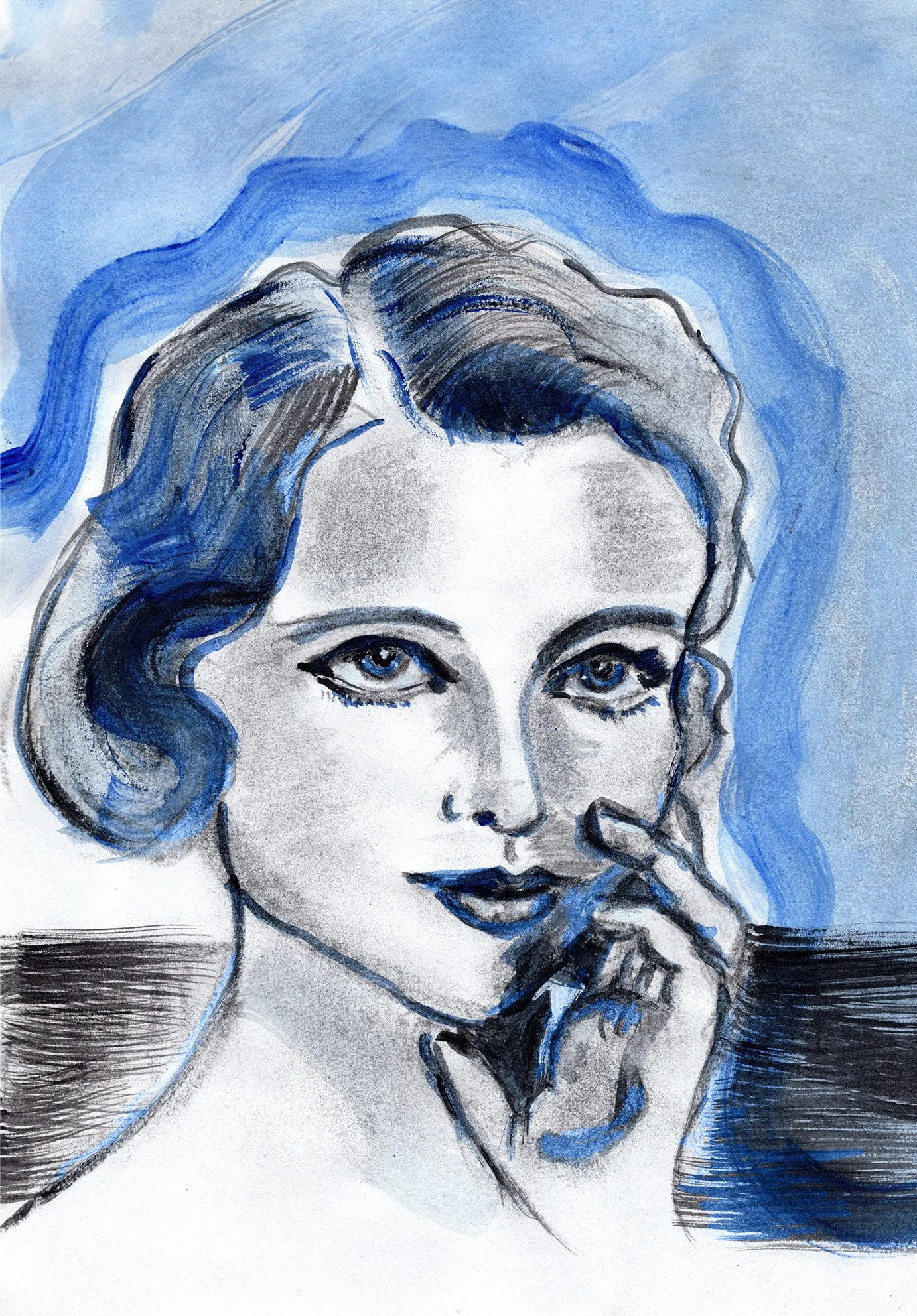
A4 picture in a 30×40 cm white mount (Frame NOT included).
This is an intriguing piece of framed artwork, seemingly a drawing or mixed media sketch focusing on a portrait of a woman.
Artwork Analysis
Subject: The central subject is the bust of a woman looking directly at the viewer. Her pose is suggestive, with one hand near her face, possibly resting her chin or brushing her lips.
Style: The style appears to be a loose, expressive sketch combined with washes of color. It has a slightly Art Deco or early 20th-century feel, primarily suggested by the woman's finger-waved or bobbed hairstyle and her dramatic makeup (dark, defined eyes and lips).
Media & Technique: The work appears to use pencil or charcoal for the primary lines and shading, and watercolor or ink washes for the blue color. The texture created by the sketching and the fluidity of the blue washes provide an appealing contrast.
Color Palette: The palette is largely monochromatic in shades of grey and black, dominated by vibrant blues. The blue is used prominently in the background, hair, shadows, eyes, and lips, giving the piece a cool, intense atmosphere.
Mood & Expression: The woman's expression is complex—she has intense, focused eyes and a slightly enigmatic or seductive gaze. The dramatic shadows and cool blue tones lend a feeling of mystery, elegance, and perhaps a touch of melancholy.
Framing: The drawing is presented in a simple, thick black frame with a wide white mat, which effectively isolates and enhances the artwork's colors and details.
Possible Interpretations
The sketch evokes the glamour and intensity often associated with the 1920s or 1930s screen sirens or stylish socialites. The strong use of blue could symbolize:
Coolness or Aloofness: The dramatic, cool tone of her expression.
Water or Waves: Suggested by the loose, wave-like shapes in the background.
Intensity: Highlighting her piercing blue eyes.
Overall, it is a captivating and stylish portrait that successfully blends detailed line work with expressive color washes to create a memorable impression.
No results found
No results match your search. Try removing a few filters.