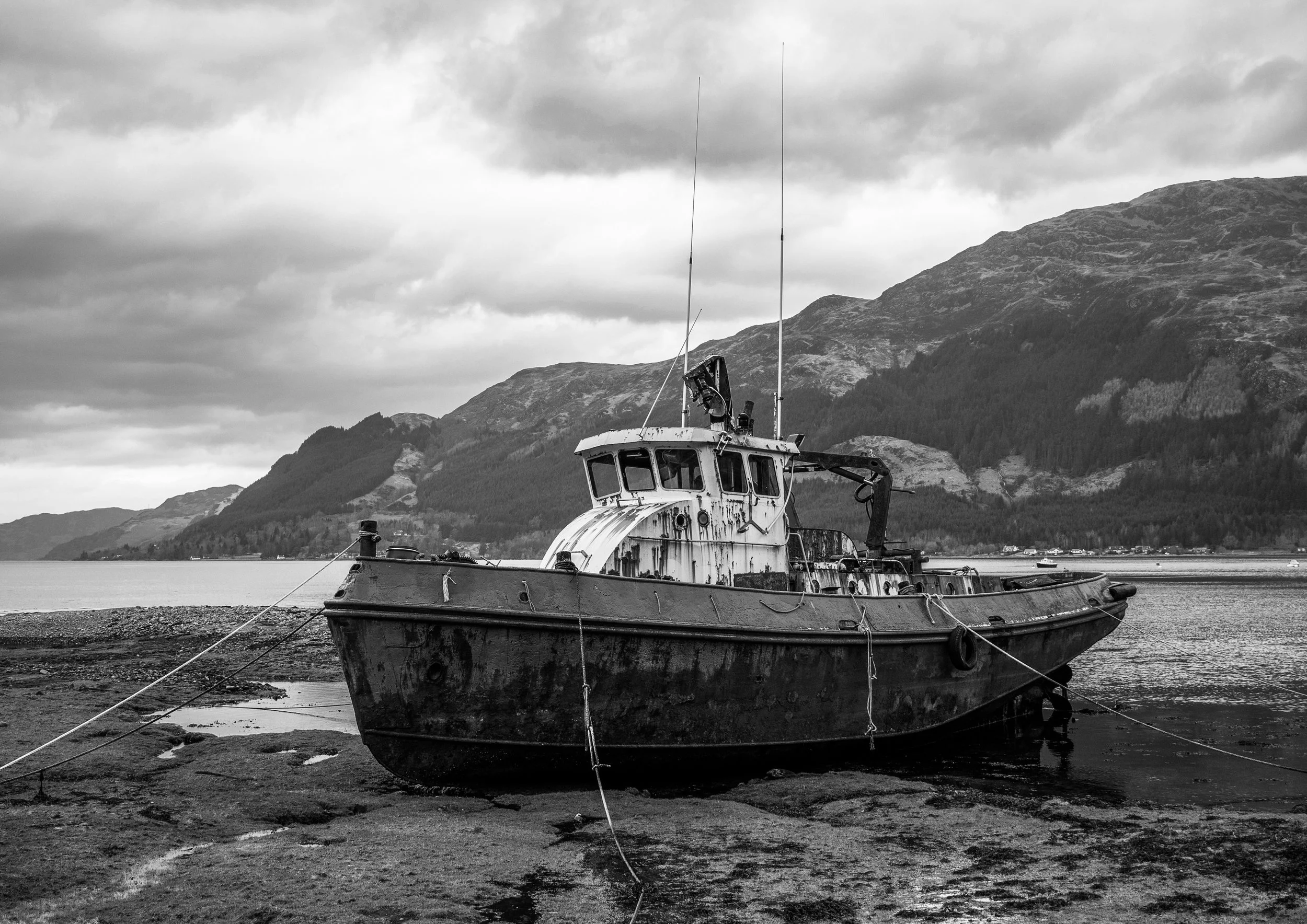
This is a striking, evocative photograph. The choice of black and white emphasizes texture and contrast over color, turning a scene of decay into a study of resilience and the passage of time.
The central focus is an aging, weathered fishing vessel—likely a tug or a small trawler—beached on a rocky shoreline. It sits at a slight tilt, grounded by the tide or perhaps abandoned long ago.
The Vessel: The peeling paint, rusted hull, and streaks of grime tell a story of long years at sea. The ropes anchoring it to the shore create leading lines that draw the eye toward the ship's bridge.
The Background: The rugged, mountainous terrain in the distance suggests a location like the Scottish Highlands or a Norwegian fjord. The low-hanging, heavy clouds add a sense of melancholy and stillness to the environment.
The Framing: The clean white border against the black frame creates a "gallery" feel, inviting the viewer to treat the image as a formal piece of art rather than just a snapshot.
The image carries a heavy sense of nostalgia and "memento mori." It captures the intersection of man-made industry and the relentless power of nature.
ElementArtistic EffectMonochrome PaletteStrips away the distraction of color to highlight the "bones" of the ship and the ruggedness of the earth.StillnessThe water is calm, and there is no visible human activity, giving the impression of a ghost ship frozen in time.TextureYou can almost feel the grit of the barnacles on the hull and the dampness of the overcast air.
There is something deeply dignified about this boat. Even though it is no longer cutting through waves, it remains a sturdy presence against the vastness of the mountains. It serves as a reminder that everything—no matter how strong—eventually returns to the elements.
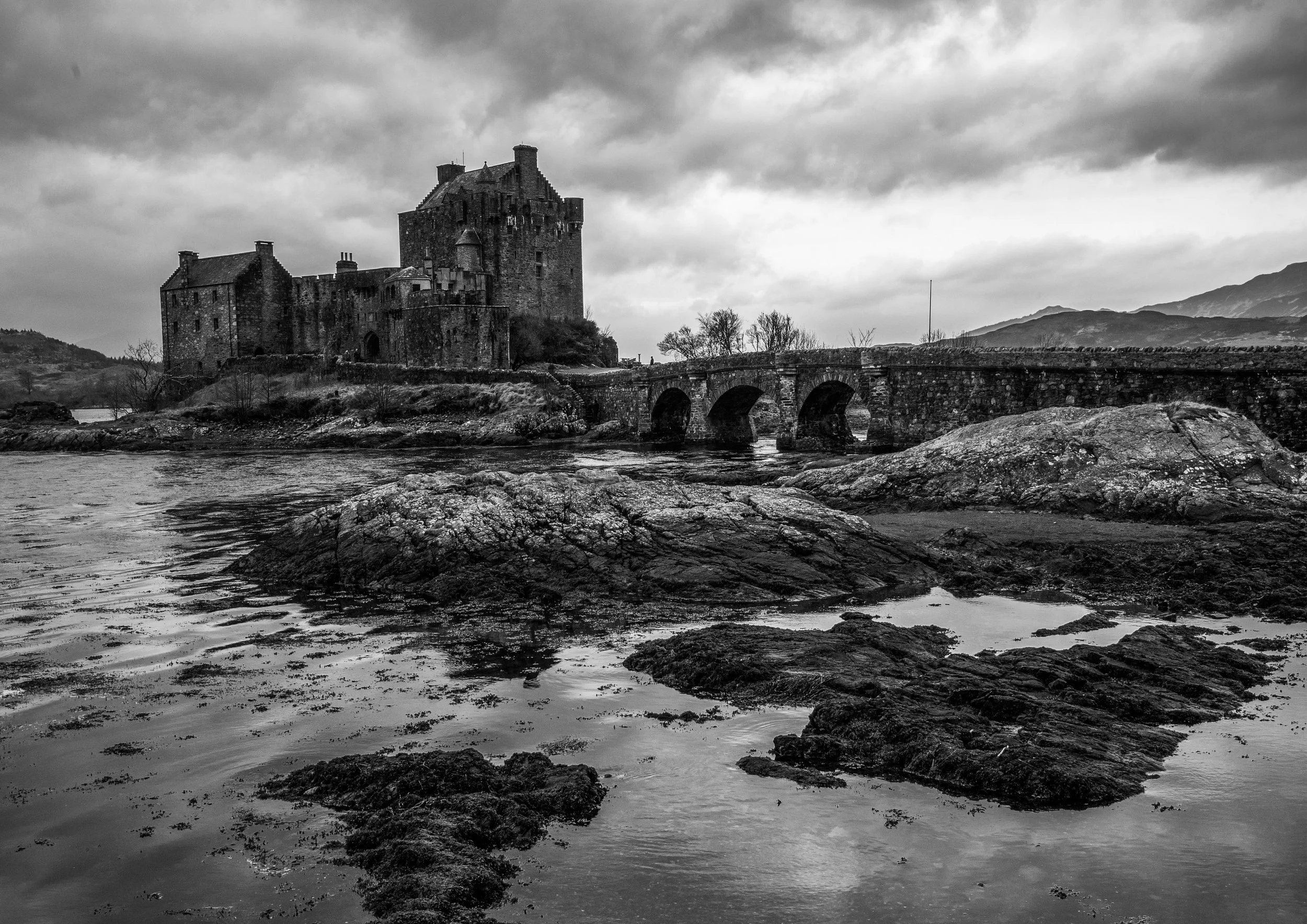
This is a striking black-and-white photograph of Eilean Donan Castle in the Western Highlands of Scotland. By stripping away the colors of the heather and the loch, the image focuses entirely on the raw texture and dramatic atmosphere of this iconic landmark.
Perched on its small tidal island where three sea lochs meet, the castle looks incredibly formidable in monochrome.
The Stone Work: The lack of color highlights the rugged, weathered texture of the masonry. You can almost feel the cold, damp stone.
The Bridge: The stone arched bridge provides a beautiful leading line, drawing the eye from the right side of the frame toward the main keep.
One of the most effective parts of this shot is the foreground.
The Rocks: The dark, barnacle-covered rocks and seaweed in the foreground create a heavy, grounded feeling.
The Water: The tide seems to be low, revealing the jagged floor of the loch. The reflections in the small pools of water add a silvery contrast to the dark rocks.
The choice of black and white transforms the scene from a "tourist postcard" into something much more cinematic and moody.
The Sky: The overcast, heavy clouds create a diffused light that eliminates harsh shadows, allowing the fine details of the castle's windows and battlements to stand out.
Timelessness: Without modern cues like colorful clothing or bright cars, this photo feels like it could have been taken a hundred years ago—or yesterday. It captures the "eternal" spirit of the Highlands.
While it looks ancient, much of what you see was actually reconstructed in the early 20th century. It lay in ruins for nearly 200 years after being destroyed during the Jacobite rising of 1719, until Lt. Col. John MacRae-Gilstrap restored it to its former glory.
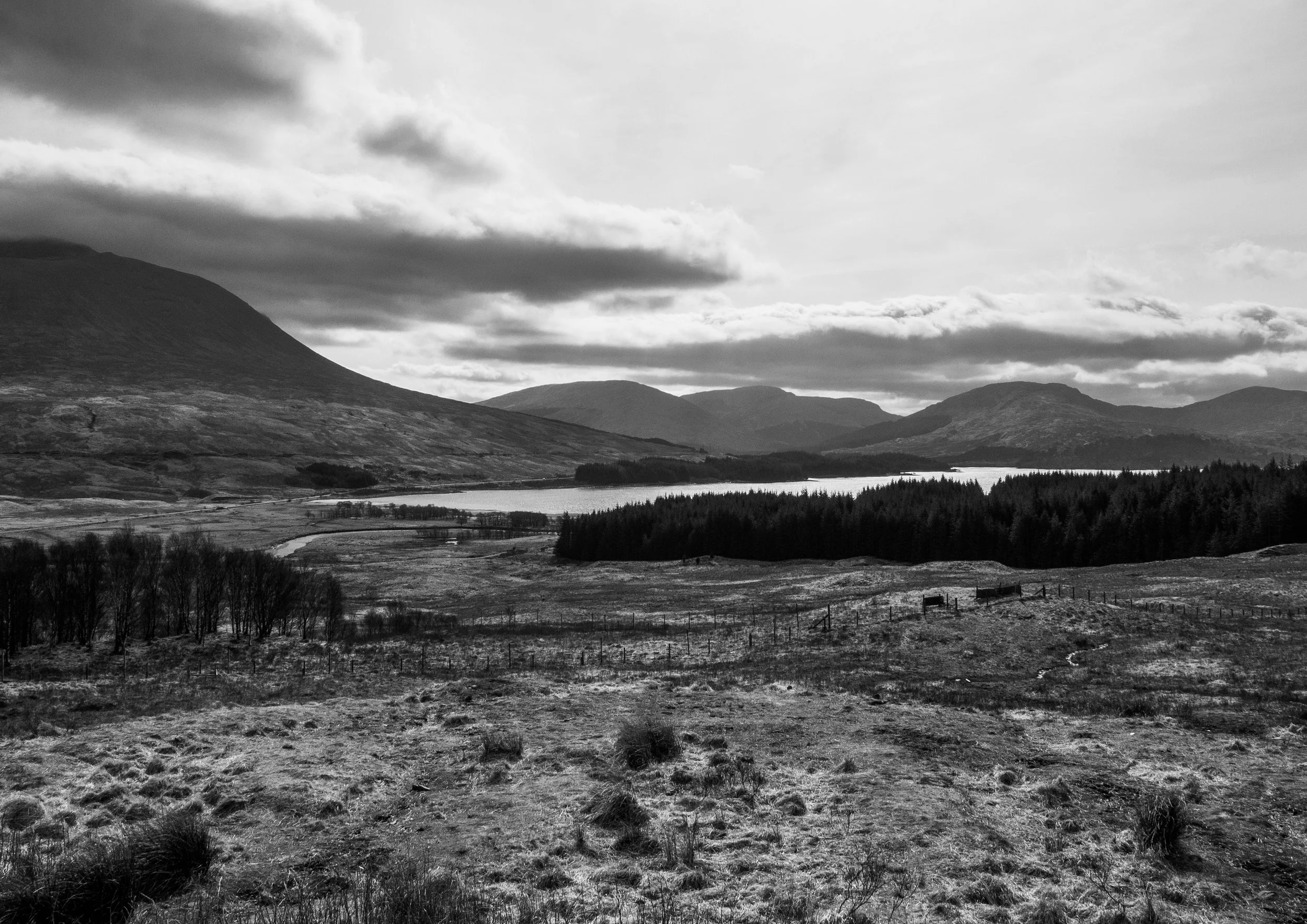
This image captures the raw, cinematic mood of the Scottish Highlands with a striking sense of scale. The choice of high-contrast black and white transforms a traditional landscape into a study of texture and light, emphasizing the ruggedness of the terrain.
The composition is dominated by the dramatic interplay of light and shadow.
The Sky: The heavy, low-hanging clouds are the soul of the photo. The sun is fighting through the overcast layer, creating a bright "hot spot" that casts a metallic sheen over the water below.
The Land: The rolling hills in the mid-ground are beautifully layered. The light catches the peaks while the valleys fall into deep shadow, creating a sense of depth that feels almost three-dimensional.
The photo features several classic markers of the Scottish wilderness:
The Loch: The sliver of water in the center acts as a focal point, its brightness contrasting sharply with the dark, dense pine plantation sitting on its bank.
The Moorland: The foreground shows the coarse, windswept grass and heather typical of the region. The subtle presence of a fence line suggests a human touch—likely a sheep farm—in an otherwise vast and lonely expanse.
The Mountains: The large, rounded mass on the left creates a "wall" that frames the softer peaks in the distance, typical of the ancient, weathered mountains found in areas like Glencoe or The Trossachs.
There is a profound sense of solitude here. The heavy grain and the stark monochrome palette evoke a feeling of timelessness; this could have been taken yesterday or a century ago. It captures that specific "Hiraeth" or longing—the feeling of a landscape that is beautiful but indifferent to human presence.
Technical Note: The wide-angle perspective allows the eye to travel from the textured foreground all the way to the hazy, distant peaks, mimicking the way it feels to actually stand on a Scottish hillside and take in the vastness.
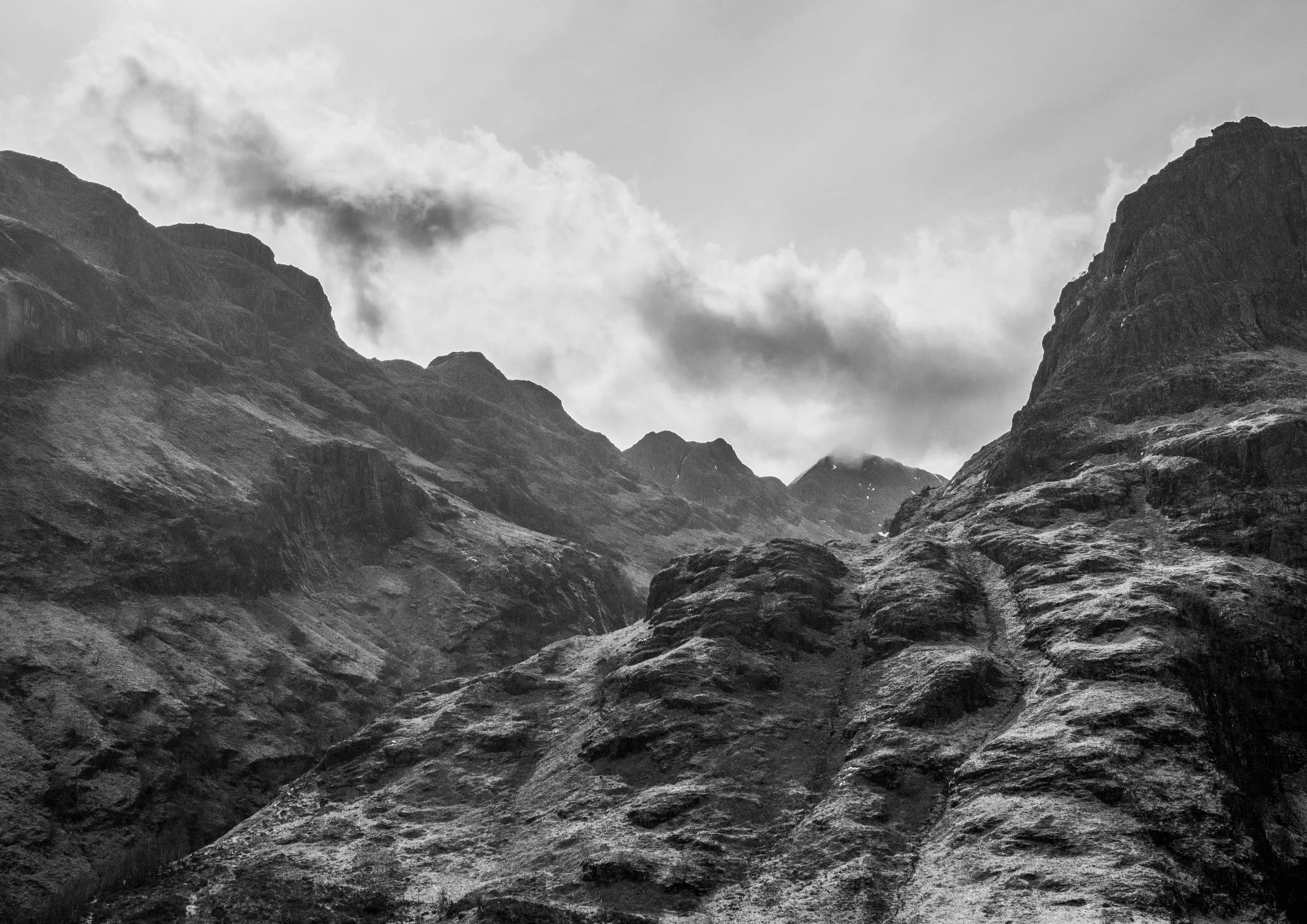
The mountains rise like ancient guardians, their shoulders carved by wind and centuries of rain. In black and white, the landscape feels older than memory stripped of distraction, reduced to rock, light, and shadow. The steep faces are scarred and ridged, every crease holding the weight of time.
A dark ribbon of cloud drifts low across the sky, caught between the peaks as if the land itself has exhaled. It moves with quiet drama, soft against the hard edges of stone. The light breaks unevenly, touching the slopes in pale silver while leaving the gullies in deep charcoal.
There is no sign of human presence no road, no fence, no dwelling only raw terrain shaped by ice and weather. The ground looks rough underfoot, slick and uneven, demanding effort from anyone who would cross it. Yet there is a stillness here, too. A calm beneath the severity.
This is Scotland in its elemental form: austere, powerful, and unadorned. A place where the sky feels close, the land feels untamed, and silence carries weight.
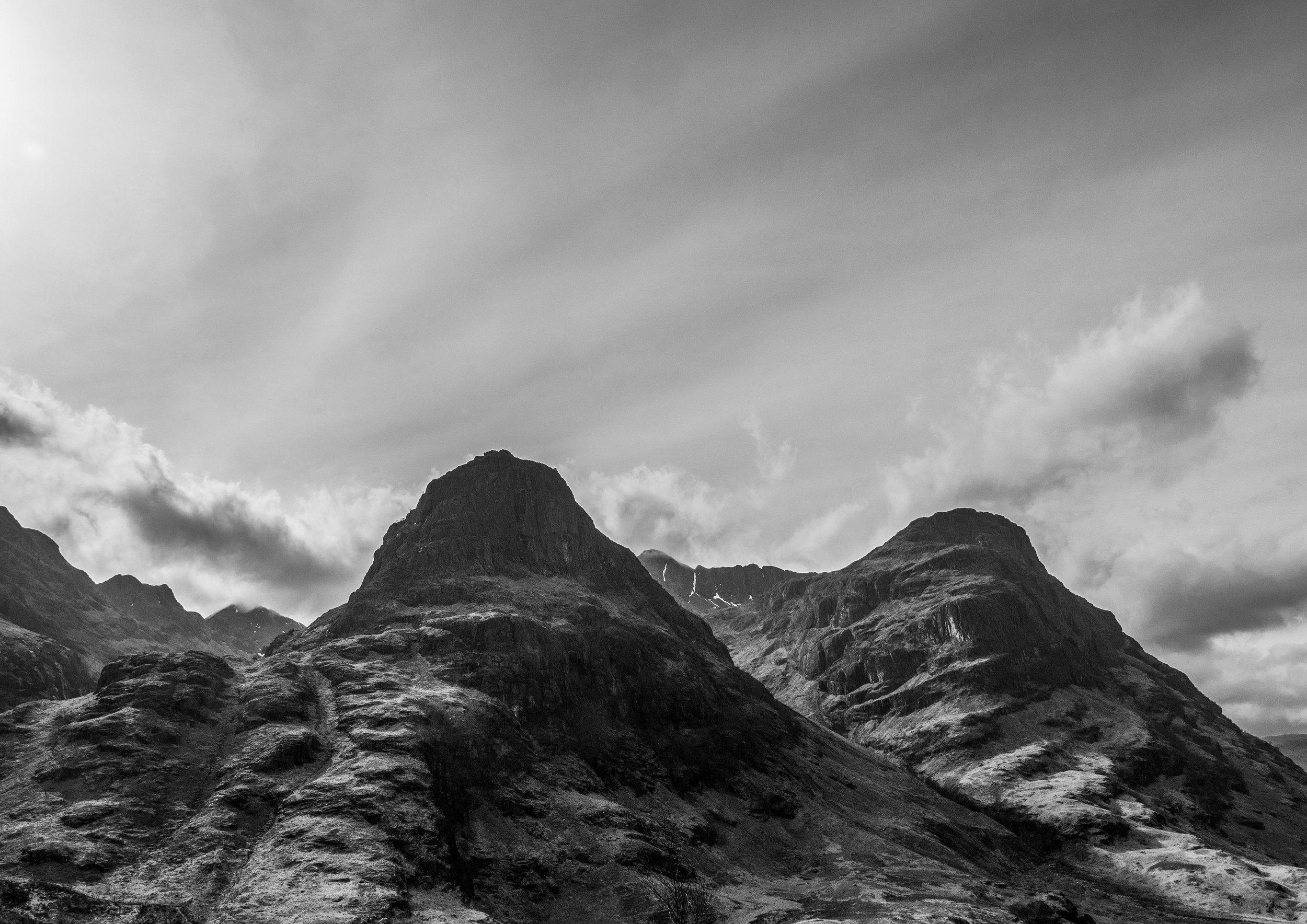
A jagged spine of mountains rises from the Scottish earth, dark and immovable beneath a restless sky. The scene is stripped of color, rendered in black and white, which deepens its drama and pulls attention to texture, light, and shadow. The slopes appear carved by centuries of wind and rain, their ridges etched like scars across ancient stone.
Low clouds drift and coil around the peaks, half-embracing, half-threatening. They move with a quiet urgency, as if the weather here is never entirely settled. Light breaks through in narrow beams, grazing the craggy surfaces and illuminating patches of rough grass and rock. The mountains seem both exposed and secretive revealing their contours while concealing their full story in shadow.
There is a sense of scale that humbles the viewer. The foreground slopes rise steeply, guiding the eye toward the central peak that stands like a sentinel. Its summit is blunt and powerful, not delicate but resolute, shaped by endurance rather than grace. Around it, smaller ridges gather like a council of silent companions.
Without color, the landscape feels timeless. It could belong to yesterday or a thousand years ago. The monochrome tones emphasize the raw character of the Highlands the austerity, the resilience, the quiet grandeur. There are no signs of human presence, no roads or buildings, only the interplay of stone and sky.
The photograph captures more than geography; it captures mood. It speaks of solitude, of weather that changes in moments, of land that demands respect. In its stark contrasts and sweeping forms, it conveys the enduring spirit of Scotland’s wild places untamed, atmospheric, and profoundly still.
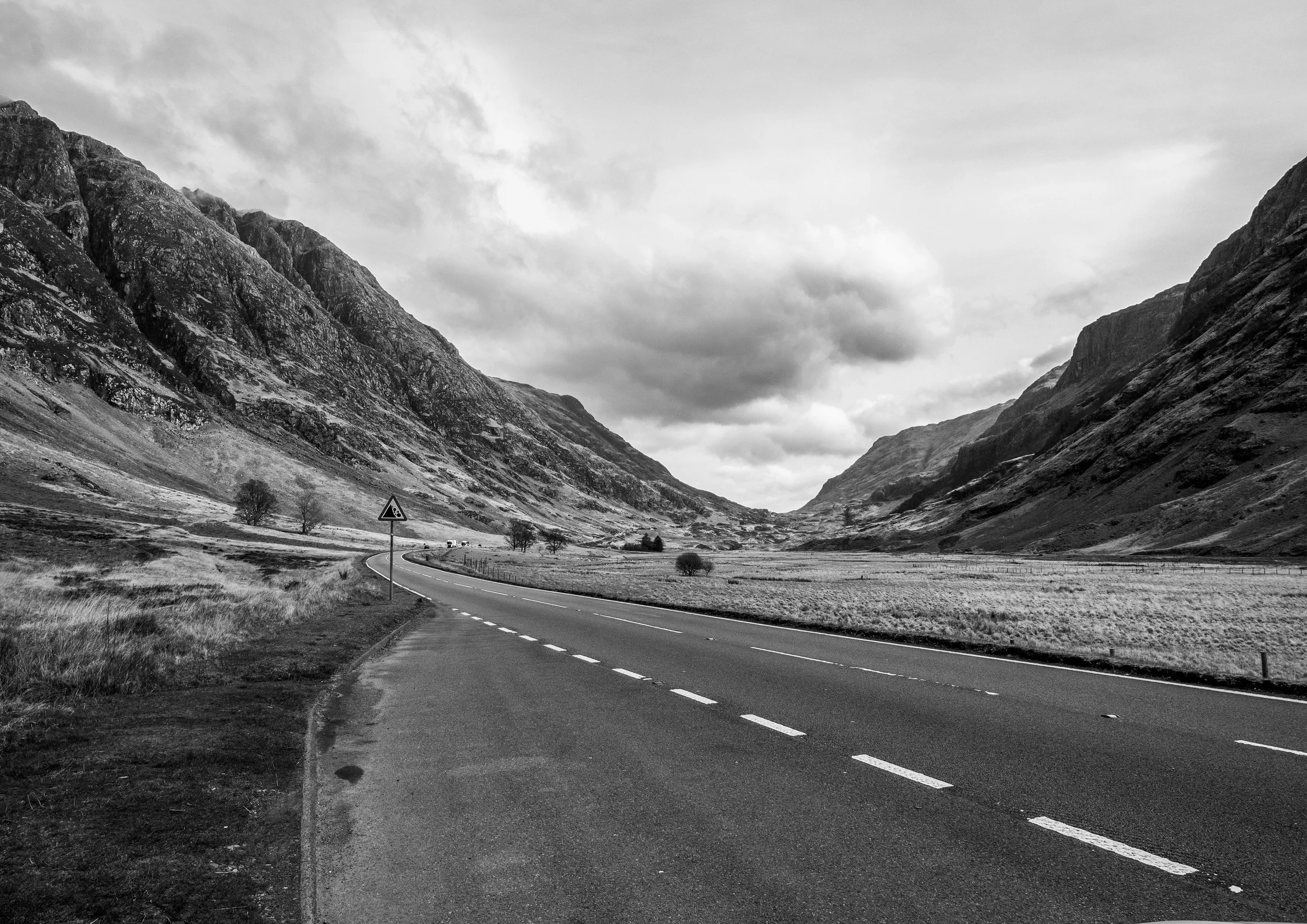
A narrow ribbon of road curves quietly into the heart of the Highlands, disappearing between towering slopes that rise like ancient guardians on either side. The mountains are scarred with rock and shadow, their faces rough and weathered, as if shaped not only by time but by memory. The valley stretches wide and open, yet it feels enclosed held in the embrace of stone.
Heavy clouds gather overhead, thick and restless, casting a dramatic hush across the landscape. Light slips through in faint patches, illuminating the pale grasses and the solitary trees scattered across the valley floor. The black-and-white tones deepen the mood, stripping the scene of distraction and leaving only texture, contrast, and feeling.
The road itself feels symbolic an invitation, or perhaps a warning. A lone sign stands at its edge, small against the vastness around it, reminding travelers that nature here is powerful and untamed. There are no buildings, no crowds, no movement beyond what the wind might stir. Just land, sky, and silence.
It is a portrait of Scotland at its most elemental rugged, solemn, and breathtakingly vast. The kind of place where the air feels older, the quiet runs deeper, and every bend in the road promises both solitude and wonder.
No results match your search. Try removing a few filters.
